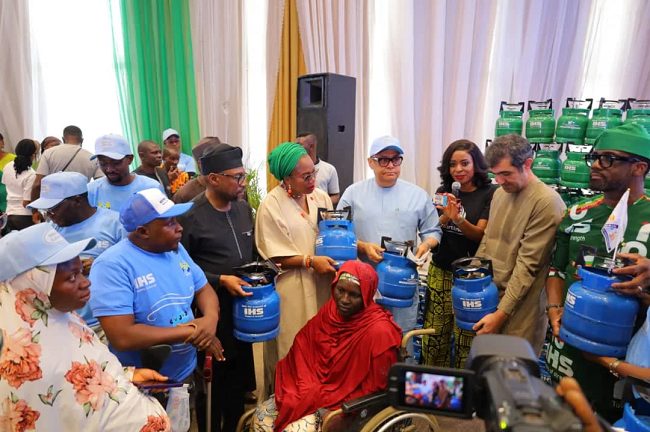
No fewer than 5,000 households are set to enjoy free gas cylinders with six months free refill of their cooking gas under the Federal Capital Territory Administration’s (FCTA) “Breathe Clean Air Initiative”.
The Mandate Secretary, FCTA, Health and Environment Secretariat (FCT-HES), Dr Adedolapo Fasawe, made this known at the inauguration of the Safe Environment Renewable Project- Breathe Clean Air Abuja, on Saturday, November 15, 2025, in Abuja.
According to Fasawe, the focus of the programme is not about sharing palliatives, but to address ignorance around people’s environment and help women manage the home and health of their household better.
Free cooking gas under FCTA’s Breathe Clean Air Initiative: 5,000 households to get free cooking gas
She stated that the Renewed Hope Agenda of President Bola Tinubu had touched every area of human life with the aim of improving standards of living for all classes of people.
Fasawe stated that the FCT Minister, Nyesom Wike, had keyed into the visions of the president and had shown enough commitment towards making the FCT a better place for all.
She added, “The truth is, health is wealth. Health and environment are equal. So, the focus of this programme is not only to give out palliatives, as we have done in the past.
“The focus of the programme is to address the Renewed Hope Agenda Initiatives.
“It is to tell Nigerians that if only we can put our hands together, and not wait for governments alone, we can have a happy, peaceful, and prosperous Nigeria. Because truly, with peace and prosperity, Nigeria will be great again.”
Also speaking, Dr Babagena Adams, Permanent Secretary, Health Services and Environment Secretariat, FCTA, said that the initiative was important, as it would help to end the stress that pregnant women pass through.
Adams said, “We are also saving the pregnant women, along with their families.
“So, if they live healthy, they will be more productive, and the GDP of FCT will increase. So, a healthy community is a wealthy community, that is the benefit.”
Earlier in his speech, a partner of the initiative and the Chief Executive Officer, IHS Nigeria Limited, Mohammed Darwish, said that the initiative was designed to help stop mothers and their children from inhaling toxic gases that are injurious to their health.
Darwish said some of the hazards that followed long use of firewood, charcoals for cooking were lung cancer diseases, among other lung-related ailments.
“The six-month voucher distributed in addition to the cylinder would encourage the beneficiaries to sustain the usage of the gas cylinders.
“This programme, in a nutshell, is about helping 5,000 mothers, sisters, and daughters by not inhaling toxic gases anymore.
“It is also by really making sure that their health is better by breathing fresh air,” he added.
The Executive Vice President of HIS, Ayotade Oyinlola, who spoke on the impact of the initiative, said the distribution would significantly reduce family income spent on medical bills.
Dr Ayuba Hannatu, a Consultant Radiation and Clinical Oncologist, National Hospital Abuja, and Secretary, Nigerian Cancer Society, FCT chapter, said the initiative was centred on health prevention, while considering lifestyle improvement.
Adding her voice, Daniela Omotola, who was one those spearheading the campaign, using Rotaract Clubs in Abuja, praised the project as a timely, life-changing intervention.
Omotola said it would help to reduce pollution-related illnesses and support a healthier FCT.
Stakeholders at the launch maintained that as more households transition to cooking gas, the pressure on surrounding ecosystems including tree losses, soil degradation and rising temperatures is expected to decline over time.
The Petroleum Technology Association of Nigeria (PETAN), alongside international oil majors and leading service companies such as Shell, TotalEnergies and ExxonMobil, has pledged full support for Nigeria’s crude oil production growth plans.
The commitment was disclosed in a statement by Mr. Wole Ogunsanya, the PETAN chairman, in Lagos on Sunday, November 16, 2025.
Ogunsanya said the pledge was made during the Nigerian Upstream Petroleum Regulatory Commission (NUPRC) “Project 1MMBOPD Additional Production Investment Forum” held in London on Saturday.
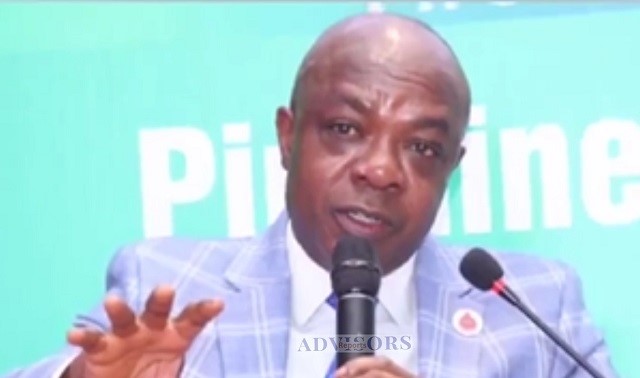
Chairman, Petroleum Technology Association of Nigeria (PETAN), Mr. Wole Ogunsanya
He said the event was strategically designed to attract fresh investment and raise Nigeria’s crude output by an additional one million barrels per day (bpd).
He explained that the forum brought together top industry players, investors, financiers, and regulators to explore opportunities, address funding gaps, and strengthen partnerships required to meet the production target.
Ogunsanya noted that the Chief Executive of NUPRC, Mr Gbenga Komolafe, used the platform to announce that the 2025 Oil Licensing Round will commence on Dec.1.
Ogunsanya said that the round aims to unlock undeveloped and fallow oil and gas fields across Nigeria.
He said that the event provided direct access for investors to project owners and policymakers, while showcasing bankable opportunities and facilitating partnerships grounded in transparency, efficiency and accountability.
He added that Nigerian legislators and senior government officials reassured investors of unwavering political will to remove existing bottlenecks.
They also pledged that the Petroleum Industry Act (PIA) will remain stable and free from arbitrary amendments—ensuring a predictable regulatory environment.
According to Ogunsanya,NUPRC highlighted that ongoing reforms and regulatory interventions have raised Nigeria’s crude oil production to about 1.7 million bpd, up from a low of 1.1 million bpd in 2022.
The two-day investment forum attracted major indigenous and international stakeholders.
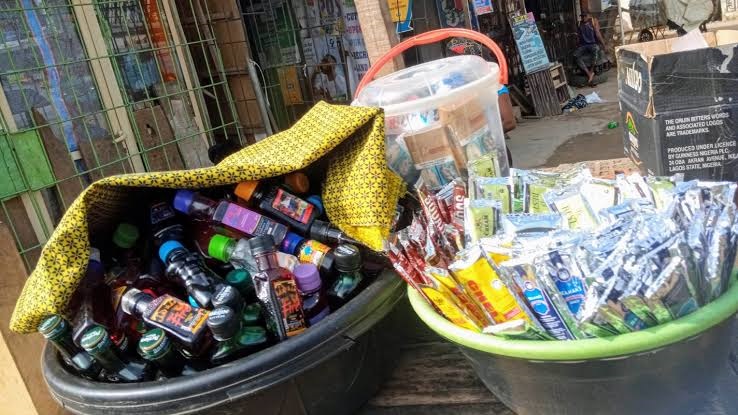
The Network for Health Equity and Development (NHED) and Corporate Accountability and Public Participation Africa (CAPPA)have thrown their weight behind the National Agency for Food and Drug Administration and Control (NAFDAC) over its decision to enforce the ban on the production and sale of alcoholic beverages in sachets, PET bottles, and glass bottles of 200ml and below, beginning December 2025.
In a joint statement on Sunday, November 16, 2025, the two leading public health advocacy organisations described the ban as a long-overdue public health intervention essential for safeguarding the well-being of Nigeria’s children, youths, and other vulnerable populations.
Alcoholic drinks in sachets and small volume bottles
They agreed with NAFDAC that the packaging, pricing, and aggressive marketing of these products had made highly potent alcohol dangerously accessible, especially to minors, and were contributing significantly to rising addiction, social disorder, road crashes, and non-communicable diseases across the country.
They noted that when NAFDAC first announced the ban in 2024, it gave manufacturers a multi-year phase-out period, which ends in December 2025, to exhaust existing stock. But some alcohol manufacturers flagrantly continued production even after the deadline.
NHED and CAPPA condemned the pushback from these manufacturers, particularly the claim by the Manufacturers Association of Nigeria (MAN) that the ban could lead to investment decline and retrenchment, saying it was a familiar scare tactic to push government to prioritise commercial greed over public health.
The manufacturing process of these products, they argued, is mostly mechanised and requires relatively limited human effort; hence, the claims about huge job losses were contrived.
“We reject in its entirety the claims by the Manufacturers Association of Nigeria (MAN) that the ban will trigger a loss of over N1.9 trillion in investment and lead to the retrenchment of over 500,000 workers,” the organisations stated.
“These figures are not only inflated and unverifiable, but they also represent a familiar scare tactic used by alcohol and tobacco corporations globally whenever governments attempt to regulate harmful products.”
Furthermore, they contended that, rather than engaging honestly with evidence-based public health policies, industry actors had chosen to weaponise economic misinformation to blackmail the Nigerian government and regulatory agencies.
“This behaviour is irresponsible, deceptive, and unbecoming of entities that claim to operate ethically,” the NHED and CAPPA added.
Dr. Jerome Mafeni, NHED’s Technical Director, emphasised that protecting lives must take precedence.
“The long-term social and economic costs of alcohol-related harm far outweigh any short-term profits that manufacturers seek to protect,” Mafeni said. “Nigeria currently bears the burden of increased alcohol-related violence, reduced productivity, escalating healthcare costs, and a rising addiction crisis among young people. These harms disproportionately affect poor and marginalised communities, who sachet alcohol products specifically target.”
He added, “It is unacceptable that children can purchase high-concentration alcoholic products for as little as₦100. It is equally unacceptable that manufacturers have, for years, prioritised profit over the safety and well-being of Nigerians.”
For Akinbode Oluwafemi, government regulation to protect public health should not be negotiable.
Oluwafemi said: “NAFDAC’s decision aligns with global best practices and mirrors what responsible governments worldwide have done to curb harmful alcohol consumption. No credible public health agency anywhere would permit the continued marketing of such products in packaging designed to encourage unrestricted, on-the-go, and underage drinking.
“We commend NAFDAC for resisting corporate bullying and for standing firmly on the side of science, public health, and national interest. We equally call on the Federal Ministry of Health, the Ministry of Finance, the Standards Organisation of Nigeria (SON), and the National Orientation Agency (NOA) to rally behind the agency and ensure seamless implementation of the ban.”
Both organisations urged the government not to yield to corporate pressure,
“We urge President Bola Ahmed Tinubu and the National Assembly to see through the industry’s theatrics and avoid any attempt to suspend, water down, or delay this life-saving policy. The well-being of over 200 million citizens must not be sacrificed at the altar of corporate profit,” they added.
Beyond enforcing the ban, the organisations urged the government to implement additional alcohol control measures, including taxation, stricter marketing regulations to protect children, clear labelling, and nationwide sensitisation on alcohol-related harm.
They insisted that the long-term social and economic costs of alcohol misuse, including healthcare expenses, reduced productivity, family breakdowns, and premature deaths, far outweigh any economic benefits claimed by the manufacturers.
“NAFDAC’s ban is the right policy at the right time. NHED and CAPPA stand resolutely with the agency and with all Nigerians committed to a healthier, safer, and more responsible society,” the statement concluded.
Renaissance Africa Energy Company Limited marked an impressive appearance at the just concluded 43rd Annual International Conference of the Nigerian Association of Petroleum Explorationists (NAPE), held at the Eko Hotel and Suites in Lagos.
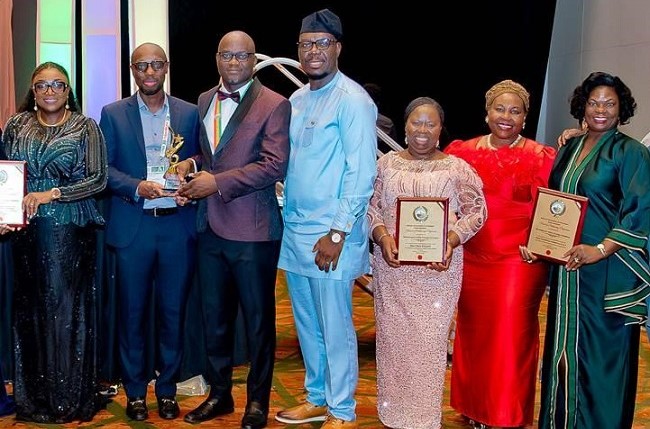
The company clinched four awards, including the coveted Overall Best Exhibitor and Best Technical Paper Presentation, at the award dinner Thursday night.
Principal Geoscientist, Owens Ovwigho Irifeta, earned the Best Technical Paper Award for his presentation titled “Safely Navigating the Dual Challenges of Depleted Reservoirs and High Pressure while Drilling”. The company also secured honours for Best Overall Exhibition, Best Exhibiting Indigenous Exploration and Production Company, and Best New Entrant.
(3rd from left) President of the Nigerian Association of Petroleum Explorationists (NAPE), Mr. Johnbosco Uche, presents to representatives of Renaissance Africa Energy Company Limited awards won at the just concluded 43rd Annual International Conference of NAPE held at the Eko Hotels and Suites, Lagos. Renaissance came out tops for exhibition and technical papers. Renaissance representatives from left: Magdalene Umoh; Olatunji Bakare; Jude Osimobi; Fortuna Utomi; Bena Oyedele; and Rose Okoronkwo.
NAPE Executive Committee noted that Renaissance’s performance stood out among a record number of participating companies and technical submissions, a reflection of the company’s growing influence in Nigeria’s upstream sector.
Managing Director and Chief Executive Officer of Renaissance, Mr. Tony Attah, expressed pride in the Renaissance team for their focus, dedication and determination to keep the company ahead of the competition.
“This recognition affirms our trajectory of growth and commitment to supporting Nigeria’s energy ambitions. We remain focused on increasing oil and gas output to boost government revenues, catalyse industrialisation, and develop young energy talent,” Attah said.
He described the performance of the Renaissance team at the NAPE conference as an expression of the vision of the company to become Africa’s leading energy company, enabling energy security and industrialisation in a sustainable manner.
He dedicated the accolades to the company’s workforce, highlighting their resilience since Renaissance’s acquisition of Shell’s stake in the former SPDC earlier this year.
Renaissance previously earned similar honours in August at the Society of Petroleum Engineers’ 2025 Annual Conference.
Renaissance is the operator of the NNPC/Renaissance/TotalEnergies/AENR JV, Nigeria’s largest oil and gas joint venture, with assets spanning onshore and shallow-water fields, the Bonny and Forcados export terminals, and the Sea Eagle Floating Production, Storage and Offloading vessel, all in the Niger Delta.
An estimated 30,000 people marched through the Brazilian city of Belém on Saturday, November 15, 2025, to mark the Global Day of Action for Climate Justice. The mobilisation, led by the People’s Summit and supported by civil society groups attending COP30, brought together workers’ unions, Indigenous communities, international networks, youth movements, and climate defenders from across the world.
Starting at Mercado de São Brás and ending at Aldeia Amazônica, the march transformed the city into a powerful call for urgent, fair, and justice-centred climate action. Participants gathered from 8:00am to organise themselves into blocs, before setting off along the route from 9:00am to 11:00am.
Additionally, over 100 marches, demonstrations and events were held in 27 countries around the world.
Activists marching through the Brazilian city of Belém to mark the Global Day of Action for Climate Justice
Demanding an end to the system that has fueled climate destruction in the Amazon to the rest of the world, the protesters condemned global economic inequality, environmental racism, and corporate impunity that have delayed action and denied justice to people in climate-vulnerable countries.
In Asia, around 10,000 people joined mobilisations in more than 40 cities and provinces in the Philippines, India, Bangladesh, Pakistan, and Nepal. In Africa, mobilisations were held in Kenya, Zambia, Benin, Nigeria, and the Democratic Republic of Congo. In the UK and Ireland, mobilisations were held in 16 cities, including London and Dublin. In Belém, around 70,000 from global and Brazilian movements participated in the Peoples’ Summit March.
Commenting on the march, Mohamed Adow, Director, Power Shift Africa, says: “Today’s march in Belém is a powerful reminder that sometimes the solutions to our biggest problems come from the most unexpected places. For too long, climate action has been shaped in closed rooms in distant capitals. But here in the Amazon, the people who have done the least to cause this crisis – Indigenous peoples, local communities, young people, and those on the frontlines – are showing the world what real climate leadership looks like.
“Their wisdom, their stewardship of nature, and their demand for justice offer the kind of solutions the world desperately needs. If governments truly want to tackle the climate crisis, they must listen to the voices from the ground and put people, not polluters, at the heart of climate action.”
Participants carried both distributed and self-made signs, with messages aligned to global climate justice demands. Visual creativity, movement solidarity, and chants for climate accountability defined the atmosphere throughout the march.
“Today’s mobilisation demonstrated the strength of global solidarity at COP30. With communities in Belém leading the way, civil society sent the strong message that climate justice is non-negotiable, and people everywhere are ready to demand it,” added Adow.
Tasneem Essop, executive director of Climate Action Network International: “We are done watching Big Polluters and the governments aligned with them decide our future. Real solutions are already alive in the territories – in the hands of Indigenous peoples, workers, women, and youth who defend land, water, and life every single day. On this Global Day of Action, we take to the streets of Belém with thousands of others to make one thing clear: the era of sacrifice zones is over. The world we need puts justice at the centre – not profit, not war, not extraction. People’s power is rising, and we are not backing down.”
Lidy Nacpil, coordinator of the Asian Peoples’ Movement on Debt and Development: “From Asia to the Amazon, we are mobilising to change the system that has kept our people hostage to climate destruction. On the streets of Belém, we are marching with thousands of allies for an end to the capitalist and imperialist order that has plundered our lands and exploited our people.
“Inside the COP, we are pushing for governments to adopt a global just transition mechanism, provide climate finance from the North to the South, and accelerate a fair transition from fossil fuels to renewable energy. Ultimately, we are fighting to end the system that has brought back-to-back typhoons to the Philippines, floods to India and Pakistan, and landslides to Nepal. System change is the only way forward – anything less is an injustice against our people.”
Leon Sealey-Huggins, senior campaigner of War on Want: “War on Want is in Belém to amplify the leadership and lived knowledge of our partners on the frontlines – those exposing false climate solutions and driving real, people-centred, just and popular transitions. We’re taking action across the UK and marching here in Belém to demand a Belém Action Mechanism for Just Transition – and to tell the UK government to stop blocking the demands of millions of workers, frontline communities, feminists and Indigenous peoples. The fight for climate justice is the fight for economic, social and racial justice. Wealth must be reclaimed from destructive industries and redirected towards life-sustaining futures. Through mass mobilisation, solidarity, and sustained organising, we are making it clear: This world is ours.”
Javier Andaluz, coordinator of Alianza por el Clima (Climate Alliance Spain):“Ten years after the Paris Agreement, we are still far from meeting the targets required by science, and our emissions continue to rise. In the face of this political inaction, we are taking to the streets once again to demand a just, urgent, and immediate transition, because if the necessary measures are not taken, it will be the most vulnerable populations who will suffer the most. Before it is too late, it is essential to establish a mechanism capable of ending fossil fuels and ensuring the financing and support needed for the energy transformation we require.”
Rachitaa Gupta, coordinator of the Global Campaign to Demand Climate Justice: “Today we marched with thousands of people because our lives, our lands, and our futures are not negotiable. We marched because we in the Global South are being sacrificed for the profit of corporations and the political convenience of powerful governments. We reject carbon markets and every false solution that lets polluters keep polluting. We demand real, public climate finance, historic reparations, and protection of Indigenous, quilombola, coastal, and forest territories. Our solutions of agroecology, food sovereignty, and community power already exist. Today people marched in Belem to show that from the Amazon to Palestine, peoples’ power is rising, and governments must follow our lead.”
At the close of week 1 in Belém, finance tensions from Baku are still casting a long shadow over COP30, says Mohamed Adow, Director, Power Shift Africa
COP30 is still recovering from a Baku hangover. Countries are grappling with the results of a very weak long-term finance agreement last year which was extremely vague in terms confirming the level of public, grant based climate finance. Had we got a strong public, grant-based, finance commitment in Baku, agreeing on the Global Goal on Adaptation in Belem would have been straightforward.
Mohamed Adow
The lack of definition on public money last year is the reason developing countries are so passionate about formalising Article 9.1 of the Paris Agreement, which states that rich nations are responsible for providing climate finance. There’s such a big need for public adaptation funding, given the huge debt burden developing countries are facing. That is why Article 9.1 has become a rallying call for the global south.
Global Goal on Adaptation indicators
The adaptation indicators being discussed here at COP30 are important. If done well, they will give us a common language to assess progress towards targets in vital sectors such as water access, food systems, health infrastructure, biodiversity and livelihoods. Having a clear picture on how adaptation measures impact on macroeconomic stability and development outcomes is certainly helpful when it comes to developing policies and tracking progress.
But measurements must not be confused with delivery. Coming from a pastoralist community, I know that however many times you weigh a cow, it doesn’t make it any fatter. So before we rush to lock in indicators here, vulnerable countries need to actually receive the means to adapt, in the form of adaptation finance. Pretending we’re making progress by agreeing on a measurement system might ultimately turn into a distraction from actually securing adaptation finance, which has been sorely lacking for many years.
The world is expectant
We are back in Brazil, where the Rio Earth Summit kicked off the UN climate process more than 30 years ago. It’s 20 years since the Kyoto Protocol and 10 years since the Paris Agreement. The world expects a strong outcome from Belem.
Cover text inevitable
It’s becoming clear that the COP30 Presidency will not be able to escape having a cover decision. The quicker they realise that and create formal space in the negotiations for it to be debated, the better for everyone.
Africa has called on the world leaders to turn their pledges into action regarding the Paris Agreement on Climate Change.
The Africa Group of Negotiators (AGN), chaired by Dr Richard Muyungi, and the COP30 Special Envoy for Africa, Prof. Carlos Lopes, made the call on Saturday, November 15, 2025, at the 30th United Nations Climate Change Conference of the Parties in Belém, Brazil.
Speaking at a joint media briefing, they outlined the continent’s priorities for COP30.
Chair the African Group of Negotiators (AGN), Dr. Richard Muyungi
They called for scaled-up climate finance, a strong global goal on adaptation, and fair global trade rules that uphold multilateralism and deliver development for all.
They explained that Africa’s determination to secure concrete outcomes that match the ambition and scale needed to tackle the climate crisis already devastating the continent.
According to them, Climate finance Article 9.1- the legal obligation of developed countries to provide climate finance to developing countries is critical to African countries implementing their NDCs.
“On Article 9.1, the issue is simple, developing countries cannot rely on vague assurances. We need clear, concrete commitments from developed countries, yet few have put forward new finance pledges.
“For Africa, Article 9.1 must be fully implemented, just like every other part of the Paris Agreement. It is an obligation, not an option.
“Without it, adaptation finance will be replaced by loans, leaving vulnerable countries to pay for impacts they did not cause,” they said.
According to them, resource mobilisation under Article 9.3 is valuable for mitigation, but it cannot be a substitute for guaranteed provision of finance required under Article 9.1 as adaptation depends on it.
They issued a stark warning about global finance models that increasingly burden developing countries with commercial debt.
“Blended and hybrid finance often camouflage the fact that commercial conditions are expanding. These instruments are not multiplying finance, they are simply bringing in more commercial money.
“We must pay attention when practice does not match the promise,” he said.
Muyungi further criticised Just Energy Transition Partnerships (JET-Ps) for shifting away from grant-based support toward loan-heavy arrangements.
The AGN chair emphasised that indicators must track global support, not to impose new obligations on developing countries.
“Indicators under the Global Goal on Adaptation are essential, we need a clear way to measure progress, just as we do for mitigation and the 1.5°C goal.
“But the issue is which indicators are being chosen. Some of them expect developing countries to do more with less, adding responsibilities without the means to deliver.
“Our concern is not with indicators themselves, but with ensuring they reflect real adaptation needs and come with the support required to achieve them,” he said.
According to him, recognising Africa’s special needs is rooted not in politics, but in science, geography and history as Africa’s case makes this even more urgent.
“Scientifically, countries along the equator, many of them in Africa, are warming faster and face harsher impacts.
“Under Article 4.8, Africa also falls within several categories of highly vulnerable countries. And our historical and developmental context compounds these challenges.
“All of this makes Africa’s special needs and circumstances undeniable. They must be fully recognised if the global goal on adaptation is to be meaningful,” he said.
He noted that negotiators had reduced the list of proposed indicators from over 10,000 to around 100 to align with the means of implementation including finance, technology, and capacity-building commitments.
He said regarding Baku–Belém Roadmap, unlocking the 1.3 trillion dollar underscored Africa’s concern about slow progress on climate finance following the COP29 decision on the New Collective Quantified Goal(NCQG) to mobilise 300 billion dollars annually by 2035.
“And also, to design a roadmap towards $1.3 trillion in the post-2035 period.
“From Baku to Belém, the core issue is simple, we now have a commitment to mobilise at least 300 billion dollars a year up to 2035, and to build a pathway towards $1.3 trillion.
“But instead of negotiations, we were given consultations, and the roadmap was published without the final round of discussions we expected,” he said.
According to him, the roadmap is not closed, but only to keep pushing to strengthen it. Now, how do we unlock the $300 billion that must now replace the old 100 billion benchmark?
He added that delivering the $300 billion annually would be a challenge for Africa as the world entered the new phase.
He reiterated that despite consultations in Bonn and additional ministerial discussions, African countries had expected a more inclusive process before the roadmap was published.
He said the AGN welcomed the operationalisation of the loss and damage fund through the Barbados Implementation modalities.
He, however, stated the initial $250 million allocation fell short of the scale of needs.
“Under the Barbados implementation modalities, loss and damage support is made up of pure grants, not loans, and countries can access them through four clear channels.
“These are directly through their national focal points, through existing direct-access entities, through international entities like UNDP or the World Bank, or through regional institutions.
“This is the first time we have a fund that delivers only grants, and that’s a major step forward.”
According to him, the amounts are still small, 800 million dollars in the fund with 250 million allocated for 2025–2026, but it builds momentum as we expect more pledges at COP30.
He said Africa negotiators were also pushing to secure new resources through the adaptation fund as it transitioned from Kyoto to Article 6 of the Paris Agreement.
“The principle is simple: those who caused the problem must support those living with the impacts. But for 30 years, this principle has been contested. We’re trying to uphold multilateralism while ensuring these core obligations are honoured.
“These are the difficult choices before us. With Africa requiring over $3 trillion for adaptation alone, we significantly call for increased pledges at COP30,” he said.
On trade, he stated thatthose calling for the discussions to be moved to the World Trade Organisation were the same actors not respecting it as the normative space for the concerned issues.
“We see this in examples such as CBAM, new forest-related clauses from Europe, recent tariff increases, and a growing list of protectionist measures that invoke climate concerns while penalising countries that contribute least to climate crisis.
“It is a clear paradox, what we need instead are incentives for countries that are not contributing to the problem. Some may emit in specific industries or exports, but the overall picture is what matters.
“Africa emits the least globally. You cannot penalise isolated sectors without considering the continent’s full development spectrum.”
Muyungi demanded if Africa truly cherished multilateralism or unilateralism.
“At times we all call for multilateralism, yet in practice, we defend our own territories and businesses.
“As negotiators, this contradiction puzzles us. We believed all countries would work together without putting up new borders, especially when facing a shared global challenge.
“Yet a number of countries have introduced trade-restrictive measures and justify them as WTO-related, whether on patent rights or other issues,” he said.
According to him, if unilateral measures continue, many countries will be disadvantaged and restricted from trading goods or services deemed to have an “unacceptable” carbon footprint.
“But how does a product acquire that carbon footprint? Often through technologies and services that originate from the very countries imposing these restrictions.
“This is not the right way forward if we want to protect multilateralism. Without clear guardrails, these actions will undermine the development and trade opportunities we are trying to build.”
The United Nations Development Programme (UNDP), in partnership with the Rural Electrification Agency (REA) and the Global Environment Facility (GEF), has commissioned a transformative 50kWp solar mini-grid in Namu, Quanpan LGA, Plateau State, under the Africa Minigrids Programme (AMP).
The milestone, according to the promoters, marks a significant step in Nigeria’s journey toward inclusive, sustainable energy access and rural industrialisation.
The mini-grid will provide clean, reliable electricity to over 1,555 direct beneficiaries, including 180 women rice processors, 15 male equipment operators, and 100 households, powering schools, health centres, and small businesses. It is designed to catalyse agricultural productivity by supporting cassava grating, rice milling, and other value-added processes.
“This is not just about electrifying a community; it is about energizing lives, livelihoods, and local economies,” said Ms. Elsie Attafuah, UNDP Nigeria Resident Representative. “The Namu mini-grid is a beacon of hope for rural development and a model for inclusive, sustainable electrification.”
The AMP initiative aligns with Nigeria’s Electricity Act 2023, Energy Transition Plan, and National Electrification Strategy, and contributes to the country’s climate commitments under the Paris Agreement. The project is expected to mitigate up to 22,000 metric tons of CO₂ monthly, replacing diesel and fuelwood with solar energy.
The commissioning event featured remarks from key stakeholders including the Executive Governor of Plateau State, Barr. Caleb Mutfwang; REA CEO, Dr. Abba Aliyu; and Elsie Attafuah, UNDP Resident Representative, and the Federal Ministry of Environment, and the Namu community.
The AMP programme aims to deploy 25 solar mini-grids across Nigeria, demonstrating scalable models for productive-use electrification, gender-responsive enterprise hubs, and climate-smart rural development.
COP30 President, André Corrêa do Lago, has said this year’s conference must put “people at the centre” of climate action. But a network of fragile states says more than one billion of the world’s most at-risk people are still being left out of the conversation.
In a statement released on Tuesday, November 11, 2025, the Improved and Equitable Access to Climate Finance Network said that countries affected by conflict and fragility are being “locked out” of funding to adapt to climate impacts.
The Network – which is made up of 10 countries affected by fragile governance and conflict, including Burundi, Mauritania, Somalia and Papua New Guinea – is calling for climate funds and COP30 to do more to address “this urgent blind spot at the heart of climate finance.”
André Corrêa do Lago, COP30 President
A Conflict Bling Spot in Climate Finance
More than one billion people live in countries affected by conflict, violence and fragile governance. Yet in 2022 these countries received just 10% of global climate finance, despite being some of the most vulnerable to climate impacts.
Countries face several issues in accessing finance, including long timeframes and demanding application requirements. According to Yemen’s minister or water and environment, Tawfiq Al-Sharjabi, speaking at a UNFCCC side event on Tuesday: “Complex procedures, limited technical capacities, and the absence of flexible financial instruments – all these things constrain our ability to secure climate finance.”
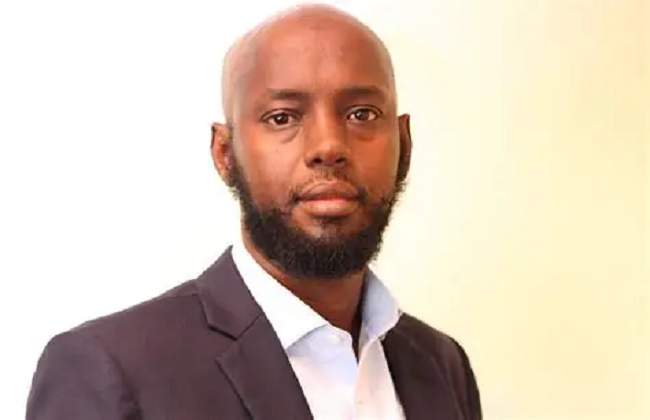
As a result, it can often be easier for countries to access humanitarian aid than climate finance, according to Somalia’s minister of environment and climate change, Bashir Mohamed Jama. “Somalia receives just over $300 million in climate-related funding each year, or less than 1% percent of the amount we need to adapt”, Jama said. “By contrast, each year Somalia receives $1.1 billion in humanitarian aid funding.”
Jama said this discrepancy highlights “a damning failure at the heart of the global development system: it is easier to unlock finance in the aftermath of disasters than it is to invest in preventing them.”
Negotiations at COP30 to increase climate finance flows only lend fresh urgency to the issue. “While the ambition to unlock an additional $1.3 trillion in Belem is admirable, we need to see equal ambition in ensuring that existing funds reach the people who need it most,” said Mauricio Vazquez, head of policy for risks and resilience at think tank ODI Global.
A Growing Push for Change
The Improved and Equitable Access to Climate Finance Network was formed in 2024 to call for more attention to the blind spot in climate finance.
On Tuesday, three new members joined the Network: Mauritania, Papua New Guinea and South Sudan.
In its statement, the Network calls for climate funds and development banks to continue reforming how they allocate climate finance, to make sure it reaches people in places affected by conflict and humanitarian crisis. The Network is also pushing for funding to be spent on long-term projects which build countries’ climate resilience, rather than support in the aftermath of disasters.
The Stakes Are High
Climate adaptation is high on the agenda at COP30. In Belém, governments will seek to finalise a comprehensive set of indicators for the Global Goal on Adaptation – a collective commitment within the UNFCCC to define and track how the world strengthens resilience and reduces climate vulnerability.
But experts say that unless more is done to include fragile and conflict-affected countries, climate change impacts will only continue to worsen lives, livelihoods and entire economies for the furthest behind. “We see the impacts of these linkages (between climate change and conflict) first-hand,” said Asif R. Khan, director of the policy and mediation division within the UN Department of Political and Peacebuilding Affairs, which currently chairs the Climate Security Mechanism.
Most of the UN’s peace operations are deployed in climate-stressed regions that are among the least equipped to manage climate shocks.
Khan said: “Climate change is amplifying the pressures that fuel conflict and displacement. For example, lack of access to water has accentuated tensions between herder and more sedentary communities in parts of West Africa.”
The most effective way to support fragile countries is to make them more stable and peaceful.
Khan said: “For us, helping countries manage climate risks is part of a broader effort to prevent crisis. And that means more than planting trees or installing solar panels. It’s also involving all parts of society to pull in the same direction to build resilience and foster peace. That also means, in turn, joined-up risk analysis, sustained partnerships, and financing that reflects realities on the ground”.
This emphasis on collaboration – across peacebuilding, development and climate adaptation – is also a focus of several donor governments.
Neale Richmond, Ireland’s Minister of State at the Department of Foreign Affairs, said: “Ireland’s international development policy is centred on reaching the furthest behind first. Adopting a comprehensive and inclusive approach that prioritises peace and reduces humanitarian needs, we recognise the need to forge a future where peace and security thrive alongside a sustainable and resilient planet.”
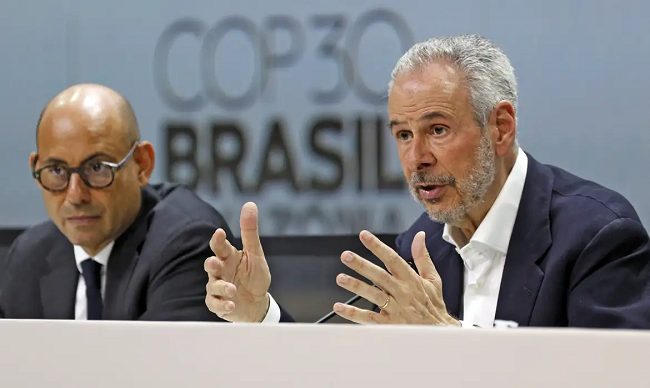
A procedural impasse is threatening to derail the COP30 climate summit holding in Belem, Brazil, five days into negotiations, with disagreements over which issues deserve priority attention preventing substantive talks from advancing.
At the conference’s opening, delegates moved four contentious topics into a separate “consultation track” after failing to reach consensus on the full agenda. None has progressed since, leaving the summit in limbo as the clock ticks toward its conclusion.
The European Union and Small Island States want formal discussions on the mitigation gap – the shortfall between countries’ current climate plans and what scientists say is needed to limit global warming to 1.5 degrees Celsius above preindustrial levels.
COP30
Developing nations are demanding that talks focus instead on climate finance commitments from wealthy countries, a discussion richer nations want to avoid.
“Both the mitigation gap and the finance gap must be addressed,” said Mattias Söderberg, global climate lead at DanChurchAid.
“Parties should move out of their fixed positions to unlock this stalemate.”
The standoff comes as climate impacts intensify worldwide and scientists warn time for meaningful action is narrowing rapidly.
Some progress emerged around adaptation finance, with growing support for a proposal from least developed countries to triple current funding commitments. Söderberg called the momentum “great news,” noting adaptation support is crucial for vulnerable communities already experiencing climate damage.
“I do hope that COP30 can deliver an adaptation finance target,” he said.
Separately, attention is turning to Saturday’s scheduled discussion of the Baku-Belém Roadmap, unveiled before the summit as a framework for mobilising $1.3 trillion annually to address climate change. Söderberg said the roadmap “must become a concrete plan to scale up funding in the coming year.”
“Without climate finance, there will be no climate action,” he said.