

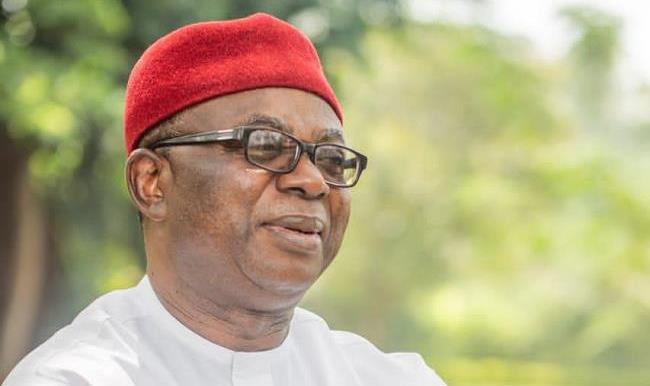
The member representing the South East on the Governing Board of the North East Development Commission (NEDC), Sam Ifeanyi Onuigbo, has reaffirmed his support for President Bola Ahmed Tinubu’s reform agenda, describing the creation and strengthening of regional development commissions as a “historic step toward equitable national growth.”
Speaking during an interactive session, Onuigbo – an experienced legislator and development advocate – outlined the expected benefits of the newly invigorated regional development framework and weighed in on national politics ahead of the 2027 elections.
Onuigbo traced the roots of regional development initiatives to Nigeria’s First Republic, referencing the impactful work of the Eastern Nigeria Development Corporation, which he said played a key role in infrastructural and industrial expansion in the old Eastern Region.
He cited landmark projects such as the establishment of the University of Nigeria, Nsukka, and the development of industrial layouts that stimulated economic growth in the early 1960s.
According to him, President Tinubu’s revitalisation of regional commissions reflects an understanding of history and a commitment to correcting long-standing developmental gaps.
“The North East Development Commission is addressing devastations caused by insurgency, particularly the Boko Haram crisis,” Onuigbo explained. “Beyond reconstruction, it is tackling ecological challenges like desertification, climate change impacts, and educational deficits.”
He added that similar commissions across Nigeria’s geopolitical zones – covering the North East, North West, South West, and South East – are expected to drive grassroots development while contributing to overall national progress.
Turning to the evolving political landscape, Onuigbo noted that realignments across the country are being driven by what he described as “verifiable accomplishments” of the Tinubu administration.
He observed that three of the five South East states – Ebonyi, Imo, and Enugu – are currently aligned with the ruling party, the All Progressives Congress (APC), and predicted that more states could follow suit.
“Our people are pragmatic,” he said. “They are seeing federal presence in infrastructure, security appointments, and economic reforms. Realignment is a natural response to visible progress.”
Onuigbo pointed to federal road projects such as the reconstruction of the Enugu–Port Harcourt and Enugu–Onitsha highways, as well as the planned development of an airport in Abia State, as tangible evidence of increased federal attention to the region.
He also highlighted the restoration of previously delisted academic programmes at the Michael Okpara University of Agriculture, Umudike, describing it as a demonstration of the administration’s responsiveness to advocacy efforts.
Onuigbo commended Babagana Umara Zulum for supporting the implementation of the Supreme Court judgment granting financial autonomy to local governments.
He argued that direct allocation of funds to local councils would enhance grassroots development, improve rural infrastructure, and strengthen local security intelligence networks.
“Local government autonomy is critical for market development, rural roads, agriculture, and security at the grassroots,” he said. “When funds are released directly, the impact is immediate and visible.”
He urged other governors to respect and implement the Supreme Court’s ruling, noting that many had themselves benefited from judicial pronouncements validating their mandates.
Defending the administration’s economic policies, Onuigbo described the removal of fuel subsidy as a “bold but necessary decision” that has significantly increased federal and state revenues.
He noted improvements in fiscal allocations to states, declining inflationary pressures, and greater foreign exchange stability as signs of economic recovery.
“Governors are no longer struggling to pay salaries,” he said. “Revenue has multiplied compared to previous years.”
He also referenced major infrastructure initiatives such as the proposed coastal highway and inter-regional road corridors, which he believes will enhance trade connectivity and economic integration.
Onuigbo concluded by emphasising that regional development commissions are not merely political structures but strategic instruments for correcting historical imbalances and fostering inclusive growth.
“We are building from different regions but with a common national focus,” he said. “If we sustain these reforms, future generations will look back and recognize this period as a turning point in Nigeria’s development journey.”
As political alignments continue to shift ahead of 2027, Onuigbo remains confident that visible governance outcomes will shape electoral decisions – particularly in the South East – where he believes growing federal engagement is already influencing public perception.
By Ajibola Adedoye