

Deep beneath Nigerian soil lies a dormant giant of natural gas with huge potential to transform into kinetic force, bridging the gap between gas fields and industrial heartlands.
In the quest to leverage this huge gas reserves for regional energy security and global markets, the Nigerian National Petroleum Company Limited (NNPC Ltd.) spearheads Africa’s energy integration through the development of transcontinental gas pipeline projects to connect West African economies and link the continent to global energy markets.
The NNPC Ltd.’s current strategy centres on enhancing the sustainability of upstream production, expanding natural gas processing and transportation infrastructure and upgrading refining assets to support chemical production and premium hydrocarbon outputs.
NNPC’s major gas pipeline ventures focus on boosting domestic supply and connecting Africa to Europe.
This is primarily through the ongoing Ajaokuta-Kaduna-Kano (AKK) Gas Pipeline for internal use, and ambitious international projects like the Nigeria-Morocco Gas Pipeline (NMGP), spanning 13 West African nations and the proposed Trans-Saharan Gas Pipeline (TSGP)
This ensures the continuous supply of high-quality energy products and services, evolving into an integrated energy company with strategic investments in gas and power, aiming to harness Nigeria’s abundant gas resources and deepen its footprint both locally and abroad.
The 2.8 billion dollars AKK pipeline is a 614 km line set to boost Northern Nigeria’s economy by supplying gas to power plants and industries, and with milestones such as the River Niger crossing (technically challenging segments) completed in 2025, it is expected to be activated for export in early 2026.
Another key project is the Obiafu-Obrikom-Oben (OB3) gas pipeline, which connects eastern gas fields to western networks, facilitating nationwide supply and linking to the AKK gas pipeline.
These projects are crucial for Nigeria’s gas-to-power goals, economic growth, and industrial revival, reducing reliance on diesel and Premium Motor Spirit (PMS).
The Nigeria-Morocco Gas Pipeline, a proposed nearly 6,000-kilometer project to transport natural gas from Nigeria through 13 West African countries to Morocco, and then to Europe was proposed in a December 2016 agreement between the NNPC Ltd. and the Moroccan Office National des Hydrocarbures et des Mines (ONHYM).
In August 2017, NNPC Ltd. and ONHYM began a feasibility study for the pipeline, which is estimated to cost $25 billion, and would be completed in stages over 25 years.
Morocco is reportedly in talks with Nigeria to pursue this gas pipeline which is progressive.
The AKK project aims to strengthen Nigeria’s domestic energy network, while the Nigeria-Morocco project seeks to expand the West African Gas Pipeline (WAGP) to connect countries along the Atlantic coast and potentially extend to Europe.
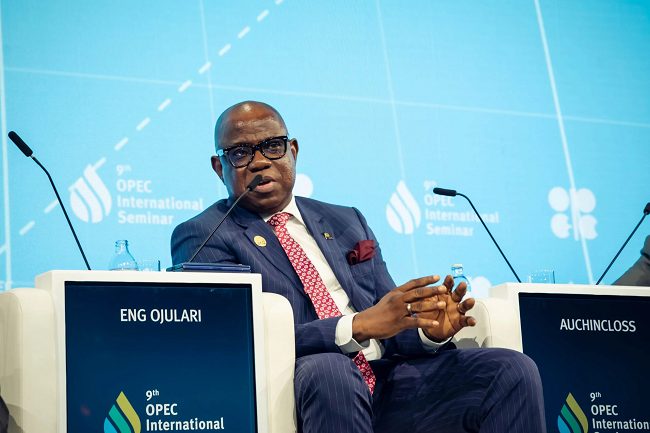
Speaking at the 2025 Abu Dhabi International Petroleum Exhibition and Conference (ADIPEC) hosted by the Abu Dhabi National Oil Company (ADNOC), in Abu Dhabi, United Arab Emirate, Mr. Bashir Ojulari, Group Chief Executive Officer, NNPC Ltd. focused on deepening infrastructural development.
Under the theme, Energy. Intelligence. Impact., ADIPEC hosted an extraordinary programme of dialogue and collaboration, uniting global leaders to build resilient systems, deploy intelligent solutions and deliver the energy the world needs.
Ojulari said the flagship Nigeria–Morocco Gas Pipeline Project was central to NNPC’s continental expansion strategy, designed to connect African nations through energy infrastructure and drive industrial growth.
“The project is one of our expansion priorities. It will run from Lagos in Nigeria all the way to Morocco around the perimeter of Africa, connecting countries along the route.
“It will enable cross-border supply and off-take, supporting industrial growth along its corridor,” he said.
He assured that the gas pipeline would build on the existing WAGP network, which already linked Nigeria to Ghana, extending it first to Côte d’Ivoire and then progressively northward through other coastal nations to Morocco.
Ojulari said the infrastructure would allow each country along the corridor to feed in gas from local fields and also off-take gas to power industries and communities, creating a mutually beneficial regional gas market.
“It provides opportunities to connect all those economies. From Morocco, the system will eventually connect to Europe, opening a new energy corridor from Africa to global markets,” he added.
“The project will help monetise Nigeria’s vast gas reserves, estimated at more than 600 trillion cubic feet, while enabling other African countries with smaller reserves to participate in shared infrastructure that promotes regional development,” he said.
He said NNPC Ltd. was simultaneously advancing domestic gas initiatives including Compressed Natural Gas (CNG) for transportation and Liquefied Petroleum Gas (LPG) for households to deepen gas utilisation and reduce dependence on biomass.
“Natural gas is now a big deal in Nigeria. Our retail trucks are being converted to run on compressed natural gas. We are also expanding LPG networks across Nigeria and Sub-Saharan Africa to phase out wood and charcoal use,” Ojulari said.
He emphasised that gas development remained central to Africa’s industrial future, describing it as the continent’s “pathway to full industrialisation.”
“Gas provides revenue, creates jobs through industrial parks, and connects new businesses. For Nigeria and West Africa, it is the foundation for sustainable economic growth,” he said.
Ojulari reaffirmed NNPC’s commitment to partnerships with African and global energy stakeholders to accelerate infrastructure that will make Africa a significant player in the global gas value chain.
According to him, the NNPC Ltd. is charting a sustainable course for Africa’s energy future through technology deployment, business integration and strategic partnerships.
After a recent inspection on the AKK project, Ojulari said the NNPC had completed welding of the pipeline’s main line, including the River Niger crossing, a long-standing technical challenge that had delayed progress on the project.
He said the achievement had paved the way for connecting the pipeline early next year.
“We have been able to complete the welding of the main line of the AKK pipeline. In summer, we were able to cross the River Niger, which was a struggle for many years. With its completion, we can start making all the connections early next year,” he said.
According to Ojulari, once activated, the pipeline will deliver gas across northern Nigeria, supporting industrial and economic activities.
“This is not just about energy,” he said. “It’s about industrialization, fertiliser plants, power generation, and gas-based industries in Kaduna, Kano, Abuja and Ajaokuta. We expect to see industrial parks spring up.”
He attributed NNPC’s improved operational outlook to reforms introduced under the Petroleum Industry Act, which, he said, had repositioned the company as a commercially driven entity operating without reliance on federal allocations.
He said the completion of the AKK pipeline network would expand economic opportunities, enhance power supply and support national industrialisation efforts, contributing to improved energy and economic security.
The AKK pipeline, first conceived in 2008, is a key component of Nigeria’s strategy to harness its gas resources to drive economic growth.
The project is expected to significantly improve energy access in northern Nigeria, where persistent power shortages and weak infrastructure have constrained industrial development for decades.
On upstream investment, Mr. Udy Ntia, Executive Vice President, Upstream, NNPC Ltd., also listed major gas pipeline projects, including the Nigeria-Morocco project and links to demand centres in western and northern Nigeria, Refinery optimisation and development of hybrid partnerships for co-investment in upstream projects.
“Co-investment is the new round of financing. We are stepping in as co-investors to ensure projects are bankable and decisions are made quickly in a rapidly changing environment,” he said.
He emphasised a shift toward partnership-driven growth between National Oil Companies (NOCs) and International Oil Companies (IOCs), calling for collaboration over competition.
“IOCs are not grabbers; they are partners. We all share the same goal, which is profitability, sustainability and growth. The real question is how we can increase the size of the pie so that everyone wins,” he said.
Ntia reaffirmed that Nigeria’s upstream strategy balances energy security, profitability, and climate responsibility, ensuring the nation’s resources remain relevant in the global energy transition.
Also, this gives the country more power and better energy, creates many new jobs for people and also helps the land by using cleaner gas instead of dirty fuel.
By Emmanuella Anokam, News Agency of Nigeria (NAN)