

The Group Managing Director of NNPC Ltd., Mr. Bayo Ojulari, has reaffirmed the company’s commitment to strengthening partnerships, building indigenous capacity, and promoting gas as a key driver of Africa’s industrialisation.
Ojulari gave the assurance on Tuesday, February 10, in Lagos at the 10th Sub-Saharan Africa International Petroleum Exhibition and Conference (SAIPEC 2026).
The conference, with the theme, “A Decade of Driving Africa’s Energy Future,” marks a decade of convening energy stakeholders across the continent.
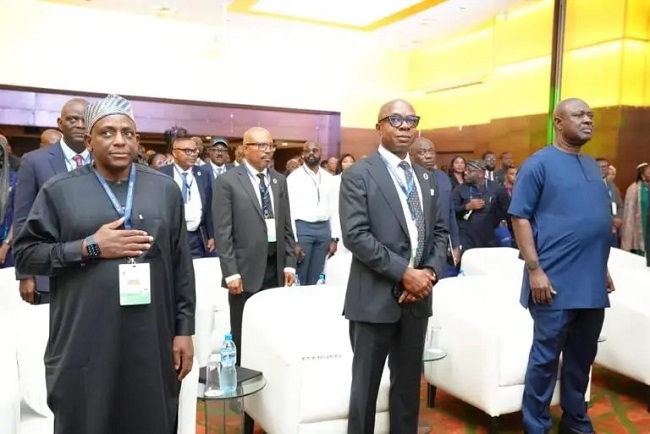
According to him, NNPC Ltd is focused on ensuring that Africa’s energy narrative is defined by creation, responsibility, and opportunity, with indigenous participation positioned at the heart of sustainable growth.
“NNPC Ltd remains committed to playing its part in strengthening partnerships, supporting indigenous capacity, and advancing gas as a catalyst for industrialisation,” Ojulari said.
He commended the organisers of SAIPEC for their vision and consistency, noting that the conference had evolved within a decade into one of Africa’s most respected energy platforms.
“In just 10 years, SAIPEC has grown beyond the confines of a conference,” he said.
“It has become a powerful statement of African capability and clear proof that our continent can convene, collaborate, and compete at the highest global standards.”
Ojulari said NNPC Ltd was proud to be a strategic partner of SAIPEC, describing the partnership as a reflection of a shared conviction that Africa’s energy future must be shaped by Africans.
“This partnership is anchored on strong institutions, credible policies, capable indigenous companies, and collaborations that deliver real value,” he said.
He expressed confidence that SAIPEC 2026 would be ambitious and impactful.
He noted that discussions on gas development, investment resilience, local content inclusion, and youth development directly addressed Africa’s energy realities, saying, “these are not abstract debates.”
“They reflect confidence in Nigeria’s capability, belief in Africa’s potential, and ambition without apology.
He added that Africa must move beyond being a follower in global energy conversations and assert itself as a credible leader.
“It should speak to an Africa that is no longer a content follower, but a real and reliable leader,” he said.
As the conference marks its 10th edition, Ojulari urged stakeholders to use the milestone to renew their collective commitment to Africa’s energy future.
“As we celebrate and look ahead, I encourage all stakeholders to recommit to the future we must build together,” he said.
Also speaking, Mr. Felix Ogbe, Executive Secretary of the Nigerian Content Development and Monitoring Board (NCDMB), called for deeper continental collaboration as the foundation for building a resilient and competitive African energy sector.
Ogbe made the call in his keynote address, delivered on his behalf by Dr Abdulmalik Halilu, Director of Corporate Services, NCDMB.
“At the continental level, our drive for Africa must be anchored on collaboration,” Ogbe said.
“We must collectively leverage the Brazzaville Accord to promote regulatory harmonisation, sectoral cooperation, and an Afro-centric approach to local content development.
He said aligning regulatory frameworks and reducing bureaucratic bottlenecks would enhance the competitiveness and economic viability of African energy projects, positioning the continent to attract global investment.
Ogbe described the establishment of the Africa Energy Bank, under the African Petroleum Producers’ Organisation in partnership with Afreximbank, as a strategic milestone.
“The bank is designed to mobilise capital for African energy projects, provide access to affordable financing, strengthen industry players, and build capacity across the continent,” he said.
He urged governments, regulators, investors, and industry leaders to support the bank’s successful take-off.
He stressed that access to finance remained critical to unlocking sustainable growth.
“The path forward for Africa’s energy sector requires collaboration and a shared vision,” Ogbe said.
In his welcome address, the Chairman of the Petroleum Technology Association of Nigeria (PETAN), Mr. Wole Ogunsanya, said that in spite of the evolving global energy transition, Africa’s most urgent challenge remained energy access, affordability, and reliability.
According to him, more than 600 million Africans still lack access to electricity, while industrial growth continues to be constrained by persistent energy deficits.
“For Africa, energy transition is not about abandoning hydrocarbons,” he said.
“It is about leveraging our resources responsibly to drive development, while gradually integrating cleaner and renewable solutions.”
He described the rise of indigenous capacity across Africa’s energy value chain as one of the most profound achievements of the past decade.
He cited Nigeria’s success with deliberate local content policies.
“In Nigeria, indigenous companies now lead in drilling and well services, engineering, fabrication and construction, as well as asset acquisition and field development,” Ogunsanya said.
He noted that PETAN members had evolved from service providers into strategic partners, delivering complex energy projects to international standards.
“A decade ago, we set out to drive Africa’s energy future,” he said.
“Today, we are not at the end of that journey, but at the beginning of a far more ambitious chapter.”
Ogunsanya said SAIPEC was conceived ten years ago as more than an industry event.
“It was envisioned as a movement to amplify African capabilities, encourage collaboration, and redefine Africa’s role in the global energy landscape,” he said.
According to him, the platform has driven strategic dialogue on policy and investment, elevated indigenous participation, connected African service companies to global opportunities, and translated conversations into real projects.
Looking ahead, Ogunsanya stressed that Africa’s energy future must be defined by Africans, for Africans, and driven by investment and execution.
“Africa needs capital, and capital needs confidence,” he said, noting that investor confidence was built on regulatory clarity, stability, transparent processes, competitive fiscal frameworks, and bankable projects.
He urged stakeholders to embrace digitalisation, automation, data-driven operations, and low-carbon solutions to enhance efficiency, safety, and sustainability.
“As we mark this 10th edition of SAIPEC, let us recommit to moving from dialogue to delivery,” Ogunsanya said.
He added that PETAN would continue to accelerate gas development and infrastructure expansion, deepen local content utilisation, create jobs, transfer skills, and position Africa as a competitive and reliable energy destination.
“SAIPEC must remain a platform where ideas become investments and conversations translate into projects,” he said.
By Yunus Yusuf