

The Renewable Energy and Energy Efficiency Associations Alliance (REEEAA) on Friday, September 26, 2025, concluded its 4th International Conference at the Radisson Blu Anchorage Hotel, Lagos, under the theme “Energy Transition: From Rhetoric to Action in Nigeria.”
The two-day high-level gathering brought together policymakers, development partners, investors, industry leaders, and practitioners to transform Nigeria’s clean energy ambitions into measurable and coordinated outcomes.
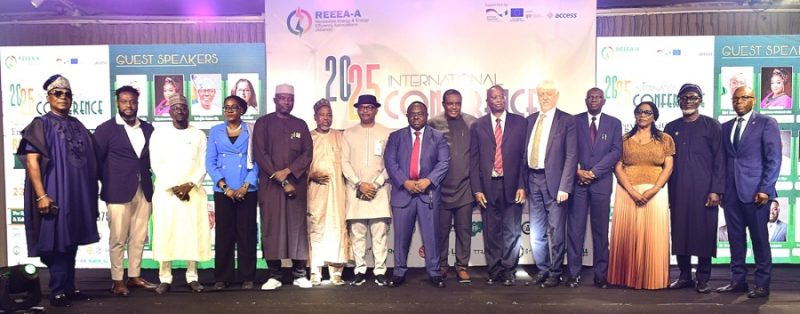
In his welcome address, REEEAA President, Prof. Magnus Onuoha, reaffirmed the Alliance’s mandate as the unified voice of Nigeria’s clean energy sector. He recalled that REEEAA emerged under the Nigerian Energy Support Programme (NESP II) – a collaboration of the Federal Ministry of Power, European Union, German Government, and GIZ – to consolidate Nigeria’s fragmented renewable energy ecosystem into one coordinated platform.
“For over five years, REEEAA has spoken with one voice, engaging constructively for actionable and result-oriented outcomes. Our mission remains clear: to mainstream clean energy into Nigeria’s sustainable development agenda,” he said.
Prof. Onuoha commended President Bola Ahmed Tinubu for enacting the Electricity Act 2023, describing it as a decisive step toward energy democratization that empowers subnationals to drive renewable growth. He also acknowledged Lagos State’s leadership in subnational energy transition and lauded the Federal Ministry of Power, under Chief Adebayo Adelabu, for its active collaboration with the Alliance.
The President further recognised indigenous innovators advancing renewable energy without subsidies – dubbed the “G13” – and advocated for the integrity of data, sector insights, and knowledge sharing.
“This conference is not just a gathering – it is a platform for impact. Let us move together from rhetoric to action,” he urged.
Lagos State Reaffirms Subnational Leadership
Representing Governor Babajide Sanwo-Olu, Biodun Ogunleye, Lagos State Commissioner for Energy and Mineral Resources, opened the conference by reaffirming Lagos’s role as a trailblazer in Nigeria’s renewable energy transition.
He announced the planned conversion of 42,000 streetlights to solar power, renewable electrification of 32 general hospitals, and an additional 2,000 kilowatt-hours of capacity to strengthen public infrastructure.
“Energy transition is no longer an option – it is an urgent necessity. Lagos is demonstrating that subnational governments can lead by example through decisive policies and investments,” Ogunleye stated.
Federal & Institutional Commitments Elevated with $2 Billion Solar Mobilisation
Representing the Minister of Power, Chief Adebayo Adelabu, the Managing Director/CEO of the Rural Electrification Agency (REA), Mallam Abba Abubakar Aliyu, outlined the Federal Government’s renewed momentum toward decentralised power systems and private-sector-led energy growth.
He disclosed that the government has mobilised over $2 billion in public funding to de-risk solar investments and catalyse private-sector participation.
This includes:
- $750 million from the World Bank’s Distributed Access through Renewable Energy Scale-up (DARES) programme;
- $200 million from the African Development Bank;
- $190 million from the Global Energy Alliance for People and Planet (GEAPP); and
- $800 million currently under negotiation with multilateral lenders.
Aliyu explained that the Federal Government has absorbed nearly all non-operational risks through dollar-denominated grants and guarantees, urging commercial banks to move beyond micro-level financing and scale up support for larger projects.
Already, several banks – including Access Bank, FCMB, and Stanbic IBTC – have entered renewable partnerships such as FCMB’s ₦100 billion solar funding MoU.
He further noted that Nigeria imported 1,721 MW worth of solar PV panels between June 2024 and June 2025, ranking second only to South Africa in Africa’s renewable imports.
With 45 percent of Nigerians lacking reliable power, the country loses $25 billion annually to electricity shortages. Bridging this gap will require $23 billion in new investment, while executing the National Energy Transition Plan will demand $410 billion.
Close to ₦1.7 trillion was committed to energy-related projects in the 2025 federal budget, demonstrating the government’s readiness to act.
Gender-Responsive Clean Energy Development
The Minister of Women Affairs, Hajiya Imaan Sulaiman-Ibrahim, represented by Prince Xavier Eyamba, Chief Technical Adviser on Climate Change and Sustainable Development, reiterated the ministry’s resolve to ensure that Nigeria’s energy transition remains inclusive and socially equitable.
She announced the rollout of 4 million e-cookstoves, which will create 40,000 green jobs and reduce indoor air pollution, alongside 25,000 electric tricycles for women and youth across all six geopolitical zones.
“Women and children are disproportionately affected by energy poverty. Our clean cooking and e-mobility initiatives will lower emissions while empowering women economically and socially,” she said.
Capacity Building and Skills Development
The DG of NEMSA, Tukur Tahir Aliyu, advocated the upskilling of installers ad developers in the renewable energy space. He stated that only technical proficiency can enable the sustainability of local content development in the Nigerian clean energy space
Strategic Partnerships and Next Steps
The conference produced a series of tangible commitments and follow-up actions, including:
• Finalising an MoU between REEEAA and NEMSA to strengthen technical standards, compliance, capacity building, and public awareness;
• Collaboration with Access Bank to expand de-risking mechanisms for renewable energy investors and developers;
• Launch of REEEAA’s bi-monthly journal “Clean Energy News”;
• Continued cooperation with GIZ under the Nigerian Energy Support Program (NESP) to enhance advocacy and capacity development;
• €35.6 million commitment from the German Government to strengthen Nigeria’s energy transition framework;
• GIZ’s upcoming “Energy Transition Challenge Fund”, offering co-investment grants and technical support for clean energy businesses;
• Nigeria–Germany ministerial dialogue scheduled for November 4, 2025, in Berlin, covering climate, investment, agriculture, and renewable cooperation.
Moving from Rhetoric to Action
In his closing remarks, Prof. Abubakar Sambo, Chairman of REEEAA’s Board of Trustees, represented by the Deputy Chairman, Dr. Sunny Akpoyibo, called for implementation discipline: “The momentum for energy transition is undeniable. What remains is the discipline to implement, monitor, and sustain these efforts.”
The conference concluded with a reaffirmation of the Alliance’s commitment: “The solutions are within our reach; what Nigeria needs now is collective will and strategic action to ensure measurable impact at scale.”