

The Nigerian Content Development and Monitoring Board (NCDMB) has enjoined operators in the midstream segment of the oil and gas industry to comply with the Nigerian Oil and Gas Industry Content Development (NOGICD) Act 2010, or risk attracting sanctions, including project withdrawal, suspension and criminal prosecution.
The Board also reaffirmed that obtaining the Nigerian Content Equipment Certificates (NCEC) attracts zero processing fees, and it had banned the use of middlemen in all its transactions and confirmed that expired or misapplied NCECs will lead to automatic disqualification from tenders.
These positions anchored the NCDMB Sensitisation Workshop for Midstream Companies and Stakeholders, held on Friday, February 27, 2026, in Lagos, as the Board deployed a five-directorate technical team to deepen compliance awareness across Nigeria’s fast-expanding midstream segment.
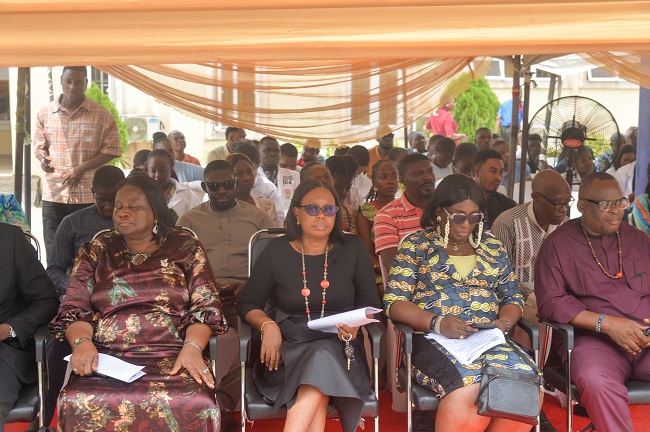
Organised by the Monitoring and Evaluation Directorate and supported by the Project Certification and Authorisation Directorate, Capacity Building Directorate and Planning, Research and Statistics Directorate, the workshop was themed, ‘Compliance with the Provisions of the NOGICD Act 2010: The Path to Industrialisation’.
Opening the workshop, the Acting Director of Monitoring and Evaluation, NCDMB, Mr. Omomehin Ajimijaye, said the decision to host the Lagos leg of the engagement underscored the Board’s commitment to extending Nigerian content enforcement beyond the upstream sector and the Niger Delta region.
“Today’s workshop is one of the key platforms for deepening engagement with the midstream sector. We are not focused only on the upstream sector. We are also doing our best to ensure that our midstream and downstream stakeholders are carried along in the quest for Nigerian content value expansion, and for the economic progress and energy security of our country,” he said.
Conveying the appreciation of the Executive Secretary of NCDMB, Felix Omatsola Ogbe, he thanked participants for honouring the invitation at short notice, describing them as strategic partners in the Board’s national mandate.
Ajimijaye outlined four objectives of the engagement: deepening understanding of the NOGICD Act; clarifying statutory reporting templates; addressing midstream-specific compliance challenges; and strengthening collaboration between the Board and industry players.
“Your feedback is crucial as we move towards our collective goal of raising Nigerian content to 70 per cent. This journey requires partnership and mutual understanding,” Ajimijaye added.
The Director of Capacity Building, Abayomi Bamidele, said, “The Act mandates all operators and contractors to prioritise Nigerian employment and training,” noting that any project or contract valued at $1m and above must submit an Employment and Training Plan for Board approval.
He explained the NCDMB Field Readiness Initiative, designed to bridge workforce gaps created by retirements and emigration of some personnel, and open the oil and gas sector to OND, HND and BSc holders via the NOGIC JQS portal.
Bamidele reiterated that NCEC processing is completely free, middlemen are prohibited, and companies must own, not lease, certified equipment.
Delivering a detailed technical presentation, the Supervisor, Project Certification and Authorisation Directorate, Mr. Elvis Ogede, explained that every operator was statutorily required to submit a Nigerian Content Plan in line with Sections 7 and 8 of the Act.
“With respect to your scope of work, we expect you to set targets. These targets are achievable, not just aspirations – with the capacity that exists in-country,” Ogede said.
He explained that operators must engage the Board at five mandatory points, including Nigerian Content Plan submission; approval of selective or sole-source contracting strategies; review of invitation-to-tender documents; participation in bid openings; and submission of technical and commercial evaluation reports before issuance of the Nigerian Content Compliance Commitment.
Clarifying recent changes, Ogede stressed that the NCCC was not a certificate of past compliance but a binding commitment.
“It is not a certificate that you have complied. It is a commitment – what you are going to do – and you will be monitored against it,” he said.
He also warned that Memoranda of Association could no longer substitute for valid NCEC, that expired NCECs are disqualifying, and that service-specific certification is mandatory.
“Nobody should expect to use a consultancy NCEC for fabrication work and then complain when disqualified,” he added.
The Deputy Manager, Midstream Monitoring Division, Mr. Damola Aderibigbe, outlined the Board’s monitoring framework, which spans performance, compliance and intervention monitoring across upstream, midstream and downstream operations.
“We do not just monitor activities – we measure performance against commitment,” he said.
He listed 14 statutory reports required from companies and warned that late or incomplete submissions remained the most common compliance failures.
Aderibigbe stressed that engineering firms must hold corporate COREN accreditation, not just individual staff certification.
“If you fall short of the law, remediation will be required, suspension may follow, legal action can be taken, and projects can be withdrawn. But the Board is a business enabler – we want compliance, not conflict,” he said.
The Supervisor, Planning, Research and Statistics Directorate, Mr. Emmanuel Paulker, said that the NOGIC JQS portal had registered 406,000 individuals and 11,445 companies, including 115 operators, though much of the midstream sector remains outside the system.
He said 1,603 expatriate quota applications had been processed, with 1,417 approvals, generating 13,833 employment commitments, and warned that companies must obtain NCDMB’s approval before approaching the Federal Ministry of Interior.
“Anything outside that process is a contravention of the law,” Paulker said.
Delivering the vote of thanks, the Supervisor, Midstream Monitoring Division, Engr. Pius Waritimi, reiterated that compliance commitments are binding and encouraged stakeholders to engage the Board early.
“We want everyone here to join the NCCF and the Sectoral Working Groups, where industry concerns can be addressed constructively,” he said.
Meanwhile, a state-of-the-art Clinical Skills and Simulation Laboratory, fully equipped by the NCDMB, was on Friday, February 27, 2026, commissioned at the Bayelsa Medical University (BMU), Yenagoa, with the goal of positioning the institution to align with global best practices in medical education, and “strengthening local capacity in Bayelsa State and Nigeria at large.”
Equipment provided include high-fidelity adult and pediatric patient simulators, laparoscopic training systems, obstetric trainers, advanced life support mannequins, consultation cubicles, and audio-visual learning systems, all of which the university authorities claimed would enable students to “learn, make mistakes, and perfect their life-saving skills in a zero-risk environment before they ever touch a human patient.”
Speaking at the commissioning ceremony at the Clinical Skills Acquisition Centre, BMU Main Campus, the Executive Secretary of the NCDMB, Felix Omatsola Ogbe, said that capacity building is “not just about oil and gas; it is about ecosystems,” and that the industry does not operate in isolation. He listed health care, education, engineering, and logistics, among others, as sectors with linkage to the oil and gas industry.
He noted that “Simulation-based learning is now the global standard in medical education” and that it allows students to acquire hands-on clinical skills, improves decision-making, and builds confidence in a controlled safe environment before engaging the blue patient.
Represented by Mr. Ene Ette, Acting Director, Planning, Research and Statistics (PRS) of the Board, the Executive Secretary commended the Management of BMU and partner organisations for their collaboration, professionalism, and shared vision, pointing out that the upgraded laboratory is a strategic investment in human capacity and capital development and a practical demonstration of how policy can translate into measurable impact.
In his welcome address, the Vice Chancellor of the institution, Professor Dimie Ogoina, noted that the event was not just the commissioning of a building or unveiling of medical equipment, it was about “securing the future of healthcare in Bayelsa State, the Niger Delta, and Nigeria at large.” He said words could not adequately express his profound gratitude to the Management of the NCDMB.
He recalled that when he assumed office as Vice Chancellor in 2025, he shared his vision, encapsulated in what he termed A.S.P.I.R.E. Agenda, to transform Bayelsa Medical University into a globally recognised leader in medical education, research, and innovation, driven by technology and excellence. “Today,” he remarked, “as we look at this world-class facility, we are seeing the ASPIRE Agenda come to life.”
To the Executive Secretary and the entire Management of the NCDMB, he declared: “You have provided us with the very best – from advanced patient simulators and CPR mannequins to essential surgical and diagnostic kits,” noting that by equipping the lab to such a standard, the Board was “directly contributing to the reduction of medical errors, the improvement of patient safety, and the development of indigenous healthcare professionals who will serve our communities and our industries.”
“We are not just training doctors for today, we are nurturing digital-age physicians capable of competing on the global stage,” he emphasised.
Professor Ogoina also appreciated the Bayelsa State Governor, Senator Douye Diri, and the Commissioners for Health and Education, for the unwavering support and for creating an enabling environment that allows partnerships like the one with NCDMB and its partner organisations to thrive.
In a similar vein, the Provost of the College of Medicine, Bayelsa Medical University, Professor Philip Eyimina, expressed profound gratitude to the NCDMB for its foresight and generosity in equipping the University Clinical Skills and Simulation Laboratory, and to the Bayelsa State Government for continued commitment to strengthening healthcare and education in the State.
He pointed out that the newly upgraded laboratory played a significant role in the institution’s recent accreditation verification exercise. According to him, “The presence of a functional, well-equipped Clinical Skills Laboratory strongly affirmed our readiness to deliver high-quality medical education in line with national standards.”
According to him, “In this laboratory, our students will learn essential competencies – history taking, physical examination, suturing, intravenous access, cardiopulmonary resuscitation, obstetric skills, and emergency response – while developing critical thinking, teamwork, and communication skills.”
In a special address, the State Governor, Senator Douye Diri, who is the Visitor to the University, lauded the NCDMB for providing facilities which he described as remarkable. He recalled the aspiration of the Vice Chancellor to make BMU “a leading university in medicine,” noting that “What the NCDMB has done is clearly a demonstration of going with that vision to market this university to the entire world.”
Represented by the State Commissioner for Education, Dr. Gentle Emelah, the Governor declared that the institution has the firm support of the State Government as it strives for high academic standards and global reckoning.
In a goodwill message, the Pro-chancellor of the University, Professor Tarilah Tebepah, said while the Governing Council was considering the vision of BMU becoming globally known as a leader in medical education, producing very sound innovative healthcare professionals, it never lost sight of the fact that a lot of technology, equipment and funding would be required.
He thanked the NCDMB profusely, while pleading that it should continue to identify with the institution as it grapples with resource-related challenges.
The event was concluded with a tour of key units of the state-of-the-art Clinical Skills and Simulation Laboratory, which include a Virtual Reality Station, Paediatric and Airway Management Stations, EGG and Patient Monitoring Station, IV Fluids Administration and Cannulation Station, and a Demonstration Hall.