

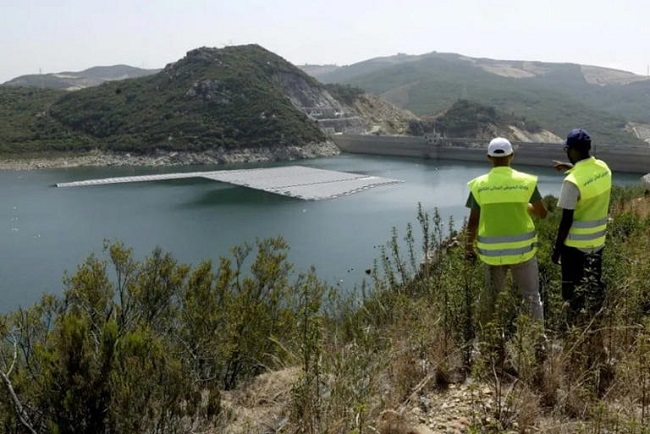
Morocco is testing floating solar panels on the Tangier Med dam in an effort to curb evaporation and generate electricity, as the country grapples with its worst drought in four decades.
The pilot project, launched in late 2024, aims to reduce water loss from evaporation, which intensifies between April and September with rising temperatures, while supplying clean energy to the nearby Tangier Med port.
For seven consecutive years, Morocco has faced record-low rainfall. Reservoir levels have dropped to about 35% this summer, according to the Ministry of Equipment and Water. Between fall 2022 and summer 2023, average temperatures rose 1.8 degrees Celsius above normal, leading to the evaporation of nearly 1.5 million cubic meters of dam water daily, the equivalent of more than 600 Olympic swimming pools.
At Tangier Med, evaporation ranges between 3,000 and 7,000 cubic meters per day in the summer, said Yassine Wahbi, head of water resources planning in the Loukkos basin. The project is expected to lower that by about 30%, saving some 1.2 million cubic meters of water annually, enough to meet 1% of Tangier’s yearly demand.
When completed, more than 22,000 panels will float across 10 hectares of the reservoir, anchored to withstand shifting water levels and winds. The system will produce up to 13 megawatts of electricity for the port. Trees will also be planted along the dam’s banks to reduce wind-driven evaporation.
Climate expert Mohamed Said Karrouk called the initiative “pioneering,” but cautioned that floating panels cannot cover Morocco’s vast dams and may be affected by falling water levels. He urged greater investment in transferring surplus water from northern basins less exposed to drought to central and southern regions.
Morocco currently operates a 67-kilometer waterway from the Sebou basin to Rabat and plans to expand such projects. The country is also conducting feasibility studies for two additional floating solar sites near Marrakech and in the north.
Globally, France, Indonesia and Thailand are experimenting with floating solar, while China operates the world’s largest installations. Still, Morocco sees desalination as its main long-term solution, with plans to scale up annual output from 320 million cubic meters today to 1.7 billion cubic meters by 2030.