

The sixth meeting of the Conference of the Parties to the Minamata Convention on Mercury (COP-6), held in Geneva from November 3 to 7, 2025, brought together over 1,000 participants in person and nearly 4,000 online viewers. Parties adopted 22 decisions to advance the Convention’s objective of protecting human health and the environment from mercury pollution, marking a week of collaboration, determination, and shared purpose.
In his closing remarks, COP-6 President Osvaldo Álvarez Pérez (Chile) highlighted the discipline, flexibility, and unity of purpose that continue to drive progress under the Convention: “Thank you all for your trust, your humor, and your tireless cooperation. With your creativity and commitment, we have set ambitious new goals, and left mercury a little further behind, together”.
Minamata Convention Executive Secretary, Monika Stankiewicz, expressed appreciation to all delegates, observers, partners and the Secretariat team. “We have just opened the door to another chapter of the mercury history book. What you all have accomplished here this week is truly inspiring,” she said. “You show the promise of multilateral action, at a time when it is most urgently needed”.
COP-6 Decisions
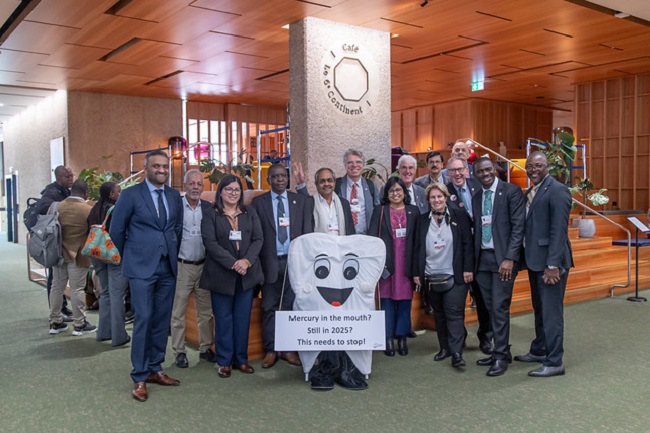
COP-6 adopted new amendments to Annex A, establishing a global phase-out of dental amalgam by 2034, a decision described by many delegations as a historic milestone for the Convention. The adoption was met with applause and standing ovations in plenary, reflecting the shared commitment of Parties to protect people and the planet from mercury exposure. This science-based, time-bound agreement marks a decisive step toward the total elimination of mercury use in dentistry and a safer future for all communities.
Parties also agreed to step up global efforts to eliminate mercury-added skin-lightening products, enhancing enforcement and cooperation with the World Health Organisation and other partners to curb illegal trade and protect public health. In addition, some extensions were granted to Parties for specific mercury-added products still transitioning toward phase-out.
Parties strengthened action on artisanal and small-scale gold mining (ASGM), recognizing the importance of providing alternative livelihoods for mining communities, particularly those in vulnerable situations, when moving away from mercury use. The COP requested the Secretariat, in coordination with relevant international initiatives, to explore how supply-chain transparency and certification can reduce mercury use and enhance accountability of buyers and intermediaries across the gold trade. Parties also call for strengthened collaboration with the Global Mercury Partnership and the engagement of Indigenous Peoples, local communities, women and youth in this effort.
To tackle the supply and trade of mercury, the COP adopted a decision updating guidance on identifying mercury stocks and the use of forms, while requesting the Secretariat to develop strategies to address illegal trade and prepare guidance on harmonized customs codes for mercury-containing goods. Complementing this, a separate decision on mercury compounds invites Parties and stakeholders to submit information on their supply, use and trade, and establishes an open-ended expert group to advance technical discussions ahead of COP-7.
On biodiversity, the COP encouraged Parties and stakeholders to implement the roadmap for enhancing co-benefits between the Minamata Convention and the Kunming–Montreal Global Biodiversity Framework, including integrating actions to reduce mercury pollution from ASGM into national biodiversity strategies.
On capacity-building, technical assistance and technology transfer, and on the financial mechanism, Parties signified the importance of a robust replenishment of funds in the next programmatic period. GEF-9 will be critical in supporting Parties to meet the obligation on time. A decision on knowledge management endorsed the continued development of digital tools to enhance transparency and data accessibility, explore the use of artificial intelligence, and promote information exchange among Parties and stakeholders. Looking ahead, Parties also adopted a decision outlining preparations for the first effectiveness evaluation of the Minamata Convention, setting in motion a key milestone to assess global progress of the Convention’s impact.
Parties called for closer collaboration with the Intergovernmental Science-Policy Panel on Chemicals, Waste and Pollution, the Global Framework on Chemicals, the Basel, Rotterdam and Stockholm Conventions, and others. Stakeholder participation reached new levels at COP-6, with women, youth, Indigenous Peoples and civil society taking an increasingly visible and engaged role in the discussions.
The establishment of the International Indigenous Peoples Forum on Mercury, the launch of the Convention’s Women’s Caucus, and the Youth Declaration are milestones in reaching the objective of the Convention to protect human health and the environment from mercury pollution.
Activities
During the week, COP-6 featured a wide range of activities organised in cooperation with the Geneva Environment Network and other partners. These included public events such as From Science to Action: Protecting the Amazon from Mercury Pollution, the launch of the Minamata Women’s Caucus, and a dialogue on lessons learned from the planetGOLD programme.
The Global Mercury Partnership also organised activities addressing skin-lightening products and harmful beauty practices, including the Humanæ photo exhibition by Angélica Dass on the Geneva lakeshore and a film screening and panel discussion on Detoxifying Cosmetics and Beauty Ideals.
Information exchange and networking were fostered through 19 Knowledge Labs held at the venue throughout the week, while partner institutions and organisations showcased their projects in the exhibition area, including the Minamata Photographer’s Eye display and other initiatives highlighting science, innovation, and cooperation under the Convention.
Looking ahead, the seventh meeting of the Conference of the Parties (COP-7) will take place in Geneva from June 14 to 18, 2027, under the presidency of Marie-Claire L’Henry (France) who will lead Parties in the next phase of implementation.