

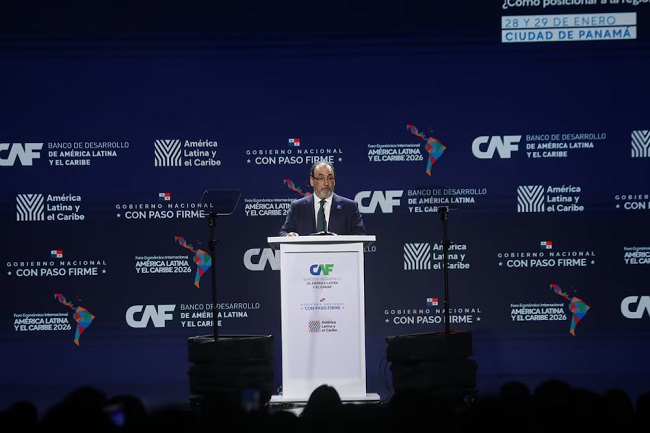
During the International Economic Forum Latin America and the Caribbean 2026, the C40 Cities Climate Leadership Group and the Development Bank of Latin America and the Caribbean (CAF) announced a new strategic partnership to accelerate urban climate finance and project delivery across Latin American cities.
The collaboration was formalised through the signing of a Memorandum of Understanding (MoU) in the presence of more than 30 local authorities from Latin American cities attending the Forum, including the mayors of Bogotá and Quito, and the deputy mayor of Fortaleza.
The MoU establishes a framework for cooperation focused on helping cities prepare, finance and implement high-impact urban climate projects over the next five years, with support from CAF. The partnership prioritises climate adaptation; promotion of biodiversity, clean and sustainable urban mobility; sustainable urban planning; and water and sanitation systems, while strengthening cities’ access to climate finance connecting them to investment opportunities.
Federico Gutiérrez, Mayor of the city of Medellín, Colombia, and C40 Vice-Chair for Latin America, said: “Medellín has shown that cities can drive transformative change. As climate risks intensify, from extreme heat to mounting water challenges, partnerships like this are critical to strengthening urban resilience across Latin America and ensuring that climate action delivers real social and economic benefits for our citizens. Cities are already stepping up to confront the climate crisis and protect our communities, but unlocking greater access to climate finance is essential to turn ambition into action and deliver solutions that change people’s lives.”
As climate impacts intensify across the region, the partnership places a strong emphasis on climate adaptation through nature-based solutions and promotion of biodiversity, the initiative aims to support cities to address extreme climate risks, such as extreme heat, flooding, sea-level rise, droughts etc., by implementing projects that promotes urban greening, water-sensitive urban design that help cool and promote resilient cities while improving quality of life.
Julian Suárez Migliozzi, Manager of Sustainable Territorial Development, said: “This partnership with C40 Cities represents a concrete step in CAF’s commitment to become the bank of subnational governments and the green bank of Latin America and the Caribbean. Our cities are home to 80% of the region’s population and are on the frontlines of the climate crisis – they need financing solutions that match the urgency of this challenge.
“Through this collaboration, we will work side by side with mayors to transform climate action plans into bankable projects that attract investment and deliver tangible benefits: greener neighborhoods, cleaner air, water security, and sustainable mobility.”
The partnership will align with regional initiatives such as CAF’s BiodiverCities Network and the Adapting BiodiverCities (ABC) programme, to be implemented by CAF and the Adaptation Fund between 2026 and 2028, strengthening links between biodiversity, climate resilience and urban development.
Under the MoU, C40 Cities and CAF will collaborate on sustainable urban development, climate adaptation and climate finance, supporting cities at different stages of project preparation and connecting them to the C40 City Finance Programme and associated funding initiatives such as the C40 Cities Finance Facility (CFF) and the City Climate Finance Gap Fund.
Mark Watts, Executive Director of C40 Cities, said: “Climate impacts are a daily reality for millions of people in Latin American cities, from extreme heat to floods and water stress. This partnership with CAF will scale up investment for real, on-the-ground action, supporting adaptation, resilience and low-carbon development where it matters most. We know what needs to be done; the challenge now is financing and delivering it at speed. By working with cities to turn plans into bankable projects, we can unlock the finance needed to protect communities and accelerate climate action at scale.”
Key areas of cooperation include:
- Climate adaptation and resilience, including the integration of climate considerations into municipal budgeting and capital investment through climate budgeting approaches;
- Clean and sustainable transport, including knowledge exchange and financing support for the electrification of public transport and other zero-emission mobility solutions;
- Urban nature-based solutions, supporting the development and financing of green and blue infrastructure through initiatives such as the C40 Urban Nature Accelerator;
- Water security and sanitation, strengthening resilience in the water, sanitation and solid waste sectors through programmes such as Water Safe Cities, with a focus on addressing risks from floods, heat, droughts and landslides;
- Urban planning and circular economy approaches, supporting integrated, sustainable and inclusive urban development.