

Following the historic adoption of the Samarkand Strategic Plan for Migratory Species 2024–2032, the 15th Conference of the Parties to the Convention on the Conservation of Migratory Species of Wild Animals (CMS COP15) in Campo Grande, Brazil, marked a decisive step forward by establishing a clear roadmap for the plan’s effective implementation.
While COP14 laid the political foundation, the outcomes in Brazil have turned global commitments into concrete mandates, defining critical points for monitoring, accountability and the transboundary cooperation necessary to safeguard the planet’s migratory corridors.
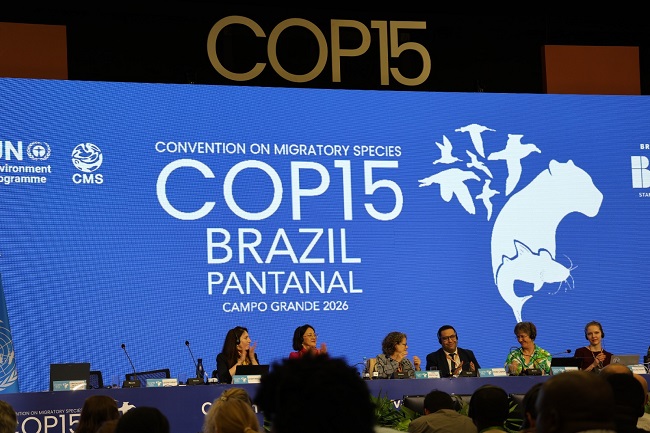
From March 23 to 29, 2026, CMS COP15 brought together governments, international organisations, scientists, conservation NGOs, Indigenous Peoples and local communities under the theme “Connecting Nature to Sustain Life”. With over 130 Parties taking part in the negotiations, the conference addressed the increasing pressures from habitat degradation, fragmentation, overexploitation and climate change on species that depend on interconnected ecosystems across countries and continents.
From planning to action
The adoption of a global roadmap to implement the Samarkand Strategic Plan was a major achievement, with Parties agreeing to integrate migratory species goals and targets into national biodiversity strategies and policies. To ensure accountability and measurable results, the CMS Secretariat was mandated to support implementation, monitoring and indicators, with progress to be reviewed at future COP meetings.
IUCN contributed actively throughout the meeting and called on Parties to strengthen the conservation of migratory species, protect ecological connectivity and align efforts with the Global Biodiversity Framework. Parties agreed to these priorities, including by enhancing cooperation between the CMS and the Convention on Biological Diversity.
Gabriel Quijandría, IUCN Regional Director for South America, said: “These decisions ensure that the protection of wildlife is not an isolated effort, but a central component of biodiversity strategies at both global and national levels.
“IUCN stands ready to continue working with Parties, the CMS Secretariat and partners to support implementation, science-based action and concrete conservation results on the ground.”
Vivek Menon, IUCN SSC Chair, said: “The successful implementation of the Samarkand Strategic Plan will depend on strong science, collaboration and expertise. The IUCN Species Survival Commission (IUCN SSC), through its global network of Specialist Groups, is committed to supporting Parties and the CMS with the best available knowledge, data and tools to guide conservation action.
“By bridging science, policy and practice, the SSC can help ensure that commitments made at CMS COP15 translate into effective results for migratory species across their entire range.”
Other key decisions and highlights
Other key outcomes include critical decisions on ecological connectivity, impact assessment for migratory species and transboundary conservation areas, reinforcing the importance of connected habitats and migration routes for biodiversity worldwide. In addition, a wide range of decisions address the major pressures affecting migratory species, with particularly strong outcomes on marine, freshwater and climate-related threats. Parties agreed to use science-based “Important Areas”, such as Key Biodiversity Areas, to guide marine spatial planning, protected areas and conservation action.
Supported by IUCN, the conference also addressed renewable energy as a cross-cutting issue at the heart of a nature-positive energy transition, emphasising that renewable energy infrastructure must be carefully planned to avoid disrupting migratory paths.
Outcomes for species conservation included the addition or upgrade of 40 species, subspecies and populations in CMS Appendices I and II, including the cheetah, striped hyena, giant otter, several shark species, freshwater fish and migratory birds. Finally, 15 new “Concerted Actions” were approved for species such as chimpanzees, dolphins, bats, sharks and seabirds, while 10 new or updated species-focused action plans were adopted.
A key highlight of the High-Level Segment was the adoption of the Pantanal Declaration, which calls for stronger international cooperation, increased financial support and urgent action to address climate change, habitat loss, pollution and infrastructure impacts. The declaration also highlights the importance of wetlands – including Brazil’s Pantanal – as critical habitats for migratory species.
The outcomes of CMS COP15 strongly reinforce IUCN’s ongoing work across the Union, including the implementation of IUCN World Conservation Congress Resolutions on recognising ecological corridors, promoting wildlife-friendly infrastructure and strengthening transboundary conservation.
Accelerating ecosystem and migratory species conservation
Beyond the plenary, IUCN showcased how technical expertise translates into policy and on-the-ground action through over 10 side events and high-level sessions, covering four areas to accelerate ecosystem and migratory species conservation.
First, the Union highlighted the importance of strengthening multilevel governance by addressing global threats such as deep-sea mining and habitat loss, positioning wetlands as critical ecosystems for international cooperation. Second, it stressed how to scale digital innovation through strategic partnerships, such as the Tech4Nature initiative in Brazil, to promote evidence-based decision-making.
IUCN also emphasised the need to advance high-quality conservation by integrating the IUCN Green List and private reserves into territorial planning to ensure ecological connectivity and wildlife-friendly infrastructure. Through its engagement in the joint CITES–CMS African Carnivores Initiative (ACI), IUCN also highlighted the importance of coordinated, landscape-level conservation, strengthened transboundary cooperation, and mobilising partnerships and sustainable financing to scale up conservation action for African carnivores across their range.
Finally, IUCN showcased how it is empowering subnational leadership, where cities and local governments serve as a vital bridge to integrate migratory species into national biodiversity strategies.