

At the International Union for Conservation of Nature (IUCN) World Conservation Congress on Wednesday, October 15, 2025, members made history with the adoption of Motion 042 – the first motion across the entire global multilateral system to explicitly address fossil fuel production as a threat to nature.
The motion calls on governments and civil society to confront one of the root causes of the combined climate and biodiversity crises through supply-side measures. This, according to the Fossil Fuel Non-Proliferation Treaty Initiative, represents the strongest language ever adopted in a multilateral forum on the supply of oil, gas and coal.
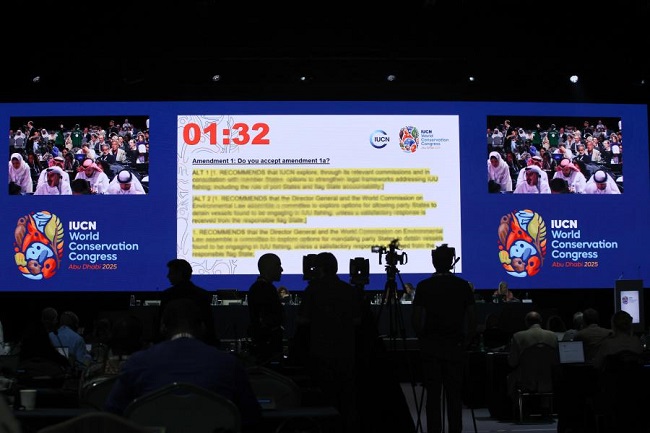
Motion 042 acknowledges the urgent gap in international governance of fossil fuel production and encourages states to explore a variety of instruments, including explicitly naming a potential Fossil Fuel Non-Proliferation Treaty, to phase out coal, oil, and gas, stop new extraction, and ensure a just transition for workers and communities. The motion also reaffirms the IUCN’s role in conservation by calling for the protection of ecosystems at the source of extraction, stopping new fossil fuel expansion, and promoting real conservation measures.
This development comes in the wake of the recent International Court of Justice (ICJ) advisory opinion, welcomed by IUCN Motion 141, which affirmed States’ obligations to prevent climate harm and protect the rights of present and future generations. Members also adopted IUCN Motion 038, calling for the promotion of the implementation of the goals agreed upon under the Paris Agreement, including transitioning away from fossil fuels in energy systems, in a just, orderly and equitable manner.
Ralph Regenvanu, Minister for Climate Change Adaptation, Energy, Environment, Meteorology, Geo-Hazards and Disaster Management of Vanuatu, says: “Today is a historic moment for global conservation. For the first time, the IUCN has recognised what science has been telling us for decades: we cannot protect nature while expanding fossil fuels. With this vote, the IUCN has agreed to engage on the need for a Fossil Fuel Treaty. This is the long-overdue leadership and courage the world needs.
“After the recent ICJ Advisory Opinion, governments know they have a legal obligation to prevent climate harm. The Pacific has long been calling for a just and equitable phase out of coal, oil, and gas because our survival depends on it. Now the conservation movement has joined us. This signals a new surge in momentum, and we will carry it forward to COP30 in Belem and beyond until the world delivers a fast, fair and funded transition away from fossil fuels.”
Fernanda Carvalho, Head of Policy for Climate and Energy of WWF International, says: “Today, IUCN members made history by passing motions that support the climate regime, reinforce synergies between climate and nature and address fossil fuels as a root cause of biodiversity loss. Climate change and biodiversity loss are the biggest threats the planet faces and we will only be able to reverse them with bold, integrated and innovative strategies such as a potential Fossil Fuel Non-Proliferation Treaty.”
Harjeet Singh, Strategic Advisor of the Fossil Fuel Non-Proliferation Treaty Initiative, says: “The IUCN has finally named a root cause of the climate and biodiversity crises: fossil fuels. By adopting motions that call for a serious analysis of the gaps in current international agreements, the IUCN has acknowledged what many governments still refuse to confront – there is no existing global plan to phase out coal, oil, and gas.
“That governance gap is exactly why the Fossil Fuel Treaty is what we need to provide a coherent international framework for an equitable phaseout and a just transition. Coming in the wake of the ICJ advisory opinion, this decision adds momentum to growing global demands for climate justice and puts pressure on governments to act ahead of COP30.”
Fany Kuiru Castro, General Coordinator of Coordinadora de la Organizaciones Indígenas de la Cuenca Amazónica (COICA), says: “For Indigenous Peoples, this vote is a recognition of our lived reality: you cannot protect nature while expanding fossil fuels. Oil and gas extraction has destroyed our territories and violated our rights for generations. By recognising fossil fuels as a threat to nature, IUCN is finally standing on the side of life. There is no conservation without Indigenous rights, and there is no climate justice without a full and fair phase-out of fossil fuels.”
The adoption of this series of motions on addressing fossil fuel supply and the need for a global just transition comes less than a month before the COP30 climate negotiations commence in Belém, Brazil, where governments will face increased pressure to deliver concrete commitments to phase out fossil fuels, align climate and biodiversity action, and secure finance for a global just transition. The momentum generated by Motion 042, Motion 038, and Motion 141 – together with the ICJ advisory opinion and growing political support for a Fossil Fuel Non-Proliferation Treaty – raises the bar for action at COP30 and beyond.
Motion 042 was supported by the Government of Vanuatu, and submitted to the IUCN by the World Wide Fund for Nature (WWF), together with co-sponsoring civil society and Indigenous Peoples’ organisations, including BirdLife International, Coordinadora de la Organisaciones Indígenas de la Cuenca Amazónica (COICA), and the Natural Resources Defense Council (NRDC).