

I walked into the exhibition thinking I understood waste, bins, trucks, recycling slogans, and policy gaps. I walked out realising that what we often call “waste management” in Nigeria is actually people management. And most of the people doing the work are invisible.
The project exhibition and dialogue, titled “Capturing Realities and Empowering Change: Informal Waste Work in Abuja’s Circular Economy”, was held in Abuja on January 22, 2026, and convened by the Nigeria Green Academy fellows Mr. Aniebiet Obot and Mr. Eugene Yakubu Shichetwith support from the Heinrich Böll Stiftung, Nigeria.
It brought together informal waste workers, policymakers, private sector actors, civil society, and development partners. But more than that, it brought stories into the room. Stories that do not usually make it into policy documents.
From the beginning, the tone was different. This was not about presenting perfect solutions. It was about naming reality. One of the strongest moments for me came during the keynote address by Mr. Aniebiet Obot. He spoke about how informal waste work sustains families far beyond. Many waste workers send money back home.
They support siblings, parents, and their children. Some are responding to loss of livelihoods caused by climate change, desertification, and insecurity, especially in the Northeast. Waste picking in this context is not a temporary hustle; it is a livelihood strategy in a country where options are shrinking.
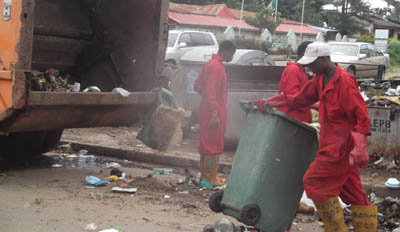
We often talk about unemployment in abstract numbers. But here, the numbers had faces. In Abuja alone, there are over 10,000 informal waste workers. That is not a fringe group, that is a workforce. Yet they remain largely criminalised, stigmatised, and excluded from formal planning.
During the first panel discussion on lived realities of informal waste workers, an informal waste worker, Mr. Hamisu Jamiu, described his daily experience. He has worked in the sector for over 10 years. He spoke about harassment by security personnel, lack of protective equipment, and the absence of any formal identification that could help people recognise him as someone providing a public service, not committing a crime.
Still, he was clear about one thing. This work feeds his family. It puts food on the table. It keeps life moving. Listening to him, I realised how often policy conversations erase dignity. We debate systems but forget the cost of exclusion on real bodies.
Other panelists reinforced this point from different angles. Representatives from the recycling sector acknowledged their reliance on informal waste workers. Government officials spoke about the need for organisation, structure, and professionalism, while also recognising that current systems are fragmented and weak. Everyone, in one way or another, admitted the same truth. The system already depends on informal labour. Pretending otherwise only makes it more fragile.
One comment from the participants stayed with me. She suggested leadership and capacity-building training for informal waste workers. Not just skills training, but advocacy, organisation, and cooperative development. The idea was simple. When people are better structured, they do not have to wait to be included. They can claim space, negotiate partnerships, and respond to opportunities on their own terms.
The second discussion, which focused on policy and practice integrating the informal sector, showed that inclusion is not theoretical. Private sector actors shared examples of programmes that work with women, youth, and informal waste workers. From supporting women to earn income through recycling, to projects that use waste as a form of currency to pay school fees for children and communities, the message was clear. When informal waste workers are supported, the benefits ripple outward.
What became obvious by the end of the event is this. Nigeria’s waste system is not broken because informal workers exist. It struggles because they are excluded from protection, planning, and investment. Informal waste workers already collect, sort, and recover materials at a scale the formal system cannot match. They reach communities others do not. They keep recyclables circulating. They hold the circular economy together, quietly. The real failure is governance that refuses to recognise what is already working.
As I left the exhibition, I kept thinking about how often we chase “innovative solutions” while ignoring the people who have been solving the problem all along. Inclusion, in this context, is not charity. It is practicality. Recognition, protection, and partnership are not radical demands. They are the minimum required for a waste system that is fair, efficient, and human.
This exhibition did not just capture realities. It asked an uncomfortable question.
If informal waste workers disappeared tomorrow, what would Abuja and Nigeria in general look like?
I think we already know the answer.
By Chibundum Chioma Udeh, Project Officer, Saabi Finding Impact Consulting