

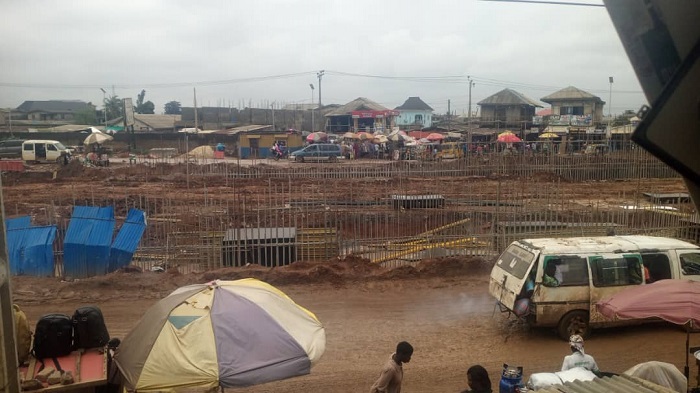
Since late 2023, the ongoing bridge construction on Idiroko Road, the only route linking Sango-Ota, Oju-Ore, and Atan in Ogun State has forced trailers, buses, kekes, and pedestrians to squeeze through a single narrow lane, risking their lives every day just to move. The project has turned the road into a constant scene of struggle, where traffic, mud, and fear now define daily life.
Whenever it rains, the untarred, rough road, worsened by the bridge construction, turns muddy and flooded with stagnant water trapped in deep potholes. The congestion becomes unbearable as vehicles and pedestrians compete for limited space, turning movement into a slow, chaotic ordeal especially during rush hours.
During the harmattan season, dust fills the air and settles in people’s lungs. What was meant to make life easier has instead become a daily struggle for residents and traders.
‘This Road Has Been Very Problematic’
“This road has been very problematic. People are facing a lot of hell plying it every day,” said Prince Adefolarin Adeniyi Ojugbele, President of the Ota Youth Assembly.
He explained that more than five shop owners he knows have closed down because customers can no longer reach them.
“The road is adding difficulty to people’s survival. Transportation isn’t easy either. Even those walking on foot are not finding it funny. The road sucks,” he added.
A Project That Feels Endless
According to Prince Ojugbele, the bridge construction, handled by Lafaneo Construction Company, is a federal project expected to last from 2024 to December 2026.
Although the work has recently picked up, he said it started slowly and without proper planning, which caused serious hardship.
“We’ve written several letters to the construction company and the government to help us find an alternative road, but we got no response,” he said.
Ojugbele explained that, since assuming office as youth assembly president, he and his team have personally visited the construction site several times and written multiple letters to both the company and government officials, appealing for the inclusion of community youths in the process and for an alternative route to ease movement.
“We’ve tried our best to help out, but we’re not getting any response,” he said. “We’re not trying to fight them; we just want to be carried along so that we can all make progress together.”
He also said the youths have deliberately chosen not to protest, despite the hardship, for fear that it could be hijacked and turn violent. “You know how protests in Nigeria can easily get out of hand,” he said. “I just want a peaceful tenure, and I believe dialogue will bring results if they listen to us.”
He added that the company and government should have worked on flood control before starting the bridge. “Flood and erosion are worsening the situation, but nobody is doing anything,” he explained.
Businesses on the Brink
For Tajudeen, a meat seller, business has dropped badly. “Since our spaces were turned into parks because of this bridge construction and filled with vehicles, our tables are now behind the motors. You won’t see us unless you search well, and not all customers have that patience to start searching for you,” he said.
What used to sell out in a day now takes two. “If the road continues like this next rainy season, we’ll suffer more,” he added.
Traders in Fear
For Madam Stella, a pregnant cloth seller, passing the road daily feels like a risk. “Trailers, okadas, kekes and everyone passes the same road. When I’m on a bike and a trailer comes behind, I just keep praying. It’s scary knowing that an accident can happen anytime,” she said.
She now stays home most days. “My belly aches because of the road stress. One day, I saw another pregnant woman fall into the gutter. It’s scary, and it’s adding to my mental health stress,” she added.
Transport Operators Struggling To Survive
Agunbiade, a former trader, said he became an okada rider after his kiosk was demolished to make way for the bridge.
“The construction workers don’t wear helmets; they are slow and don’t have proper tools. It doesn’t look like they’ll finish this year. If another rainy season meets us like this, it will be disastrous,” he said.
He added that transport fares have increased and that during harmattan, the dust makes it hard to breathe. “We thank the government for the bridge project, but if it harms us before it helps us, how will we enjoy it?” he asked.
It’s Easier When You Include the Community
Ojugbele said the community is ready to support the project but has been left out. “They didn’t involve us the youths who know the road. They brought outsiders who only want to benefit personally,” he said.
He also believes part of the problem comes from residents’ behavior. “Drivers drive carelessly, traders sell on the road, and people dump waste in gutters all these make things worse,” he said.
He noted that market women often display their goods right beside the road, making it harder for vehicles to pass, while commercial drivers compete impatiently for space on the narrow lane.
“Some people even pour dirt directly on the road, blocking drainages and increasing the risk of flooding,” he said. “Everyone needs to be disciplined, the government, the company, and the people because the carelessness of one group affects us all.”
“And when you try to enforce orderliness in this people so they can do what is right, they will say you’re not having mercy on them and that government is already making their lives hard, you as their rep should pity them and not make it harder.”
He added that the youths have reached out to the Minister of Works and other leaders from the Ado-Odo Ota Federal Constituency, calling for an alternative road and quicker progress.
Hope amid Pain
For now, residents just want the suffering to end, and for Lafaneo Construction Company and the government to speed up the work and provide temporary solutions before the next rainy season.
“You pass that road and your body starts aching,” Ojugbele said. “We’ll keep pushing until something changes. We can’t keep suffering like this till 2026.”
Related Data
According to a 2021 study by environmental scientists, the Sango-Ota intersection records one of the highest air-pollution levels in Southwest Nigeria, with PM₂.₅ concentrations reaching up to 370 µg/m³ – far above the World Health Organisation’s safe limit.
By Oyeyemi Abolade