

An Ahmadu Bello University (ABU) Zaria undergraduate, Joshua Christopher, said hardship pushed him into charcoal production, which has now become his main source of livelihood while pursuing his degree.
Christopher, who spoke to newsmen during a field visit to Idon Haya in Kajuru Local Government Area (LGA) of Kaduna State on Thursday, October 23, 2025, explained that he ventured into the business to sustain himself both in school and at home, in spite being aware of its environmental impact.
“I am an undergraduate student, currently running my degree programme in Chemistry at ABU Zaria, and this is what I do to sustain myself both at home and in school,” he said.
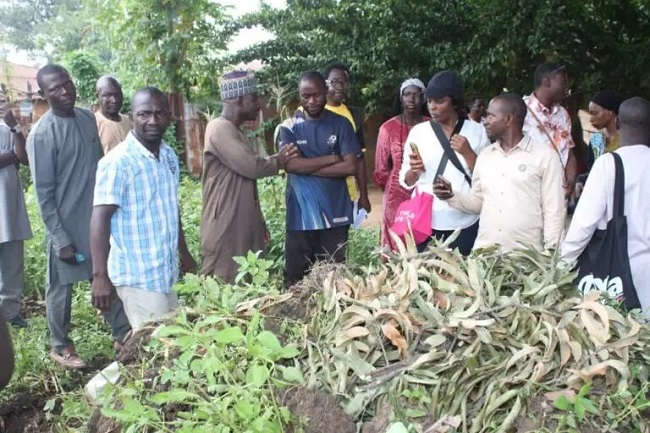
Christopher explained that charcoal production begins with cutting down trees and dividing them into logs, which are then neatly arranged, covered with soil, and burned under controlled heat.
According to him, the process can take between one and four days depending on the moisture level of the wood, and a single round of production can yield up to six bags of charcoal.
He acknowledged that deforestation was harmful to the environment but noted that economic hardship has forced many young people into the business.
“If you must deforest, then you must afforest, meaning if you cut one tree, you should plant two or three to replace it,” Christopher said.
Similarly, a 25-year-old charcoal dealer, Frank Bala, said he has been in the business for three years, describing it as moderately profitable.
Bala, who operates in Idon community, Kajuru LGA, explained that producers in the bush transport the charcoal to dealers, who then sell to retailers.
“On good days, we sell up to 50 bags, though the number varies depending on the season.
“Charcoal is cheaper during the dry season and more expensive during the rainy season because it becomes scarce,” he said.
He added that there were more than 50 charcoal dealers operating in the area, though the number fluctuates with demand.
Bala, a graduate of Agriculture, said he was aware of the negative impact of deforestation but stressed that the business provides an alternative source of income for many unemployed youths.
“I know the effects of tree cutting and deforestation, but sometimes, you have to work with what is available in your locality.
“This is better than venturing into crimes,” he said.
Bala said the security situation in Idon was relatively calm, making it easier for them to operate, though forest guards occasionally visit.
“Sometimes they come around, but we always cooperate with them and settle issues peacefully whenever necessary,” he added.
Bala appealed to the government and development partners to create alternative livelihood opportunities for young people engaged in the charcoal trade, saying such initiatives would help reduce deforestation while sustaining their income.
Meanwhile, the Kaduna State Ministry of Environment and Natural Resources has intensified operations to protect forest reserves across the state, deploying forest guards and collaborating with security agencies to tackle illegal logging and charcoal production.
The Assistant Director of Forest Resources in the ministry, Mr. Godwin Michael, said during a spot check in Kajuru that the government remained resolute in enforcing the ban on forest exploitation and promoting sustainable management of forest resources.
Michael recalled that, in 2015, the then Governor declared a state of emergency on forestry after discovering that Kaduna’s forest cover had fallen below 15 per cent, far below the internationally recommended minimum of 25 per cent.
He explained that the Keep Kaduna Green (KKG) Tree Planting Project, launched in 2016, saw over four million trees planted across the state between 2016 and 2019, but insecurity and the COVID-19 pandemic slowed progress.
“Our forest guards are handicapped because they are not armed, and most of these illegal operators come at night to cut down trees,” Michael said.
He added that the ministry has set up checkpoints in collaboration with the police to ensure compliance.
“Anyone caught with forest produce without proper documentation is arrested.
“The goods are confiscated and auctioned, and the proceeds are paid directly into the state government coffers,” he stated.
Michael further disclosed that most of the charcoal and timber entering Kaduna originate from neighbouring states such as Nasarawa, Niger, and Kogi.
“About 90 per cent of the charcoal coming into Kaduna is not from within the state,” he added.
Mr. Zakariya Naye, Divisional Forestry Officer for Kajuru LGA, identified lack of logistics and equipment as major challenges facing forest guards.
“Our major problems are lack of mobility and lack of arms.
“Without vehicles or protection, it is difficult to enter the forests and stop illegal activities,”he said.
Naye urged the government to provide the necessary support.
The field trip visit was organised by Bridge That Gap Hope for Africa Initiative (BTG), under the Women Empowerment and Climate Resilience Initiative (WECRI).
It is being implemented as part of the Partnership for Agile Governance and Climate Engagement (PACE) programme, funded by the UK International Development.
The programme focuses on building sustainable communities and enhancing climate resilience among vulnerable populations in Kaduna State.
The field trip visit and spot check were the culmination of a three-day workshop on ‘Strengthening Journalism and Reporting on Climate-related Issues’.
During the workshop, environmental experts, including Dr Joseph Onoja, the Director-General of the Nigeria Conservation Foundation (NCF), warned that deforestation contributes about 10 per cent of global greenhouse gas emissions and urged journalists to intensify climate reporting.
Similarly, Jonah Birga, an Environmental Data Analyst, presented local case studies and deforestation data for Kaduna.
He revealed that Nigeria loses approximately 350,000 to 400,000 hectares of forest annually, where urban areas, driven by high demand for charcoal, were the major contributors to the problem.
Also, Mr. Michael Simire, Publisher and Editor-in-chief of EnviroNews Nigeria, emphasided that ethical journalism recognised no “two sides” to the proven science of human-caused climate change.
He urged journalists to prioritise scientific consensus and expose misinformation, denial, and greenwashing that obstruct climate action.
He also highlighted strategies for safe and effective climate reporting, urging journalists to use FOI laws, secure tools, and inclusive storytelling.
The Executive Director of BTG, Ms. Gloria Bulus, said the organisation focuses on governance, climate change, and livelihood interventions, with strong commitment to achieving the Sustainable Development Goals (SDGs) by 2030.
Bulus explained that BTG prioritises SDG 13 on climate action, undertaking initiatives such as journalist training to enhance environmental reporting and advocacy, while also conducting community engagements to understand local environmental challenges.
She added that the organisation empowers rural women through livelihood support, pre-planting awareness campaigns, and school programmes.
Bulus emphasised that the efforts aligned with poverty reduction and the broader goals of sustainable governance and climate resilience.
By Sani Idris Abdulrahman