

For centuries, bird migration has awed humanity. Every year, millions of birds travel thousands of kilometres, transversing continents in search of feeding, breeding and resting grounds. During these sojourns, these birds provide critical ecosystem services including pollination, and pests control. Additionally, through birdwatching birds contribute billions of dollars to the tourism sector in many countries around the world. Every year, the world celebrates World Migratory Bird Day (WMBD) in May and October, to raise awareness about birds and the plight they face while migrating along routes known as flyways.
Africa is home to a number of flyways, including the East Atlantic Flyway (EAF) which extends from the Arctic, down the western flanks of Europe, and reaching the southern tip of the African Atlantic coastline, spanning 49 countries. Along the EAF, are key sites which support a large number of migratory waterbirds including the Banc d’Arguin National Park in Mauritania, Bijagós Archipelago in Guinea-Bissau – recently added to the UNESCO World Heritage Site, in addition to the Saloum Delta and Djoudj National Parks in Senegal. Together, these sites host almost three million migratory birds, underlining their importance.
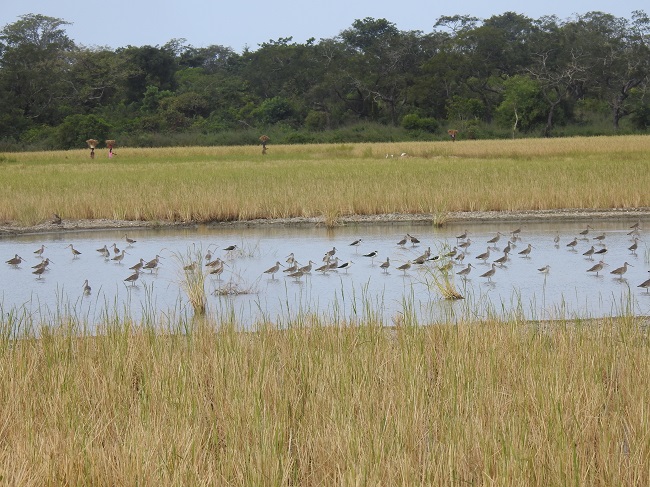
However migratory bird numbers are plummeting in the EAF, driven by various threats including deforestation, infrastructure development, industrial agriculture, overfishing and climate change among others. Further, critical sites including wetlands, grasslands and forests which host key populations of migratory bird species are disappearing at an alarming rate.
To address this challenge, BirdLife and Partners established the East Atlantic Flyways Initiative (EAFI) in 2015. EAFI focuses on improving conservation efforts and strengthening capacity of conservation partners through a local to global conservation approach along the flyway. In Senegal, Mauritania and Guinea- Bissau, EAFI partners are leading on the conservation of the Black-tailed Godwit, classified as Near Threatened on the IUCN Red List.
In Senegal’s 273 ha Tocc Tocc Community Nature Reserve, and 17,000 ha Lac de Guiers, both critical sites for migratory birds, EAFI support has enabled protection of critical sites for migratory birds, while improving livelihoods for local communities. In Guinea Bissau’s 119,700 ha Rio Mansôa and Gêba estuary, more than 3600 people have benefitted from capacity building on biodiversity management.
In addition, BirdLife and partners are involved in the International Climate Initiative (IKI) funded Climate-Resilient East Atlantic Flyway’ (CREAF) programme which aims at protecting critical wetlands sites for birds and peoplewhile empowering local communities along the flyway.Additionally, there is need for concerted efforts from various stakeholders including local communities, policy, and decision makers to identify and implement relevant solutions to conserve these critical habitats along the EAF.
Migratory birds connect communities, and landscapes across borders. As we celebrate migratory birds, let us renew our commitment to protect these majestic creatures for posterity.
By Geoffroy Citegeste, East Atlantic Flyways Initiative (EAFI) Manager at BirdLife International; email: geoffroy.citegetse@birdlife.org