

Twenty young Nigerian changemakers from over five states across Nigeria have come together to set a bold agenda on how Africa narrates its current impact and climate future.
Their gathering, which was at the instance of an event organised by the Human and Environmental Development Agenda (HEDA Resource Centre), in Lagos, was superintendent by seven facilitators spanning television, online media, food and waste advocacy, all aimed at equipping participants with tools to connect climate science with storytelling that resonates across communities.
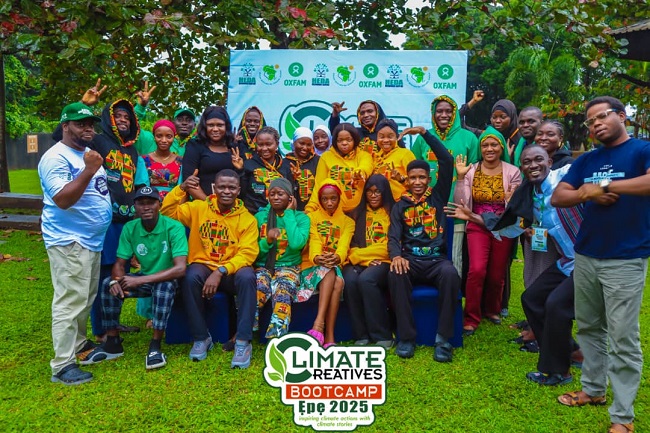
Its theme, “Creatives Climate Bootcamp, Epe 2025,” focuses on how to address some of Africa’s most pressing environmental challenges such as climate security, food waste and production, and the role of geo-spatial technology in advancing climate adaptation and mitigation.
“We are not just training young leaders, we are empowering the next generation of climate communicators who will change the way Africa sees and responds to climate change” said Mr. Sulaimon Arigbabu, HEDA executive secretary.
The bootcamp blended technical knowledge with creative practice, linking science with art to amplify urgent messages. Food and waste champions demonstrated sustainable alternatives to reduce losses in agricultural value chains, while media professionals such as Mayowa Adebote mentored participants on how to frame narratives that can influence policy and shift public perception.
The programme also featured a pitch session with award-winning film director, Tigerfire Rose, award-winning photographer Mayowa Adebote, and Dr. Olaide, who served as judges, with the air quality group coming first and food waste to compost group being the runner-up.
For many of the participants, the experience was transformative. “I came here thinking climate change was about distant policies. Now, I see how data, media, and creativity can bring it closer to home for Nigerians,” one attendee stated.
While speaking to EnviroNews, Rachel Ramson, a journalist with Silverbird said that through the HEDA climate creatives bootcamp, she has learned how to report on climate change in a way that respects scientific consensus while also exploring economic, cultural, and political complexities.
“Rather than pushing a single narrative, I now focus on elevating underreported voices, presenting competing perspectives clearly, and highlighting solutions alongside challenges. Ultimately, the training reinforced that journalism plays a key role in climate action – not by taking sides, but by shining light on facts, context, and consequences, allowing the public and policymakers to make more informed decisions,” she said.
On winning the pitch, one of the team members, Kikelomo Lawal, said in a community of 100 people, air quality is spoken rarely and according to World Health Organisation (WHO), globally 99% people are affected by unhealthy air. For her and her team, this triggered the need to design a solution that can combat air pollution, mitigate emissions in cities, and enhance quality air flow for young people.
“We are excited to win because we are passionate about air quality; it’s our field, we live and breathe in it. We integrated mobile sensor in our project when compared to fixed sensors that covers about 2 kilometres,” Lawal hinted.
As Africa battles the twin pressures of climate insecurity and external emissions, initiatives like this underscore the role of youth in driving climate discourse. With Nigeria’s vast population of under-30s, the potential for grassroots-led storytelling to influence adaptation and resilience strategies is enormous.
The HEDA Resource Centre says this bootcamp is only the beginning. Plans are underway to expand the pitch innovations of young climate narrators across more states by equipping them with the tools not only to tell Africa’s climate stories but to shape the solutions for continental impact.
By Nsikak Emmanuel Ekere