

Environment stakeholders have called for stronger collaboration, policy enforcement and public participation to improve waste management in Lagos State.
The call was made at the 2026 Forum of the Property and Environment Writers Association of Nigeria (PEWAN) on Wednesday, March 18, in Lagos.
In her welcome address, PEWAN Chairman, Mrs. Okwy Iroegbu-Chikezie, stressed the need for improved funding, effective monitoring and community participation in waste reduction efforts.
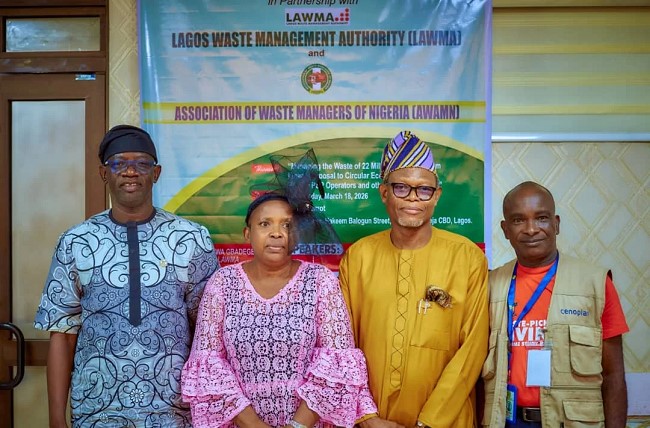
Iroegbu-Chikezie emphasised that partnerships with the private sector and local communities were critical to improving waste management outcomes and enhancing quality of life.
The Managing Director of the Lagos Waste Management Authority (LAWMA), Dr Muyiwa Gbadegesin, said managing waste requires shared responsibility among government, operators and residents.
Gbadegesin, represented by the Executive Director, Finance, Mr. Kunle Adebiyi, described waste management as critical to public health, environmental sustainability and flood control.
He said over 450 Private Sector Participant (PSP) operators handle household waste collection across the state under LAWMA’s regulatory framework.
According to him, indiscriminate dumping and patronage of illegal cart pushers undermine waste management efforts and contribute to flooding.
He added that Lagos was promoting waste sorting, recycling and resource recovery to improve efficiency and create economic value.
Also speaking, Dr Olugbenga Adebola, the President of the Association of Waste Managers of Nigeria (AWAMN), stressed the need for sustained collaboration among stakeholders.
Adebola described waste management as a collective responsibility, noting that effective waste handling was directly linked to public health and environmental safety.
He explained that poor waste management contributes to diseases such as malaria, cholera and lassa fever through blocked drainage, pest infestation and environmental pollution.
Adebola warned that open burning of waste releases toxic and carcinogenic substances, posing serious health risks, including respiratory illnesses and cancer.
He also highlighted the dangers of plastic waste, noting that mismanaged plastics break down into microplastics that contaminate water bodies and enter the food chain.
Adebola said Lagos generates over 20,000 metric tonnes of waste daily, driven by rapid urbanisation and population growth.
He identified key challenges as inadequate infrastructure, weak policy implementation, poor waste segregation and limited funding.
According to him, inefficient landfill systems and lack of functional material recovery facilities further limit effective waste processing.
He called for increased investment in waste infrastructure, including modern recycling systems and material recovery facilities.
Adebola also advocated the formalisation of informal waste collectors to improve efficiency and inclusiveness in the waste management value chain.
He urged government to provide enabling policies and long-term financing to attract private sector participation in the industry.
He stressed the need for consistent policy implementation and public education to promote responsible waste disposal practices.
The stakeholders expressed optimism that outcomes from the forum would support efforts to achieve a cleaner and more sustainable Lagos.
They also urged continuous engagement among key actors to address environmental challenges in the state.
By Fabian Ekeruche