

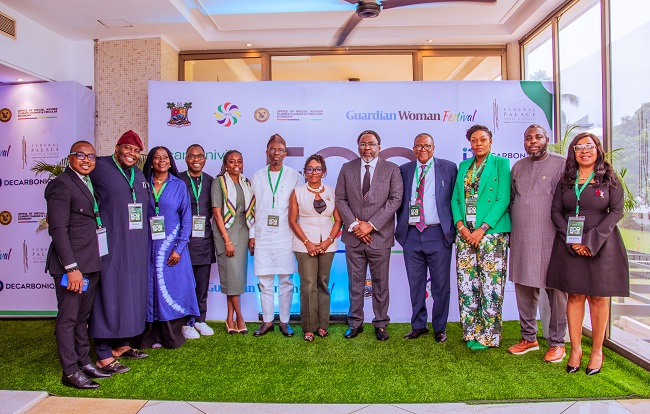
Sustainability professionals, industry leaders and private sector stakeholders gathered in Lagos on Tuesday, March 24, 2026, in an attempt to unlock the financial value of climate and circular economy actions within the industry.
At EcoNexus 3.0, convened courtesy of the Office of the Special Adviser to the Governor on Climate Change and Circular Economy (OCCE), Lagos State, industry actors explored practical approaches to climate accountability and circular economy opportunities. The forum was themed “Beyond Compliance: Monetising Climate and Circular Actions for Industries.”
Mrs. Titilayo Oshodi, Special Adviser on Climate Change & Circular Economy, in a welcome address, described this as being about moving from effort to evidence, evidence to verification, and verification to financial value.

“Because when done right, climate action is not a cost centre, it is a revenue stream, a balance sheet asset, and a driver of long-term resilience,” she stated, adding that, across sectors, organisations are already embedding sustainability into their operations.
Oshodi listed organisations like Lafarge Africa, Dangote Group, Oando Clean Energy Limited, Nestlé Nigeria, Seven-Up Bottling Company, MTN Nigeria, PAKAM Technology, Impact Investors Foundation, Access Bank and Keystone Bank as active sector players.
According to her, they are converting plastics, industrial by-products, and agricultural waste into alternative fuels; advancing biodegradable solutions by transforming organic and sachet waste into compostable materials and bioenergy; driving plastic recovery, recycling initiatives, and more sustainable packaging systems; optimising energy use across infrastructure and integrating sustainability into large-scale operations; digitising waste collection systems, improving traceability, and strengthening material recovery value chains; mobilising capital toward sustainable enterprises; and, financing green projects, enabling access to green finance, supporting sustainable lending frameworks, and creating pathways for businesses to scale verified climate solutions.
But she emphasised that some of these initiatives have remained invincible, unverified and unmonnetised, adding: “That is the gap that we are here to close.”
“How do we measure this impact accurately, verify it credibly, and convert it into real economic value? This is where digital Measurement, Reporting, and Verification – MRV becomes critical.
“All these initiatives, whether it is converting industrial waste into fuel, recovering plastics, digitising recycling systems, optimising energy use, or financing green projects, reach their full potential only when they are digitally captured, monitored, and reported within a structured MRV framework.”
Accurate measurement, according to her, ensures that every tonne of waste recovered, every unit of energy saved, and every emission reduced is properly quantified, giving organisations real visibility into their impact and performance.
Credible verification, she added, entails structuring data in a way that meets global standards such as the GHG Protocol, IFRS S2, and TCFD, making sustainability efforts auditable, transparent, and globally recognised.
Creates tangible value, Oshodi disclosed, involves turning verified results into carbon credits, circular economy credits, or performance-based incentives.
“For example, Lafarge Africa monetises emission reductions from alternative fuel usage, Oando Clean Energy generates verified credits from biodegradable waste conversions, and Nestlé Nigeria monetises recovered plastics. Through this approach, sustainability stops being just compliance; it becomes a measurable, verifiable, and monetisable strategic asset,” she stressed.
She described EcoNexus 3.0 as a platform for transformation.
“It is an opportunity to unlock real value and drive change within organisations. The future belongs to organisations that measure with precision, verify with integrity, and monetise with confidence,” Oshodi emphasised.
Mr Abiola Oshunniyi, Global Development Tri-Sector Strategist, in a presentation on “ESG Frameworks & Corporate Sustainability Performance”, stressed that ESG value is not created in reports, but, rather, created when data, decisions, and systems align across sectors.
ESG, according to him, is the cost of staying in business, and monetising it is the competitive advantage.
“Nigeria possesses a unique opportunity: not to catch up to legacy global compliance models, but to leapfrog directly into a performance-driven ESG economy,” Oshunniyi said, adding that, in the next decade, ESG will be the cost of staying in business.
“The real advantage will belong to those who integrate it, measure it, and monetise it,” he added.
Dr Adebola Odunsi, Chief Executive Officer, Carbonivity Limited, in a presentation titled “Beyond Compliance: Monetising Climate & Circular Actions for Industry”, lamented that organisaions are already executing interventions like waste recovery, energy efficiency, sustainability reporting and supply chain optimisation, but are not translating them into carbon assets, climate finance and foreign exchange revenue.
He stated that carbon is now traded like oil ($/barrel), cocoa ($/tonne) and metals ($/ounce), adding that carbon credits are tradable, measurable, certifiable and revenue-generating.
“Carbon can be held, sold, forward-contracted and securitised. Carbon is no longer external to business – it is a financial asset class,” disclosed Odunsi.
He described Climate change as a carbon management problem, as carbon – existing naturally in the atmosphere as Carbon dioxide (CO₂), Methane (CH₄) and Nitrous oxide (N₂O) – traps heat and causes global warming.
Funke Shobanjo, Chief Operating Officer, FBNQuest Merchant Bank, is of the view that sustainability has moved: from compliance to capital allocation, from reporting to revenue potential, and from participation to value capture.
According to her value is not being captured because it is neither structured, measured, nor monetised.
“If it is not structured, it is not monetisable,” she added, pointing out that structure is what makes activity investable, as it converts effort into value.
“Funders do not finance intention. They finance structure,” Shobanjo emphsised.
She advised financial institutions to fund aggregated pipelines, use ESG data in credit assessment, and develop blended finance structures
She asked government to standardise ESG reporting frameworks, de-risk green investments, and enable policy clarity.
Shobanjo urged development partners to support pipeline development, provide technical assistance, and co-invest to unlock scale.
According to her, women are already active across sectors and value chains, often active at execution level, but not at value capture level.
“Compliance is the minimum. Value capture is the opportunity,” she summarised.