

There is no doubt that the Ecocykle Development Foundation’s (EDF) N300,000 cash prizes awarded to the winners of its 2025 Climate Edutainment (ClimEd) competition will go a long way towards encouraging innovative strategies, environmental education, and climate-friendly practices among Nigerian teenagers
The school where the project was executed, Primark International Academy (PIA), and the recipients of the funds pledged to use them to support a range of sustainability initiatives, with a focus on solving the problem of inappropriate waste management and disposal within their school premises.
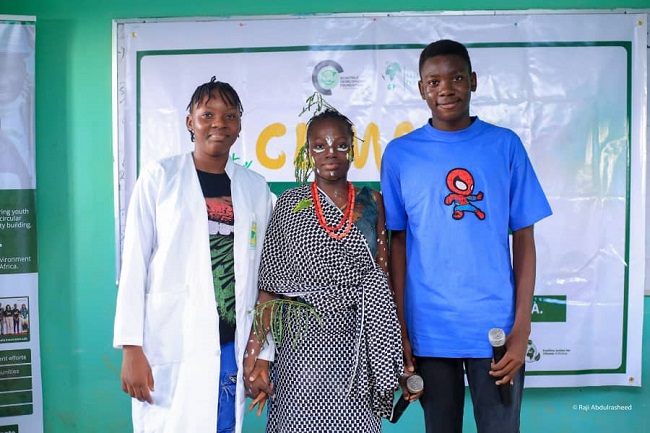
Sir Oko Agaji, the pioneering principal, in his remarks at the grand finale that took place on Friday, October 3, 2025, in Abuja, thanked the initiators for finding PIA among all the schools around worthy of carrying out such a life-changing programme.
“Really, I feel excited, very excited, and privileged,” he said, because climate change is a serious global issue that is having an impact on animals, agriculture, and peaceful human existence in general.
He cited the highly heated atmosphere that was filled with loud noises to draw attention to the emotions of the students and members of the management team, as well as external guests who were all invited to be part of the occasion.
The gesture, he went on to explain, clearly reveals that they were prepared to take advantage of the opportunity offered by the scheme to improve environmental education and fight the climate crisis by fixing some inefficiencies in the school, particularly in the laboratories.
Vehemently, the principal believes and recommends that the government and private sectors work together because the issue at hand directly impacts everyone, causing erosion and posing new ecological threats, as he has witnessed in his own school system.
“If we can partner and make sure we can fight this cause together, it is going to be something that is rewarding,” he said, in response to a question about how the project can be sustained and expanded to benefit more people.
Following the announcement of his group as the overall winner of the competition, the senior prefect of the school, Coban Nathaniel, told EnviroNews in an interview that the programme has been very wonderful and that he finds it to be very educative and inspirational.
“I have been made to change my thinking on certain things about how I treat my trash and environment,” he hinted, underscoring the gains of his newly acquired knowledge not just as a climate solution, but also as a tool for biodiversity preservation.
He promised that going forward, he will be working with other students to educate more people and raise awareness on climate change and how they can cope with it. Nathaniel also pledged to reach out to his friends and encourage them to do the same to make a difference because he feels that by working together, they are stronger.
When asked what he thought other young people like himself could do to provide real answers to the climate crisis, he advised them to practise afforestation and agro-ecology, as well as spread more information about climate change and its effects on everybody.
He hoped that everyone would follow the programme and understand that the earth is theirs to care for. “We should not abuse it, and we should attempt to ensure that while we take from it, we also give back to it, and that is all I have to say.”
Impact and processes
Exploiting a sensitisation workshop, the Plan Learn and Act Now (PLAN) game, poetry, and music, this project shows how creative art can be used to teach school pupils basic climate science and simple available solutions they can deploy to solve the problem.
The exercise had six groups that competed for the award and five judges, including Elsie Imaikop, a representative from the Federal Ministry of Environment, who oversaw the proceedings and announced the winners.
In their comments on the outcome of the engagement, the panel members praised the participants for their efforts in identifying some of the causes of climate change and urged them to consider how to develop real-life solutions because the crisis at hand requires immediate and tangible action.
Students were evaluated based on their ability to frame the challenge, as well as their ingenuity and innovation. Others were founded on the quality and manner of presentation, teamwork, and the scalability and sustainability of the solution under consideration.
Group two finished first and received a staggering sum of N150,000, scoring 91.8%. Group three was the second winner, with a total score of 80.2% and a sum of N100,000, while group five came in third with a score of 76.4% and N50,000. The purpose of these grants is to enable each of them to develop environmentally friendly programmes both inside and outside of the school.
Diverse views, but shared goal
As Sophie Chika, the project officer for Young Professionals in Policy and Development (YouPad) and one of the judges, noted, “The most important thing I noticed is not just identifying a problem, but also offering a solution to it, because the problem at hand is not just mere talk, but one that requires a sustainable answer.”
Although Chika is advocating for more concrete measures to combat the monster, Imaikop believes that identifying the issue is also a crucial component of climate education, which inspired and laid the foundation for the implementation of the entire project.
But like the school’s principal, they both applauded the organiser for putting together the event, highlighting how important the competition is to assisting the youth in formulating ideas and promoting climate action.
“I really enjoyed and saw myself in all of you,” Imaikop, who works with the Department of Climate Change (DCC) under the ministry, testified, because even though the students were unable to provide immediate solutions to the tasks assigned to them, they all communicated climate change – “that is the main reason why we are here.”
Way forward
For the initiators of the project and her supporter, Green Protocol, their message is simply to raise a generation of young climate champions who will become knowledgeable about climate and environmental challenges and creatively campaign for change in their communities.
Pelumi Omowaye Emmanuel, EDF’s head of communication, asserts that the government must be heavily involved and provide the necessary resources to help extend the project to other young people who live in communities and attend schools outside of the nation’s capital.
In conclusion, reflecting on the principal of PIA’s call for government-private sector collaboration, the senior prefect’s appeal for environmental protection, and the government’s promise to work with stakeholders to promote the idea, one question remained unanswered: how to coordinate all of these pledges and translate all of the expectations into real-life actions.
EDF has shown us the way to go; it is now time for state and non-state actors to join them and ensure that this noble and nascent vision is sustained for the good of both current and future generations of Nigerians.
By Etta Michael Bisong, Abuja