

A new assessment of African Forest Elephants reveals an estimated 135,690 individuals, with an additional 7,728 to 10,990 elephants based on more tentative “guesses”. Updated methods provide a clearer, more accurate understanding of the species’ status – revising population figures by an additional 16%, compared to figures published in 2016.
Thanks to significant advances in DNA-based survey techniques and expanded monitoring across the species’ range, 94% of all counted African Forest Elephants are now based on scientifically robust estimates, compared to just 53% in 2016.
Nevertheless, African Forest Elephants remain Critically Endangered on the IUCN Red List of Threatened Species and are under continued threat from poaching and habitat destruction.
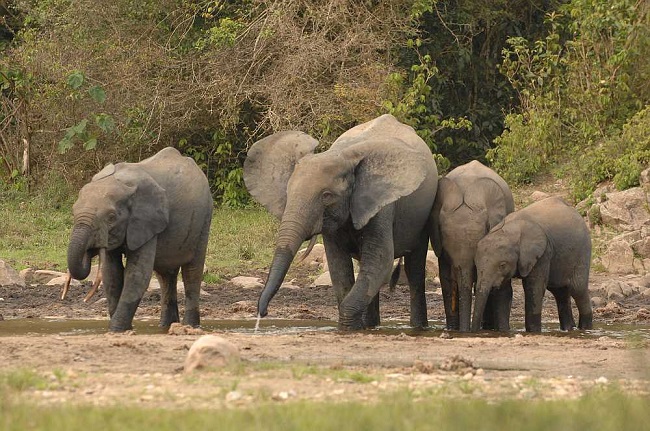
“This report provides the most accurate picture of elusive African forest elephant populations to date. It shows us that conservation action is working for these iconic animals, which are crucial forest ‘gardeners’, essential for tree seed dispersal. With this new data, we have an unprecedented opportunity to focus conservation efforts where they are needed most and give the species a real chance to recover,” said Dr Grethel Aguilar, IUCN Director General.
These findings come from the African Forest Elephant Status Report 2024, published by the IUCN African Elephant Specialist Group (AfESG) of the IUCN Species Survival Commission (SSC) and released at the 20th meeting of the Conference of the Parties to the Convention on International Trade in Endangered Species of Wild Fauna and Flora (CITES Cop20), in Samarkand, Uzbekistan.
This is the first time African Forest Elephants (Loxodonta cyclotis) have been assessed independently from African Savanna Elephants (Loxodonta africana), following their recognition as distinct species in 2021.
“This report provides new clarity on African Forest Elephant numbers, but forest elephant populations continue to decline in several key landscapes. We need strengthened anti-poaching measures, better land-use planning for habitat connectivity, and sustained international support to translate the cautious hope provided by this report into long-term recovery for one of the world’s most threatened elephant species,” said Dr Benson Okita-Ouma, Co-Chair of the IUCN SSC African Elephant Specialist Group.
“The updated numbers of African Forest Elephants should not be interpreted as population growth, but rather as the result of improved survey coverage made possible by DNA-based methods. These techniques have significantly reduced uncertainty in detection estimates and enabled us to assess areas that were previously inaccessible,” said Prof Rob Slotow, Co-Chair of the IUCN SSC African Elephant Specialist Group.
Improved survey methods reveal a more accurate picture
African Forest Elephants are notoriously difficult to count due to dense rainforest cover. As such, reports have been based on a combination of estimates and informed ‘guesses’.
Estimates come from areas that have been carefully surveyed, making them the most reliable counts. ‘Guesses’ – using local expertise, signs of habitation, counts that are of less stringent quality than estimates, etc. – are used where full surveys aren’t possible.
With this report, 94% of the total reported Forest Elephant population now comes from high-confidence estimates, compared to 53% in 2016.
The latest assessment incorporates DNA capture-recapture, a method that first identifies the unique genetic “fingerprints” of individual elephants from dung samples. By comparing initial “captures” with subsequent “recaptures”, scientists can calculate population size with far greater reliability. This was the method used in the recent nationwide survey of Gabon.
This survey was key in providing a more accurate estimate of the elephant population, revealing many more elephants than in 2016. Additional surveys, especially in northern Republic of Congo and Cabinda (Angola) added 600–700 elephants to the “new population” category.
Where Forest Elephants live, where they are declining, and threats
Central Africa, characterised by vast tracts of intact tropical forest and low human population density, remains the stronghold for forest elephants, holding just under 95% of the global population.
Gabon alone accounts for 66% of the global population, the Republic of the Congo (RoC) holds 19% and the remaining elephants in this region live across four other Central African countries. Of the remaining three regions, five percent are in West Africa and less than one per cent in East and Southern Africa.
Despite improved data, declines continue in some areas. Two key landscapes, Okapi Wildlife Reserve (DRC) and the W-Arly-Pendjari (WAP) complex (Burkina Faso), lost around 7,000 elephants combined.
Although poaching rates have fallen in many regions since 2018–2019, illegal killing for ivory remains a threat across Central and West Africa. Expanding mining operations, road and rail development, and large-scale agricultural projects, including palm oil, are fragmenting habitat and pushing elephants into shrinking forest areas.
According to the most recent IUCN Red List assessment, African Forest Elephants experienced a >86% decline over 31 years up to 2015, driven primarily by poaching and habitat loss. The species’ slow reproductive rate further hampers recovery.
Data opportunity for targeted protection efforts
The 2023 status report was funded primarily by Allen Family Philanthropies, with additional support from the European Union through the CITES Monitoring the Illegal Killing of Elephants (MIKE) Programme, as well as Save the Elephants, Wyss Academy for Nature, International Fund for Animal Welfare, WWF-US, WWF-International, and the US Fish and Wildlife Service African Elephant Conservation Fund.
“Accurate and up-to-date data are critical for understanding the status of African Forest Elephants and strengthening their protection. This report provides a bright spot about these critical species, while underscoring the importance of continuing to address threats to African Forest Elephant populations,” said Yuta Masuda, Director of Science, Allen Family Philanthropies.