

Nigeria has retained one of the lowest petrol prices globally despite recent increases driven by geopolitical tensions in the Middle East, with industry data pointing to the stabilising role of Dangote Petroleum Refinery & Petrochemicals in cushioning the domestic market.
According to GlobalPetrolPrices.com, petrol in Nigeria currently averages $0.88 (N1,191.39) per litre, significantly below the global average of $1.32 (N1,787.08) per litre, based on an exchange rate of N1,353.85 to the dollar. This places Nigeria among the more affordable fuel markets globally, even as international prices continue to rise.
Across key markets, petrol prices are notably higher, with the United States at $1.075 (N1,455.39), India at $1.095 (N1,482.47), and South Africa at $1.189 (N1,609.73) per litre. Prices rise further in advanced economies, including the United Kingdom at $1.874 (N2,537.11), France at $2.152 (N2,913.49), and Germany at $2.343 (N3,172.07), while Hong Kong records as high as $3.967 (N5,370.72) per litre.
Nigeria also compares favourably within the West African region, where petrol prices are higher in Togo at $1.192 (N1,613.79), Benin at $1.218 (N1,648.99), Ghana at $1.240 (N1,678.77) and Cameroon at $1.478 (N2,000.99) per litre.
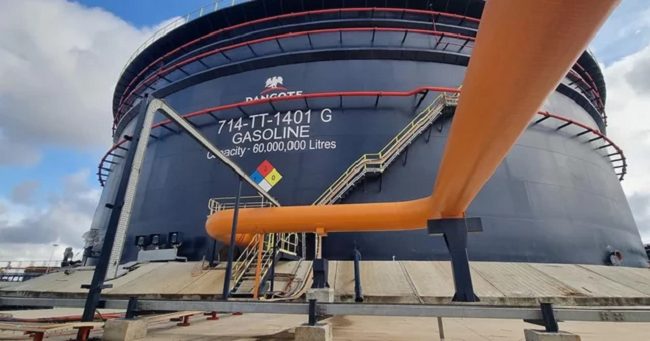
Analysts attribute this relative stability to the growing impact of Dangote Petroleum Refinery & Petrochemicals, which has helped moderate domestic price volatility by absorbing a significant portion of the global cost pressures while ensuring consistent product availability. This intervention has become particularly critical as many countries face supply disruptions, rationing and sharp price spikes following the escalation of tensions in the Middle East.
A key insight from the data is that very few countries globally sell petrol below $1 (N1,353.85) per litre without some form of state intervention.
According to GlobalPetrolPrices, most countries with pump prices under the $1 threshold operate fuel subsidies, price controls, or regulated pricing mechanisms to shield consumers from international market volatility. In contrast, Nigeria operates a fully deregulated downstream market following subsidy removal in 2023, meaning domestic prices are directly influenced by global crude movements and foreign exchange dynamics.
Despite Nigeria’s transition to a deregulated market following subsidy removal in 2023, Dangote refinery has continued to act as a buffer for the economy. While domestic petrol prices have risen by about 35 to 40 per cent since the onset of the crisis, this increase remains lower than in several other markets, with countries such as Cambodia and Vietnam recording hikes of over 67% and 49% respectively.
Industry observers note that without the scale and capacity of Dangote Refinery, Nigeria would have been far more exposed to global supply shocks, potentially resulting in higher pump prices, foreign exchange pressures and widespread product shortages. Instead, local refining has strengthened supply security, moderated price increases and reinforced Nigeria’s position as one of the more stable fuel markets globally at a time of global instability.