

Civil society organisations, government institutions, and media representatives have agreed to form a coalition to monitor and promote transparency in climate finance management across Nigeria.
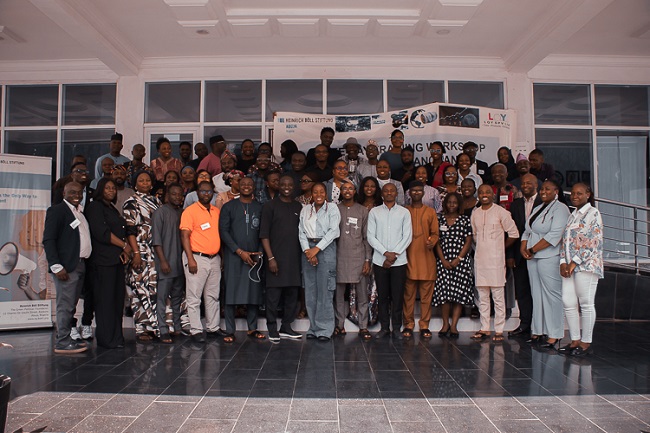
This was one of the major outcomes of a four-day capacity-building workshop on Climate Finance and Green Projects convened by Heinrich Bӧll Stiftung (hbs) Nigeria in collaboration with LQY SPV Ltd, and held in Abuja, from October 28 to 31, 2025.
The workshop brought together 67 participants from 44 organisations, including representatives of the Federal Ministry of Finance, Budget and National Planning, Federal Ministry of Environment, National Council on Climate Change (NCCC), Fiscal Responsibility Commission, Nigeria Governors Forum, civil society organisations, and journalists from leading media outlets.
Nigeria’s recently updated Nationally Determined Contribution (NDC 3.0) aims to cut emissions by up to 80% on a conditional basis requiring over USD 323 billion in climate financing. However, limited access to finance, weak institutional coordination, and poor data transparency continue to hinder progress.
The hbs Nigeria workshop sought to address these gaps by equipping both government and civil society actors with practical tools to design, manage, and monitor green projects while ensuring transparency, inclusion, and accountability.
Over the four days, participants explored key themes such as climate finance instruments, green bonds, project design, policy alignment, gender-responsive budgeting, and accountability frameworks. Facilitators drawn from policy, finance, and development sectors guided participants through exercises that simulated real-world scenarios of green project funding and oversight.
“This initiative bridges the gap between civic actors and public institutions in ensuring that climate finance truly delivers results for people and the planet,” said Mr. Obi Ugochukwu, Team Lead at LQY SPV Ltd.
One of the most significant outcomes of the training was the formation of a Coalition on Climate Finance Monitoring and Transparency, comprising civil society groups, journalists, and policy advocates.
The coalition will collaborate with government agencies to track climate finance flows, monitor green projects, and engage financial institutions such as the Central Bank of Nigeria (CBN) to enforce sustainability principles and prevent greenwashing in the private sector.
According to participants, the coalition will also play an important role in ensuring public disclosure of data on climate projects and improving coordination among ministries, departments, and agencies (MDAs).
Representatives of the Federal Ministry of Finance, Federal Ministry of Environment, NCCC, and the Fiscal Responsibility Commission commended hbs Nigeria for initiating the dialogue and pledged to support efforts toward institutionalising transparency and accountability in green financing.
At the subnational level, the Nigeria Governors Forum (NGF) announced plans to replicate the training in different states, mapping potential green projects and training subnational governments to develop and finance green projects, while encouraging CSOs participation in ensuring sustainable and accountable implementation processes.
Meanwhile, media representatives committed to working with the coalition and NCCC to track climate finance allocations in national and state budgets, and to report on progress and gaps in green project delivery.
“This collaboration between journalists, CSOs, and government can redefine how public resources for climate action are tracked and reported,” noted one participant from the Centre for Social Justice.
The National Council on Climate Change (NCCC) reaffirmed her commitments to work with all stakeholders to strengthen Nigeria’s climate finance governance framework. Participants also agreed to mainstream Gender Equality and Social Inclusion (GESI) principles in all project design and monitoring activities, ensuring that climate finance benefits women, youth, and vulnerable communities.
According to hbs Nigeria’s representative – Mr Donald Ikenna, “Transparency in climate finance is key to achieving Nigeria’s just transition. By empowering CSOs and journalists, we are building a movement that can hold systems accountable.”
The workshop marked a critical step in bridging the gap between policy ambition and financial accountability in Nigeria’s climate response. With the new coalition and institutional commitments, Nigeria now has a stronger foundation for ensuring that climate finance delivers real, measurable impact.