

Civil society organisations have raised concerns over the proposed entry of multinational meat company, JBS S.A., into Nigeria’s agricultural sector.
They warned that factory farming poses serious risks to public health, the environment, and livelihoods.
Industrial animal farming, also known as factory farming, is an intensive system of animal agriculture that maximises output while minimising costs.
It involves housing large numbers of animals in confined spaces to produce meat, eggs, and milk efficiently, but it has significant animal welfare, environmental, and public health concerns.
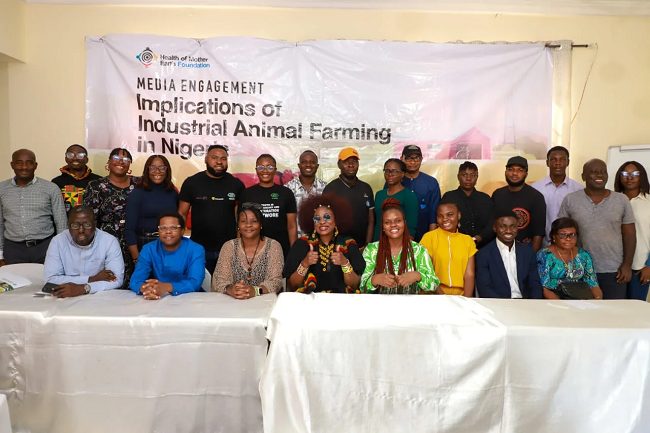
The CSOs made the appeal during a media training on industrial animal farming and its implications for Nigeria on Tuesday, October 21, 2025, in Lagos.
The Ogun State Government, in February, secured a $2.5 billion investment from JBS to boost livestock development.
Speaking to journalists on Nigeria’s future food systems, Mrs. Mariann Bassey-Olsson, the Deputy Executive Director of the Environmental Rights Action/Friends of the Earth Nigeria (ERA/FoEN), described factory farming as “a profit-driven model”.
Bassey-Olsson described it as an initiative that prioritises corporate gains over people’s welfare, animal welfare, and environmental safety.
According to her, industrial livestock systems such as those proposed by JBS are characterised by animal confinement, overuse of antibiotics, land grabbing, and heavy water consumption with grave implications for climate, biodiversity, and food sovereignty.
“Factory farming is intensive, large-scale and purely profit-oriented. Animals are caged, injected with antibiotics, and raised in unnatural conditions.
“The result is food that endangers our health and degrades our environment,” she said.
Bassey-Olsson warned that JBS’s proposed $2.5 billion investment in six large-scale meat processing plants across Lagos, Ogun, Oyo, Kano, Cross River and the Federal Capital Territory should not proceed without full public disclosure and environmental scrutiny.
She recalled that JBS had been linked to environmental destruction, illegal deforestation, and human rights abuses in Brazil and other countries.
“If a company can cause so much damage in its own country, what should we expect in Nigeria, where regulation is weaker?
“We must apply the precautionary principle – where there is doubt, pause,” she said.
She urged the Nigerian government to place citizens and smallholder farmers at the centre of agricultural planning rather than foreign corporations.
Bassey-Olsson advocated agroecology – an environmentally friendly and people-centered farming approach – as the true path to sustainable food security.
“Agroecology is agriculture in harmony with nature. It respects the people who grow the food and those who eat it.
“It cools the earth and restores balance to our ecosystems. Nigeria can feed itself without poisoning its environment,” she added.
Also, Mr Mayowa Shobo, Programmes Officer at the Human and Environmental Development Agenda (HEDA Resource Centre), said the organisation’s research on industrial farming revealed widespread cases of land grabbing, pollution, and human rights violations in host communities.
Shobo emphasised the need for stronger government oversight and corporate accountability in Nigeria’s agricultural investments.
“We are not anti-investment. But while we modernise livestock production, companies must comply with environmental and social standards,” Shobo said.
“Too often, these multinationals engage in brainwashing – promising jobs and development, but leaving behind pollution, loss of land, and public health crises,” he added.
He called on relevant regulatory agencies to ensure consistent monitoring of large agribusiness operations and to involve host communities in decision-making processes.
Both ERA/FoEN and HEDA urged the Federal Government to strengthen agroecology policies, support smallholder farmers, and reject exploitative industrial models that threaten Nigeria’s food sovereignty and environmental future.
By Fabian Ekeruche