

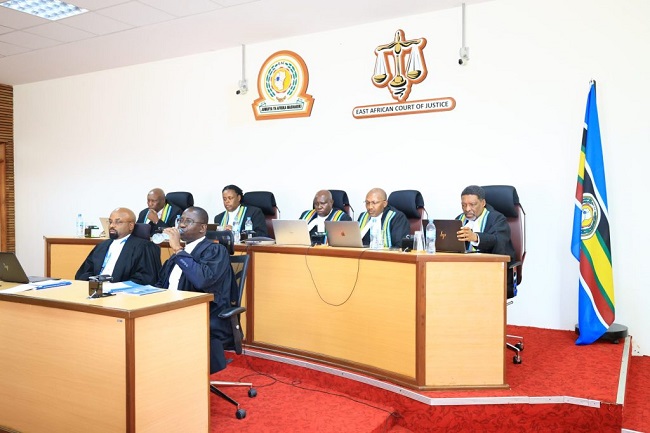
The East African Court of Justice (EACJ) Appellate Division on Wednesday, November 26, 2025, delivered its ruling in a high-stakes case challenging development of the East African Crude Oil Pipeline (EACOP).
Through the ruling, the judges upheld the decision by the First Instance Division of the EACJ which, in November 2023, dismissed a case filed by four East African civil society organisations (CSOs) in November 2020, much to the disappointment of the EACOP-Project Affected Persons (PAPs) who viewed the court as having shut the door of justice on them.
The Court ruled that the case filed by Natural Justice (Kenya), Africa Institute for Energy Governance (AFIEGO) Uganda, Centre for Food and Adequate Living (CEFROHT) Uganda, and the Centre for Strategic Litigation (Tanzania) fell outside the required filing period.
The CSOs sought to stop the human rights, environmental, and climate impacts or risks associated with the EACOP project.
During Wednesday’s court session, judges at the Appellate Division of the EACJ observed that the First Instance Division did not err in ruling that the case by the CSOs was filed out of time.
The judges, who include Justice Nestor Kayobera, the president of the Appellate Division of the EACJ; Justice Anita Mugeni, the Vice President of the court; and Justice Kathurima M’Inot, agreed with the First Instance Division, noting that the EACJ does not have jurisdiction to hear the main case.
The other judges present in court included Justice Cheboriona Barishaki and Justice Omar Othman Makungu.
The judges however overturned the order issued by the First Instance Division awarding costs to the governments of Uganda and Tanzania, as well as to the Secretary General of the East African Community (EAC). The three are the parties against whom the CSOs filed the suit.
While reading the ruling, Justice Kayobera observed as follows, “We have carefully considered the pleadings of the parties … (and) from the chronology of events [relating to signing of the EACOP agreements], any sane person would adduce that the reference (case filed by the CSOs) … runs afoul of the time limitation provision (in) the EAC (East African Community) Treaty. The case is hereby dismissed”.
By upholding the ruling of First Instance Division, the judges dismissed the case by the CSOs on a narrow legal technicality in EAC laws which provides that cases filed outside a 60-day time limit are not heard by court.
Worth noting is that key agreements related to the EACOP were made public only years after they were signed. The case by the CSOs was based on EACOP-related agreements such as the Inter-Governmental Agreement (IGA) and Host Government Agreement (HGA).
The judges failed to consider when communities and CSOs actually became aware of the project’s impacts and EACOP agreements, effectively shutting the door on the case without examining any of the evidence.
“We strongly condemn the ruling made by the East African Court of Justice, which has told millions of people across the region that technicalities matter more than their lives, their land, and their future. That is not neutrality nor objectivity. It is a choice in favour of oil companies and the governments that serve them,” said Zaki Mamdoo, StopEACOP Campaign Coordinator.
The StopEACOP Coalition maintains that the decision to dismiss the case on procedural grounds prevents examination of the substantive issues including land compensation disputes, transboundary impacts, environmental impacts including impacts on water sources and protected areas, and the project’s overall alignment with the EAC Treaty on its commitments to sustainable development, the protection of human rights, and the responsible and ethical management of transboundary resources.
“In refusing to hear the harms of EACOP on a technical pretext the legitimacy of this Court now hangs by a thread, and history will have to decide whether it was a forum for justice or simply an office providing cover for corporate plunder,” continued Mamdoo.
Independent bodies, local and international civil society organisations have documented the negative impacts of the controversial EACOP project from irregular land acquisition processes, potential risks to the Lake Victoria basin that over 40 million people depend on to human rights violations.
Similar concerns have just been raised by civil society groups in the Democratic Republic of Congo (DRC) following disastrous pollution recently observed by local communities and subsequently corroborated by a scientific report published by Environmental Law Alliance Worldwide (ELAW), pertaining to cross-border oil developments in the region.
To that end, the CSOs in DRC under the banner “Our Land Without Oil” have taken their government, the government of Uganda, and the Secretary General of the EAC to the EACJ over an ecological disaster, disrupting the livelihoods of fisher communities in Lake Albert and Lake Edward as a result of lake asphyxiation and chemical contamination linked to oil activity in the region.
While the StopEACOP Coalition holds out hope for this legal effort, the dismissal of Wednesday’s case sends a chilling message to all those seeking regional remedies for regional harms: that even the highest court in the Community may refuse to hear evidence when powerful interests are at stake represents a gravely concerning injustice.
“We must insist that the Court, and all regional institutions, do better. We will continue to demand that they live up to their mandates. But this ruling also shows us that we cannot afford the illusion that these institutions will save us.
“Our survival depends on continuing the struggle on every front and with every tool available to us, organising in our communities, confronting financiers and insurers, challenging governments, and building a renewable energy future for our communities,” said Recheal Tugume, an EACOP-impacted community member from Hoima.
Mr. Dickens Kamugisha, the Chief Executive Officer of AFIEGO, stated, “The court’s decision is a setback for regional justice and the protection of vulnerable communities as well as biodiversity and our shared climate. The decision has left over 331 million East Africans at the mercy of greedy corporations, which pillage and destroy important ecosystems that communities depend on. The ruling is a travesty, but we remain determined to use all available strategies to protect people and nature.”
Ms. Elizabeth Kariuki, Hub Director – Nairobi Hub, Natural Justice, noted, “This ruling is devastating for the very people whose lives have been upended by EACOP – the families that lost their land and livelihoods, and the communities watching their ecosystems disappear. Today, the court has closed its doors to them. But we will not give up. We will continue to fight alongside communities to ensure that their suffering is not ignored.”
Mr. Cosmas Yiga, a project affected person from Uganda, added, “We have seen the oil curse. We, the PAPs, have been oppressed and we don’t expect any gain from the oil industry. And, as far as I see, let not any ordinary Ugandan expect anything good from the oil industry, besides oppression. Today is a sad day.”