

Some consumers and retailers of Liquefied Petroleum Gas (LPG), popularly known as cooking gas, have called on the Federal Government to ensure steady availability and price stability of the product.
They spoke on Monday, October 13, 2025, in Abuja and Ibadan in reaction to the recent surge in LPG prices, following the face-off between the Dangote Refinery and petroleum workers’ unions.
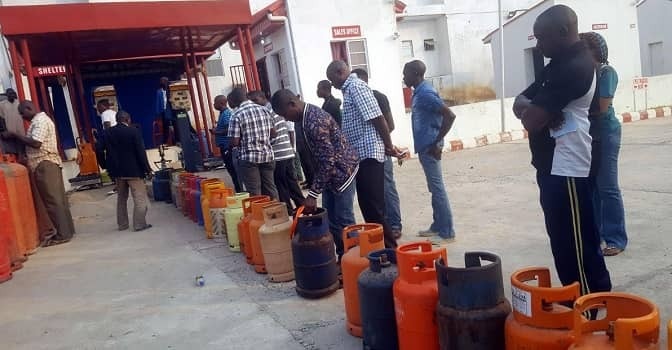
The respondents said though the queues and scarcity were gradually easing, government’s intervention was needed to restore full product circulation and regulate pricing.
The Nigerian National Petroleum Company Limited (NNPC Ltd.) had linked the price hike to a temporary disruption in gas loading and distribution during the Petroleum and Natural Gas Senior Staff Association of Nigeria (PENGASSAN) strike.
The strike, prompted by the dismissal of Nigerian workers at the Dangote Refinery, led to several days of halted operations, jetty delays, and what NNPC described as an “artificial” price surge.
The strike was suspended on Oct. 1, following government’s intervention.
Before the crisis, LPG sold for between N1,100 and N1,200 per kg in the FCT, but prices spiked to between N1,400 and N1,800 per kg in some locations, amid worsening scarcity attributed to supply shortfalls.
According to checks, there are no queues at the private outlets in Gwagwalada, Kubwa, Lugbe and Nyanya-Karshi axis, while short queues are seen at NIPCO refilling outlets at Nyanya-Karshi axis, which has maintained N1,080 per kg.
Mrs. Rose Peters, a consumer, expressed displeasure after queuing for few hours at NIPCO along Nyanya-Karshi axis before refilling, adding that it was so due its low price.
Another consumer, John Okoro, who decried the high prices being witnessed, urged the government to ensure its affordability in view of its push for penetration and utilisation of clean energy in the country.
“I live in Gwagwalada; though there are no queues or scarcity but currently, the product sells at N1,400 per kg against N1, 200 per kg sold before the crisis; I expect normalcy,” she said.
Mr. Emmanuel Ekesi, a consumer who called for proper regulation of the prices, decried the fact that Nigerians seized the opportunity created by the strike to hike prices.
Ekesi said he bought gas at Shafa station at Lugbe at N1,500 per kg.
On his part, Mr. Promise Ajujumbu, Chief Executive Officer, Promise of God Gas, said its scarcity and price hike began when the unions embarked on strike, leading to supply disruptions across outlets, in spite of fragile supply chain.
Ajujumbu, who is the Public Relations Officer of the Liquefied Petroleum Gas Retailers Association of Nigeria (LPGAR), Nyanya Unit, said though the strike caused a supply gap and getting the product had been difficult as tankers queue for days.
According to him, the situation is easing gradually, while full product circulation is being expected.
He appealed to the government to collaborate with the Dangote Refinery to enable affordable price of the product since the refinery sells at N780 per litre to marketers.
A gas plant operator in Ibadan who pleaded anonymity explained that the issue started with LPG scarcity, which later resulted in increase of the price. According to him, the scarcity and hike in price of cooking gas was caused by disruption in supply as a result of an industrial action by PENGASSAN which has since been called off. While the strike was resolved, the distributions in supply chain has caused long queues at LPG filling stations with inconsistent prices across the nation.
Embattled buyers on a long queue in the Oyo State capital have also expressed how deeply they’ve been affected by the scarcity and increase, stressing that the currently unstable price is now between N1,700 – N1,800 per kg whereas it used to be N1,100 per kg, and with that, buying the cooking gas after a long queue is not certain. They urged the government to find a lasting solution to the problem.
Reacting to the altercation between PENGASSAN and management of the refinery, Vice President Kashim Shettima has blamed the members of PENGASSAN for holding the nation to ransom over what he described as a minor labour dispute, stressing that it was totally unnecessary.
He had however declared that the 650,000-barrel-per-day Dangote Refinery is of critical importance to Nigeria and must be supported at all costs.
By Emmanuella Anokam and Omowunmi Abraham