

Biodiversity in Europe faces an existential threat. Not only is climate change putting it under pressure, but also man-made nitrogen emissions into the atmosphere.
“This risk is hardly talked about, yet it is having an absolutely devastating effect on biodiversity in Europe. The species-rich nature, especially the colourful meadows and flowering grasslands, is coming under severe pressure from aggressive grasses and nitrophilous weeds due to long-term nitrogen emissions into the atmosphere. Europe’s landscape is gradually turning into a green desert,” warns Dalibor Dostal, director of the conservation organisation European Wildlife.
One significant source of this negative change is nitrogen oxide emissions from internal combustion engine cars.
According to the European Environmental Agency, the road transport sector remains the largest source of nitrogen oxide (NOx) emissions and was responsible for 37% of the total NOx emissions in the EU in 2020.
“A rapid transition to electromobility is not only important for climate protection, but also for preserving biodiversity in Europe. European companies should play a key role in this. The transition to electromobility is the most important contribution of companies to their corporate social responsibility (CSR) in the field of climate protection and biodiversity,” notes Dostal in his appeal to European companies and their current approach.
In his words, it is important that companies operating across the EU approach this issue in the same responsible way in all countries. “It is unfortunate if subsidiaries of companies in Western Europe buy electric cars, but their subsidiaries in Central and Eastern Europe continue to buy cars with internal combustion engines,” said Dostal.
At the same time, it is crucial for Europe’s biodiversity that the EU maintains its ban on the production of internal combustion cars after 2035.
“Emissions of nitrogen oxides from biofuels or synthetic fuels are equal to or even higher than those of cars with diesel or petrol internal combustion engines. Whereas electric cars have zero emissions,” said Dostal, drawing an important comparison.
Studies on large fleets of cars show that real-world emissions of nitrogen oxides in conventional diesel passenger cars (Euro 5 and Euro 6) are in the hundreds of mg/km in normal operation. For example, an analysis of 149 vehicles found average emissions of 330–440 mg of NOx/km for Euro 6 diesels, depending on the type of driving, and even about 720 mg of NOx/km2 for Euro 5.
Similar values, around 350–560 mg/km, were measured in an official study by the European Commission. Overall, the average modern diesel car in real operation emits around 4–7 times more NOx than emission limits allow. Moreover, biofuel combustion engines produce 10–23% more NOx than fossil diesel.
Also, synthetic fuels have NOx emissions comparable to current internal combustion engines according to findings to date, and as such there is no lowering of dangerous nitrogen emissions. “Synthetic fuels and biofuels pose as much or more of a threat to biodiversity than fossil diesel or petrol. It is by no means a modern or clean technology. This is just a marketing ploy to prolong the use of internal combustion engines in Europe at a time when the US and China are competing to dominate the global EV market,” concluded Dostal.
While for nitrogen oxides, road transport is the largest source of emissions in the EU, for nitrogen overall, agriculture is an even more significant source, especially livestock farming and the use of artificial fertilisers on fields. While rapid change is not possible in agriculture to preserve Europe’s food security, all the necessary technologies are already available in the EU to achieve rapid improvements in the transition to electromobility.
In addition to road transport, shipping is a significant source of NOx emissions in the EU. According to a joint report by the EEA and EMSA (EMTER), maritime and inland shipping accounted for around 24% of all NOx emissions (6) in the EU in 2018.
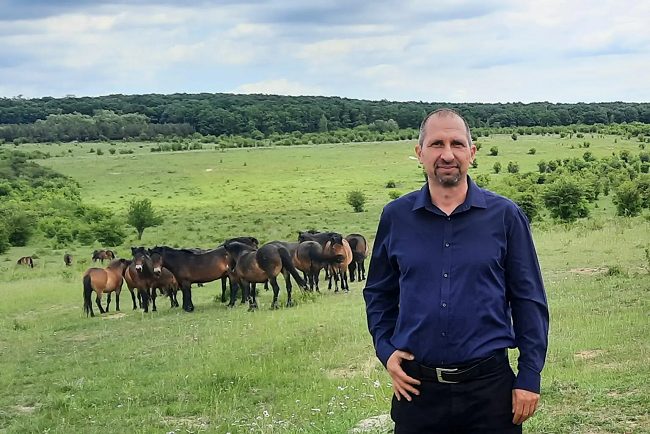
The natural grazing of large herbivores such as European bison and wild horses can bring a slight improvement to the state of the diverse landscape. But it remains essential to move as quickly as possible to zero-emission transport, i.e. battery electric vehicles.