

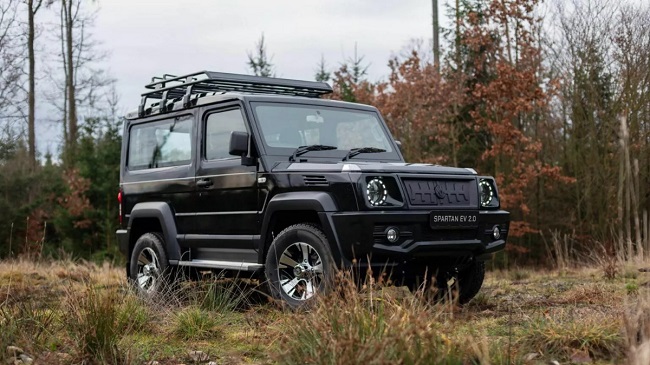
A new off-road electric vehicle manufactured in Europe was tested by nature conservationists in the European Serengeti large herbivore reserve near Prague. The Spartan EV 2.0 electric off-roader produced by the European company MW Motors had to handle the harshest of terrains during the tests.
“We tested the off-road electric vehicle in the roughest part of the reserve, which is nicknamed the ‘tank graveyard’. During the tests, the EV managed to traverse the most difficult of terrains and steep slopes. Of the off-roaders that we’ve used or tested at the reserve over the ten years of its existence, it definitely handles the terrain the best,” said Dalibor Dostal, director of the European Wildlife conservation organisation, which founded the large herbivore reserve in collaboration with scientists in 2015.
The large herbivore reserve is striving to implement the changeover to zero-emission equipment as fast as possible. A Polaris Ranger electric utility vehicle with a flatbed has been used for everyday care of the reserve since last year. In the near future, the reserve also needs a multi-seat vehicle for visitors, school excursions, film-makers and other fairly large groups that the existing working machine cannot accommodate.
“A fast transition to electromobility in the reserve is important not just for limiting greenhouse emissions. Exhaust emissions from internal combustion engines also adversely impact biodiversity and human health. That’s why electric vehicles have several benefits. It’s in nature conservation and forest care in particular that the transition to electromobility should be faster than in other fields,” added Dostal.
The Spartan EV 2.0 electric off-roader was placed on the market by MW Motors last year. In terms of appearance, the vehicle resembles the German Mercedes-Benz G-Class. The sturdy off-roader with a range of 240 km can pull up to 3.5 tonnes and is intended for a segment that does not have a broad offer in the Czech market as yet.
The vehicle also manages to draw energy through fast charging; its V2L interface enables it to charge various electric tools or domestic appliances. The vehicle is manufactured in two sizes: in four-seat and six-seat versions. Both have a cargo variant available, in which the back seats are replaced by a storage space.
“The main advantage is its ease of off-road control. Even an unexperienced driver can handle a complicated section. The huge torque available in a wide range of speeds provides a sense of security. You can get up a steep hill just by lightly touching the accelerator. Thanks to precise power delivery, it is possible to move literally by centimetres, which is appreciated by anyone who must manoeuvre, for example, with a trailer in difficult terrain,” says Martin Vesely, technical director of MW Motors.
Thus, typical users of the off-road electric vehicle include nature reserves, farmers, foresters and people who need to utilise the advantages of an electric vehicle in harsh terrain. The UK is one of the main markets for the electric off-roader.
MW Motors was founded by Irish native Maurice Anthony Ward in 2017. In addition to the Spartan EV 2.0 electric off-roader, it is also developing the Luka EV retro electric sports car.