

Parties took decisive steps to strengthen global conservation and ensure that international wildlife trade does not drive species toward extinction. The 20th World Wildlife Conference closed on Friday, December 5, 2025, in Samarkand, Uzbekistan, concluding two weeks of deliberations that delivered a broad range of decisions on species conservation, scientific guidance, enforcement of trade measures and implementation of the Convention on International Trade in Endangered Species of Wild Fauna and Flora (CITES).
Nearly 3,500 participants attended the Conference, also known as the 20th meeting of the Conference of the Parties to CITES (CoP20). Participants included governmental representatives from 164 CITES Parties, as well as observer organisations, media, local stakeholders and others. Over the course of the meeting, Parties reviewed 50 proposals, adopted over 350 decisions, and held 45 votes, advancing substantial work.
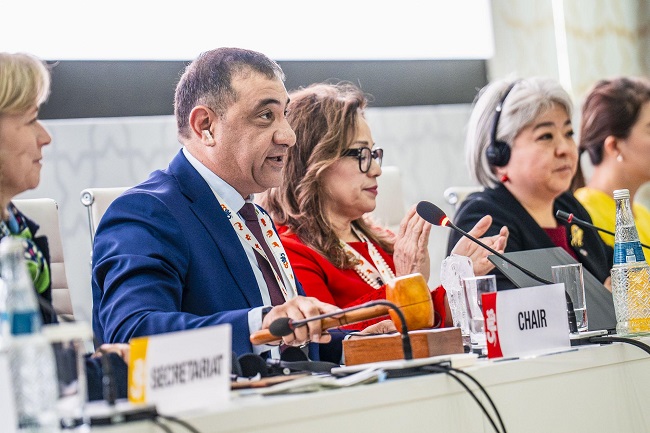
The outcomes achieved at CoP20 not only reflect Parties’ spirit of consensus, compromise, and cooperation, but also the spirit of multilateralism to continuously strengthen CITES implementation and enforcement.
Parties reached broad agreement on a wide range of species issues. Updates to the CITES Appendices included 82 new listings – among them 50 marine species, endemic reptiles, sloths, sea cucumbers, deep-water sharks, dorcas gazelle, and multiple bird species. The Bontebok, a notable conservation success story, was removed from the Appendices following sustained population recovery. Parties also adopted formal recognition of two African elephant species – the African forest elephant (Loxodonta cyclotis) and African savannah elephant (Loxodonta africana) – aligning CITES with current science and strengthening conservation planning.
Building on this work, Parties agreed to a new genus-wide framework to reinforce conservation, management, and monitoring of all anguillid eels through a resolution and related decisions to improve trade controls and address trafficking, while retiring earlier eel-related measures. A CoP20 resolution on jaguars strengthens range-wide conservation of the species through the newly adopted Regional Action Plan, calling for stronger national legislation, coordinated law-enforcement efforts, enhanced monitoring of illegal killing and trade, and expanded international and community-based action.
Regional cooperation featured strongly at CoP20, with unified positions from Africa on vultures and mammals and from Central and South America on finches, tarantulas, and other reptiles.
At the end of the two-week meeting, CITES Secretary-General, Ivonne Higuero, reflected on the significance of the meeting, stating: “These two weeks have shaped the future of this Convention and reaffirmed its vital role in ensuring that international trade in wild animals and plants is sustainable and does not threaten their survival. Our work does not end here. What lies ahead is demanding, and success will depend on collective resolve. The momentum built in Samarkand must translate into meaningful action.”
CoP20 Alternate Chair, Mr. Alisher Salomov, Advisor to the Chairman of the National Committee of Ecology and Climate Change of the Republic of Uzbekistan, emphasised progress in Central Asian country coordination, stating: “CITES CoP20 has been a landmark event of exceptional political and environmental relevance for Uzbekistan. The Conference has demonstrated that regional cooperation can be ambitious and effective and that Uzbekistan is a reliable partner contributing strategic initiatives that gain strong and broad international support.
“The signing of the Samarkand Declaration by the countries of Central Asia is the largest conservation undertaking of its level in the region’s history and will serve as a long-term foundation for environmental governance and integrated biodiversity protection.”
Growing concern over wildlife in the exotic pet and curio trade resulted in new measures and guidance. Parties also advanced work on medicinal and aromatic plants, underscoring their cultural, livelihood, and health importance – an area expected to feature prominently in preparations for United Nations World Wildlife Day 2026.
Parties adopted enhanced measures addressing online wildlife crime, illicit financial flows, corruption, annual illegal trade reporting, and reinforced mandates for the implementation of CITES Big Cats and Tree Species Task Forces outcomes. New directives were also adopted for species facing intense pressure from wildlife crime, including totoaba, pangolins, cheetahs, Asian big cats, great apes, tortoises, and freshwater turtles.
Delegates further reaffirmed the central role and importance of the International Consortium on Combating Wildlife Crime (ICCWC), noting progress in reducing trafficking of elephants and rhinoceroses while emphasising the continued threat posed by organised criminal groups.
Parties also endorsed guidance on artificially propagated plant material, updated provisions for the management of confiscated specimens, and expansion of electronic permitting and digital traceability systems. They strengthened risk assessment tools for customs and border authorities and advanced work under the CITES and Forests framework, including renewal of the CITES Tree Species Programme. CoP20 also progressed policy discussions on zoonotic risk mitigation, cooperation with Multilateral Environmental Agreements (MEAs), enhanced translation of Resolutions and Decisions, and gender-responsive implementation.
To support this expanded programme of work for 2026-2028, Parties adopted a 6.98 per cent budget scenario.
Participation at CoP20 was notably high, with 157 credentials accepted. This broad engagement was supported in part by contributions to the Sponsored Delegates Project, which ensured wide regional representation of 109 delegates from 103 Parties.
Delegates expressed gratitude to the Government of Uzbekistan for its hospitality and operational support. Samarkand – long a crossroads of ideas and culture – provided an emblematic setting for the conference’s spirit of dialogue and cooperation. The meeting also marked farewells for several long-serving contributors to the CITES community, whose expertise and commitment have shaped the Convention over many years.
With the closing gavel of CoP20, Parties entered a critical intersessional period. The outcomes adopted in Samarkand will guide scientific, technical, and compliance work through 2028. The 80th meeting of the Standing Committee (SC80), which convened shortly after the final plenary session on 5 December, has already begun translating these mandates into the intersessional programme.
Looking ahead, Panama generously offered, and Parties accepted, the hosting of the 21st World Wildlife Conference (CITES CoP21) Panama in 2028.