

Statement by the Coordinator, Agricultural Initiative of the Christian Men’s Fellowship, Anglican Diocese of Okigwe South in Imo State, Prof. Chinedum Nwajiuba, at the Farming Season Flag-off 2026 on Friday, March 27
I thank the Archbishop, His Grace Most Rev’d DOC Onuoha, Mama Blessing Onuoha, the Christian Men’s Fellowship, Chairman, Chaplain, and members. I thank all those who have keyed into this vision and everyone who has been playing positive roles.
We particularly thank the National Root Crops Research Institute (NRCRI) Umudike, the All Farmers Association of Nigeria (Imo State Chapter), other research and academic institutions, especially the University of Agriculture and Environment Umuagwo, and others I may not have mentioned by name. God bless the works of your hands.
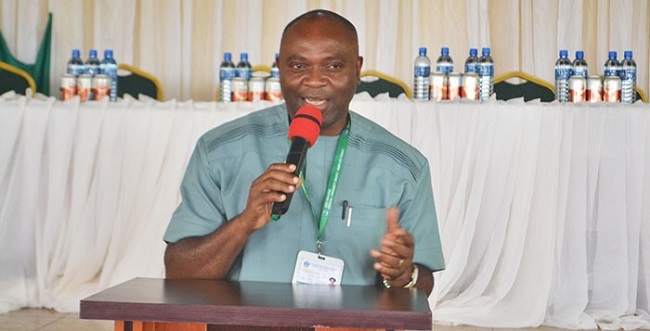
We have done an assessment of our programmes in the last two years and we are glad to say that we are doing well. The past two editions have helped to raise interests in farming by our people. More persons have become engaged in farming. People have increased the area of land they have farmed.
More young persons are showing interest. New crops, not just our traditional crops, have been introduced. Improved, high yielding varieties of crops have been adopted and extended beyond our immediate beneficiaries. Many of those who received cassava cuttings, seeds and seedlings have shared with friends and families even far away from our immediate area.
The idea of planting in sacks/bags has become widely adopted. We do not have to preach much about it as people have seen the benefits. Today, we shall be listening to Rev. Samuel Onyinyechi Edeh, Diocese of Okigwe south, Coordinator; Sir Senator Frank Ibezim, Agriculture Initiative, Ezeoke-Nsu Chapter, who has been successful in growing yams and other crops in sacks, etc. We thank him for accepting to share his experience.
It is well acknowledged that cassava, our main food security crop, has done very well, especially the variety we call TME419. For this variety, we are grateful to the National Root Crops Research Institute (NRCRI) Umudike. We are blessed to have NRCRI Umudike, and the support they have given us. We thank the leadership, especially Prof. Chiedozie Egesi, the Executive Director, for managing that Institute better than most institutions in contemporary Nigeria. Even their compound is the cleanest public institution in Nigeria.
On livestock, we have not achieved as much success. I am not sure we have even done much on that. The same applies to input and postharvest systems. We have to find ways to encourage these, especially now that we are encouraging our youth to be engaged with agriculture, not just farming.
For the youth engagement, we thank The Future Generations Institute (TFGI), especially for the youth segment of the event today. We thank the couple I call the Agriculture Power Couple – Dr. Benjamin and his wife Dr. Christiana Okoye – who will be assisting us with the youth today.
Please, let us not forget why we started this programme. Hunger, poverty, hardship, unemployment, and in addition confusion among our youth are some of our challenges. The traditional way of teaching the next generation of farmers by them accompanying parents/adults to farms, has collapsed for many reasons including urbanization, faulty socialisation that portrays agriculture as not good enough for the youth, and other confusions damaging and deceiving the young people.
Too many men and women seem to prefer to be idle, and our villages are busy with conflicts, quarrels, rumours and gossips. That is not who we were. That is not who the Igbo were. The condition of Nigeria seems to erode Igbo core values of hardwork, tenacity, grit, frugality, amamihe, ako na uche, ofo na ogu, and even fear of God. Stealing, begging, and killing, things that were frowned, punished and considered sacrilegious are now common among the Igbo. We have a raised people without a sense of shame and conscience, and with huge entitlement mentality. That is not who we were.
We produce very little and have to rely on food coming from far away. Even our traditional rulers celebrate new yam festivals with yams from alien lands. Women rely on the market for pepper and basic vegetables, as well as broom (aziza). Many of us depend on remittances from outside Nigeria and from other parts of Nigeria to buy food. The condition and direction of the management of the Nigeria state and economy worsen our situations. It is obvious that we have to help ourselves.
Unfortunately, the direction of the Nigeria economy is more likely to be worse for reasons within, and reasons outside Nigeria. Recent rise in domestic fuel costs, showing a weak country without internal safety measures and mechanisms to manage economic instability, has already led to rising cost of local transportation. That will be transmitted to cost of items in the market. That is more inflation.
We do not know when the war in the Middle East will end. We are not even sure that if it ends prices will fall. The Nigeria government has in the last two years responded to sharp rise in food cost as a result of the choices made in the management of petrol costs and exchange rate, allowed significant importation of food items especially rice and wheat (Bread, pastas, etc. consumed heavily in Nigeria).
Those are measures not sustainable. Farmers in the major food producing parts of Nigeria, in the North, are grumbling. That is not good for Nigeria agriculture. Insecurity in the North has adversely affected agriculture, and seems not to be relenting. What these suggest is that we need to work harder to ensure that hunger does not kill us.
Unfortunately, we have to do this for ourselves in a time of governments without governance. It would have been good to have a revived extension and input support from public services. That seems not to be of interest to them.
At our level, we farmers experience many challenges. One of this as you know is what has been happening to the weather. The experience with rainfall, harmattan, heat, etc. have been different in each of the years of 2024, 2025, and even so far in 2026. Nothing seems to be the same. We cannot plan. There is so much uncertainty.
Many of you have cleared the land this year, but not sure whether or not to start planting. The reason is that some persons who planted cassava early last year, lost a lot of their cassava cuttings to heat as a result of rains seemingly starting and stopping, and starting and stopping. You had to replace them at huge costs in materials and labour. The yam harvests last year suffered rotting, speculated as a result of heat when the harmattan should have cooled the bans. The same applies to telferia (ugu).
Currently, some fruit trees such as mangoes may not have fruited as they did in previous years. It would have been good if we had active extension services to take our experiences to the researchers and return to us with advice. Here today we have invited a number of researchers. They will take our questions and provide us answers.
Then we have prizes to give out today. These are in multiple categories. Most importantly is our assessment of farmers who performed well in various categories last year. We thank our sub-committee on assessment led by Sir Caleb Ikpa who moved round last year to assess farmers on the field. I know that many of our farmers have brought things for sale. I wish to advise that you do not sell until the assessors have gone round, as we have prizes to give to the top three exhibitors.
For our youth we shall encourage them by providing seeds and seedlings, and will provide them some financial encouragement, especially for the schools and the students who study agriculture in our schools.
To be able to do these we have called on friends and associates and many have responded. We are very grateful to those who have supported the CMF programme.
We are also grateful to those who have supported The Future Generation Institute (TFGI) in the Youth in Agriculture programmes.
I ended by thanking all of you again. There is an idea that we move the hosting of this annual farming season flag-off. The All Framers Association of Nigeria earlier suggested we move this round Imo State. Please we do not want to do that for at least two reasons.
The first is that our institutional backing is the Diocese of Okigwe South of the Anglican Church which geographically is limited to three Local Government Areas of Obowo, Ihitte/Uboma and Ehime-Mbano. The second is that we wouldn’t want to be misunderstood and other motives ascribed to us. Our interest is farming, and any person outside this area may ask us for advice, and we shall willing give that.
We are however willing to experiment with moving round the three Local Government Areas, and we are considering hosting the 2027 event, God willing at Umuagu Obowo, St. Andrew’s Church School field. That is where we call Seven and Half Junction. We believe the place is easily accessible. Again, I reiterate that this is tentative and you will hear from us if that will be the venue next year.