

As Nigeria progresses deeper into the 21st century, the Marine and Blue Economy has evolved from a policy aspiration into a strategic economic pillar for diversification, food security, job creation and global maritime competitiveness.
Under the leadership of Adegboyega Oyetola as minister, the Federal Ministry of Marine and Blue Economy, established in May 2023, has made strides in policy design.
The ministry has also advanced in institutional reform and sector performance, even as key structural challenges persist.
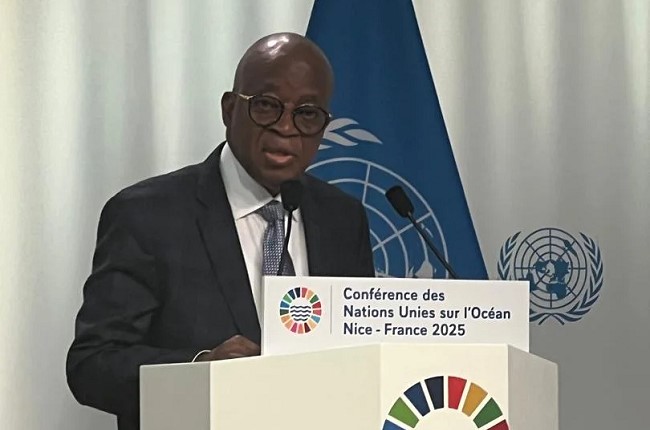
Since its creation, the ministry has pursued the Federal Government’s agenda to unlock Nigeria’s estimated $296 billion maritime potential.
This is through sustainable ocean resource utilisation, port modernisation, coastal infrastructure and marine technology development.
A defining milestone came in 2024 when the Federal Executive Council (FEC) approved Nigeria’s first National Blue Economy Policy, providing a unified framework for fisheries, shipping, aquaculture, marine transport and ocean-based renewable energy development.
Mr. Kitack Lim, Secretary-General, International Maritime Organisation (IMO) described the policy as forward-looking and sustainable, commending Nigeria’s alignment with global maritime governance and regional development priorities.
According to the IMO, Nigeria’s maritime sector has achieved a fast-evolving measured progress in maritime security and blue economy development.
One of the most notable achievements has been Nigeria’s sustained record of zero piracy incidents in its territorial waters for over three years.
This feat is credited largely to the Nigerian Maritime Administration and Safety Agency (NIMASA) and its Deep Blue Project.
The project, coordinated under the supervision of NIMASA’s Director-General, Dr Dayo Mobereola, deploys maritime security assets, surveillance drones and coastal patrol teams that have significantly enhanced regional safety and investor confidence.
These achievements helped to position and secure Nigeria’s victory at the IMO Council, Category C, election for the 2026–2027 biennium session, reinforcing its voice in global maritime governance and international trade facilitation.
On the economic front, Nigeria’s local fish production climbed to about 1.4 million metric tonnes in 2025, up from 1.1 million tonnes in 2024, according to data from the Federal Department of Fisheries and Aquaculture.
Dr Ime Umoh, Director of Fisheries, said that the rise reflected better coordination between federal and state agencies, improved aquaculture technology and the adoption of sustainable marine farming systems supported by development partners.
However, the country still faces a fish consumption gap of about 3.6 million metric tonnes annually, requiring continued investment in fish feed production, hatchery development and small-scale aquaculture enterprises.
To boost institutional efficiency, the ministry launched the Enterprise Content Management System (ECMS) to automate workflow, enhance data management and improve transparency in service delivery.
The ECMS is a Federal Government’s initiative to be adopted by all Ministries Departments and Agencies (MDAs) to enhance swift digitalisation of the public service.
The National Assembly has also played a supportive role.
Chairman of the House Committee on Ports and Harbours, Nnolim Nnaji, confirmed ongoing legislative work on the Nigerian Port Regulatory Agency Bill to streamline overlapping mandates and strengthen competitiveness.
Stakeholders at the Nigerian Shippers’ Council (NSC) also reported massive savings of over N31 billion from port automation and data integration reforms.
They said that these have reduced leakages and improved efficiency across freight and shipping operations.
Despite the progress recorded, however, the nation’s port infrastructure remains largely outdated, with many facilities dating back more than four decades.
This contributes to cargo dwell times that exceed regional and international averages.
Dr Emeka Akabogu, a maritime lawyer and policy analyst, said that overlapping agency functions and regulatory inconsistencies in the sector continued to hinder investment and operational efficiency.
Akabogu called for a unified maritime governance framework to address regulatory fragmentation and agency overlaps in Nigeria’s maritime sector.
According to him, harmonised industry-wide maritime policy and streamlined administrative responsibilities will ensure coherence across agencies and more effective governance.
As Nigeria consolidates recent gains in maritime security, fisheries output and institutional reform, analysts note that national blue economy strategies across West Africa are shaped by differing economic priorities, resource endowments and market orientations.
According to the analysts, these set the stage for contrasting development and pathways within the subregion.
Comparatively, Ghana and Senegal have expanded export-oriented aquaculture and fish processing.
Nigeria, on the other hand, has concentrated on scaling domestic production, maritime safety and institutional reform.
Each pathway reflects different national strengths within West Africa’s blue economy.
Mr. Eugene Nweke, Head Researcher of Sea Empowerment and Research Center (SEREC) said that regional cooperation remained vital.
According to Nweke, the Gulf of Guinea Commission and ECOWAS frameworks provide platforms for shared investment, maritime security collaboration and joint environmental protection.
Dr Felicia Mogo, former IMO marine pollution consultant, emphasised the need for enhanced funding mechanisms, marine spatial planning and ocean literacy to sustain Nigeria’s current growth momentum.
Oyetola, however, insists that Nigeria’s journey “from policy to prosperity” depends on collective resolve, institutional coordination and long-term commitment across government, industry and communities.
The minister said that vision without financing remains no more than a dream.
He urged domestic and international investors to support infrastructure financing, port automation and blue economy innovation hubs.
Other maritime experts recommend incentivising private investment, accelerating deep seaport development, upgrading logistics corridors, and prioritising maritime education and research to produce a globally competitive workforce.
With Nigeria’s Marine and Blue Economy now firmly anchored in strategic planning and measurable reforms, it stands as a beacon of opportunity.
However, ts full promise will hinge on policy continuity, innovation and inclusive growth.
By Diana Omueza, News Agency of Nigeria (NAN)