

When the UN General Assembly officially proclaimed the International Day of the World’s Indigenous Women and Girls, it did so in recognition of centuries of their resistance, leadership, and resilience.
The legacy of Bartolina Sisa – an Aymara leader executed in 1782 for her brave resistance against Spanish colonisation – is at the heart of the newly internationalised commemoration for Indigenous women and girls, officially recognised on September 5. This recognition of her legacy, and the sacrifices of countless other women who fearlessly advocated for their rights, arrives at a particularly powerful moment, as it coincides with two major milestones in the modern struggle for Indigenous women’s rights: the 30th anniversary of the Beijing Declaration on Indigenous Women, commemorated at CSW69 in New York, and the 25th anniversary of the International Indigenous Women’s Forum (IIWF), celebrated in Lima in June 2025.
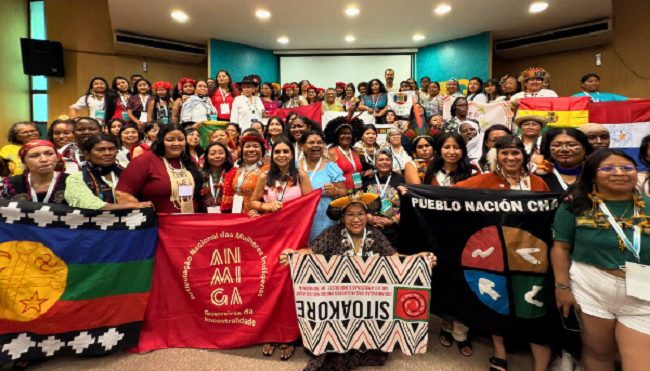
Thirty years ago, at the Fourth World Conference on Women in Beijing, Indigenous leaders like Tarcila Rivera-Zea from Peru, Victoria Tauli-Corpuz from the Philippines, Joan Carling from the Philippines and Lucy Mulenkei from Kenya successfully brought their voices to the global gender agenda.
“Being a woman and being Indigenous are not two separate identities: they are a whole that gives us the strength and vision to transform our communities,” recalls Tauli-Corpuz, whose defense of her people’s rights has led her to face threats, persecution, and attacks.
Five years after Beijing, alongside other women leaders, she founded FIMI, which today connects networks of Indigenous women across seven continents, strengthening capacities, political advocacy, and economic autonomy. Since then, women from Africa, Asia, the Americas, Europe, the Pacific, and the Arctic have converged in this “global house of Indigenous women” to defend cultural, territorial, and human rights.
Lives that Embody the Struggle
Tarcila Rivera-Zearemembers her childhood in the Peruvian Andes: a girl who grew up in extreme poverty, without access to education in her mother tongue, and who found in reading and writing a gateway to transform her life and that of her community. Today, at 74, she continues to build networks and opportunities for Indigenous women worldwide.
In the Philippines, Joan Carlinghas dedicated over three decades to protecting Indigenous communities, halting extractive projects, and resisting the marginalisation of her peoples, often risking her own life. She has been unjustly detained, falsely accused of terrorism, and threatened with death, yet she has succeeded in stopping destructive mining projects and ensuring that Indigenous women have a voice in international forums.
In Kenya, Lucy Mulenkei, a Maasai woman and journalist, has elevated environmental defense and female participation to a regional level, co-founding the Indigenous Women’s Biodiversity Network and consolidating environmental governance networks in East Africa. Her work has been recognized with multiple awards for environmental leadership and the defense of pastoralist women’s rights.
From Guatemala, Teresa Zapetabegan as her mother’s secretary in her Chatino village, learning to write to record her mother’s leadership decisions. Today, she leads FIMI globally, coordinating networks, funds, and programs to strengthen female leadership in the face of violence, territorial dispossession, and the climate crisis.
“Territorial dispossession and violence are a daily reality, but our response is not passivity; it is action. Every network, every fund we coordinate is designed to strengthen female leadership because it is in the territory where real solutions to the climate crisis are born,” states Zapeta.
These stories intertwine: women who started in different corners of the world and who, despite inequality, discrimination, and personal risks, have built a global movement that highlights the intersection of gender, Indigenous identity, and territorial rights.
Contemporary Challenges: Structural Violence, Dispossession, and the Triple Planetary Crisis
The UN’s recognition comes in a context of existential crisis, as Indigenous women continue to face existential threats related to climate change,environmental degradation, and biodiversityloss, as well as obstacles to obtaining access to food and water security. The root of these problems is intersectional discrimination, which is structural and embedded in laws and policies, affecting women based on their sex, gender, ethnicity, disability, and age.
The violent dispossession of territories, militarisation, and the criminalisation of environmental defenders are realities affecting millions of Indigenous women. These violations are often linked to extractive activities like mining and logging, which have a devastating impact on the environment, land, and waterways. In fact, sexual violence is used as a tool of warin conflict areas, and mining or logging operations increase the risk of human trafficking.
Zapeta underscores: “We are building networks of collective care and international solidarity to protect ourselves, but the majority remains unprotected.”
The UN’s recognition not only honors historical figures like Bartolina Sisa but also those who today lead struggles for climate justice, territorial protection, and human rights.
“This recognition validates decades of effort and opens a window for the world to listen to and respect our voices,” says Rivera-Zea.
Three decades after Beijing and 25 years since FIMI’s founding, these stories show that Indigenous women not only defend their territories and cultures but also inspire global solutions for social and environmental justice, reminding the world that their resistance is, at once, their strength and their legacy.