

Over 100 representatives from 20 African countries, including grassroots communities, indigenous peoples, farmers, youth, women, and civil society, have called for an end to extractivism – a practice many believe has allowed the Global North to exploit Africa – at the second African People’s Counter-COP (APCC) under the theme “African-Led Pathways to Climate Justice and System Change: Reclaiming Futures Beyond Extractivism.”
The African Climate Justice Collective (ACJC), which organised the gathering, used the platform to challenge the United Nations Framework Convention on Climate Change (UNFCCC) Conference of Parties (COP), saying that the UNFCCC process has been co-opted by capitalism and the Global North, continuously sidelining African voices and exacerbating the climate crisis.
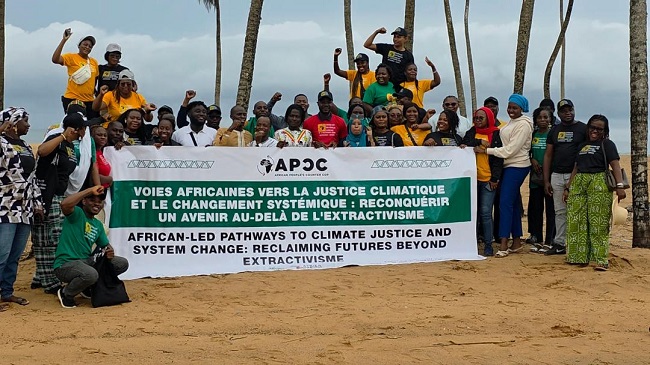
“The climate crisis ravaging Africa is not our fault; it is a reflection of the debt owed by the Global North,” said Rumbidzai Mpahlo, Coordinator of the ACJC. “While we contribute minimal emissions, we endure maximum suffering. This Declaration represents our unified demand to dismantle exploitative power and reclaim our future ahead of COP30.”
From the drought-stricken farmlands of the Sahel to the eroding coastlines of Ouidah in Benin, the message from the APCC was clear: the era of extraction and exploitation must end.
Africa’s Demands
At the heart of the APCC’s Declaration are nine urgent, non-negotiable demands – a bold framework for systemic change that redefines what genuine climate justice means for Africa and the Global South.
- Pay the Climate Debt and Reparations: Nations in the Global North must provide climate reparations, remediation, and compensation – not as loans, but as grants.
- All exploration and production must be halted immediately. Africa’s future must be powered by grassroots-led, socially owned renewable energy systems that serve local communities first
- An End to Dangerous Distractions: The APCC firmly rejects false solutions that commodify nature and deepen inequality. These include REDD+, carbon trading, Net Zero policies, waste-to-energy projects, and all forms of geoengineering
- The Right to Say No! (Free, Prior, and Informed Consent): Every community must have the legal and moral right to reject projects that threaten their land, lives, and culture. The ratification and enforcement of Free, Prior, and Informed Consent (FPIC) is non-negotiable.
- Reform Climate Finance: Global funds like the Green Climate Fund (GCF), Adaptation Fund, and Loss and Damage Fund must be adequately resourced, transparent, and directly accessible to communities most affected by climate impacts – not controlled by profit-driven multilateral banks.
- Promote Food Sovereignty: African governments must reform land laws to benefit local people, prioritise indigenous food systems, and invest at least $5 billion annually in peasant agroecology.
- Stop Waste Colonialism: Africa is not the world’s dumping ground. Governments should adopt zero-waste policies and reject the influx of obsolete technology, textiles, and plastic waste from the Global North.
- Prioritise Africa’s energy sovereignty: Support a people-led transition to renewable energy, benefiting local communities, women, youth, and indigenous peoples.
- Protect Climate Refugees: Governments and international bodies must provide urgent adaptation and resilience funding to ensure people can remain safely in their communities or relocate with dignity.
“As the world prepares for COP30 in Belém, Brazil, the APCC Declaration stands as a moral and political challenge to both African governments and the international community. The ACJC is urging leaders to endorse the Declaration, assert sovereignty, and demand global financial and environmental justice as the only legitimate foundation for climate action,” the group stated.