

As part of efforts to encourage action against climate change, especially among Nigeria’s youth, three Internally Displaced Persons (IDPs) refuge camps located within the federal capital area have been empowered on the connection between human health and environmental protection.
This initiative, which was carried out under the Youth for One Health Project (YOHP) and funded through the SOS Villages Eco Champions Initiative, in partnership with UNODC Nigeria, UNICEF Generation Unlimited 9ja, CASS Educational Foundation, the FCTA Department of Public Health, the UNESCO Nigeria Youth Network, and Theirworld, mobilised 13 volunteers and directly impacted 150 young people (over 60% female) across these IDP refugee camps, namely Kuchingoro, Karamonjigi, and Durumi Area 1, to become eco-champions and public health campaigners.
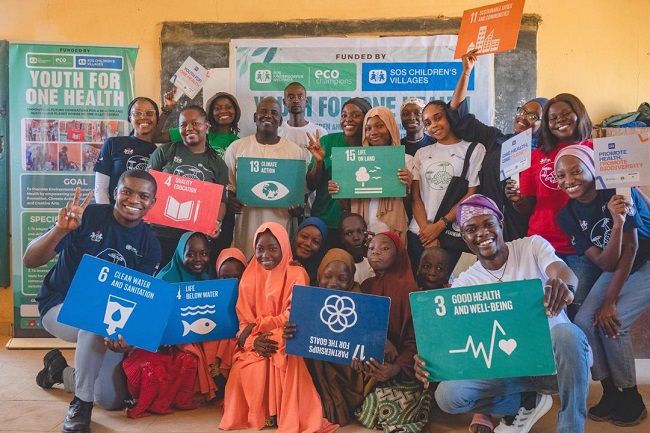
From Friday, December 19, to Sunday, December 21, 2025, participants engaged in eco-literacy and health education workshops, creative arts for Sustainable Development Goals (SDGs), advocacy against wildlife crime, plastic recycling into eco-art, tree planting, and youth leadership development at one refugee camp every day.
Pre- and post-test assessments showed a 45% increase in climate, health, and environmental knowledge among participating youths. The results were tangible and immediate. One hundred kilograms of plastic bottles were removed from camp environments and repurposed into biodiversity eco-art illustrating endangered species.
Additionally, 150 climate-action creative art murals were co-painted by the IDPs, giving the youths in the camp permanent learning tools promoting clean water, waste reduction, tree planting, and environmental hope. Nine fruit trees were planted and adopted by youths, contributing to long-term environmental quality and food sustainability, while 13 youth volunteer leaders were trained and mobilised to sustain activities through newly formed eco-clubs in each camp.
“The initiative placed young people at the centre of solutions through creative arts rather than the margins of aid,” Godwin Lasisi, the initiator of YOHP, said in response to the project’s impact on the participants.
“I can now take action to protect my environment and my health because I see the importance” Aisha, one of the participants, said.
Beyond the aforementioned numbers, he explained, lies a deeper impact. The public health specialist and SDGs champion added that displaced young people gained confidence, leadership skills, and a sense of ownership over their environment and health that empowered them to tell their stories, which were produced into a documentary.
According to him, the Youth for One Health Project represents a strategic scale-up of earlier models pioneered through the Interfaith Alliance for SDG Action Plan (IASAP) and the broader YOHP framework used to institutionalize the SDGs in secondary schools across Nigeria impacting over 20,000 young people.
Godwin Lasisi hinted that as Nigeria grapples with climate change, urban displacement, and public health challenges, this programme offers a compelling lesson because when young people are equipped with knowledge, creativity, and leadership opportunities, they become powerful agents of resilience.
“Scaling this model across more schools, IDP refugee camps, and vulnerable communities could mark a decisive step toward healthier environments, empowered youth, and sustainable development that truly leaves no one behind and accelerates the achievement of the SDGs and Africa Agenda 2063,” he stated.
By Etta Michael Bisong, Abuja