

Two things made Nigeria’s attendance at this year’s Abu Dhabi Sustainability Week Summit (ADSW 2026) very remarkable. One, it showed how the sequence of actions by Nigeria’s leader, President Bola Ahmed Tinubu, undergirded his determination to pave a promising future for the country’s energy transition agenda.
Secondly, the fact of the President’s consistent attendance, which made it easy for him to attract the hosting of Investopia 2026 to Nigeria, and the unveiling of the Nigeria’s Carbon Market Framework, combined to make the country the cynosure of all delegations at the seven days event.
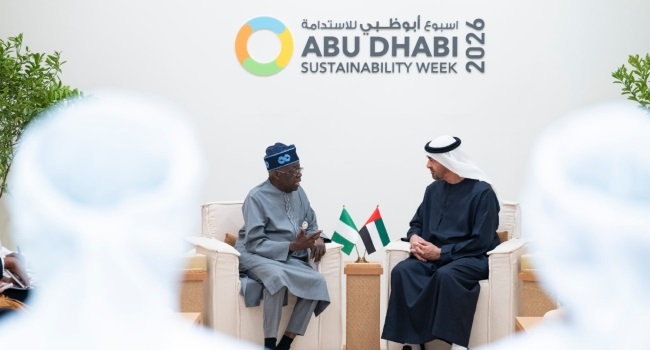
The Investopia, which is expected to be co-hosted by Nigeria and the United Arab Emirates, in Lagos in February, this year, will showcase Nigeria as an investors’ haven, especially its pedigree as home to over 250 million persons and Africa’s most populous nation.
Bouyed by its significant population of well-educated youths and easy access to ECOWAS and the rest of Africa, Nigeria indeed is the go-to place as far as access to market and networking is concerned.
Although it came at a great personal cost, I was happy I made it to the Abu Dhabi meet, where the International Renewable Energy Agency (IRENA) Assembly preceded the talks on the Sustainability Week. As I sat through the President’s address, I quickly recalled his 2025 observations. The President had declared at the ADSW2025: “The fight against Climate Change is not merely an environmental necessity, but a global economic opportunity to reshape the trajectory of our continent and the global energy landscape.” Further, he stressed that “to succeed, we must innovate, collaborate and decisively collaborate as a global community.”
I recalled also, how in the course of his inaugural address at the Eagle Square, Abuja, on May 29, 2023, the President had stated: “Our government shall also work with the National Assembly to fashion an omnibus jobs and prosperity bill. This bill will give our administration the policy space to embark on labour-intensive infrastructural improvements, encourage light industry and provide improved social services for the poor, elderly and vulnerable.”
At every turn in the activities of the ADSW 2026, it was evident that President Tinubu’s consistent push for environmental renewal undergirded his belief that energy transition was the key to future prosperity.
That could explain why during his 2024 Budget Speech in November 2023, he declared that “we have strategically made provisions to leverage private capital for big-ticket infrastructure projects in energy, transportation and other sectors.
“This marks a critical step towards diversifying our energy mix, enhancing efficiency and fostering the development of renewable energy sources…”
Of course, knowing that here was a President who signed into law the Electricity Bill barely eight days after taking office, made me recall the rigours the House of Representatives and I, under the efficient leadership of Speaker Femi Gbajabiamila, went through to deliver Nigeria’s signature law, the Climate Change Act 2021.
So far, the Nigerian leader has continued to build on that foundation to catapult the country’s profile in the emerging global energy economy. And all that showed during the ADSW 2026.
By assenting to the Electricity Act of 2023, the President dismantled decades of suffocating centralised control over power and invited states and the private sector to finally build. It was the first tangible signal that this administration might approach its promises as a blueprint, not a bromide.
What is more, as Nigeria approached the COP28 climate summit, the directive to relevant agencies was sharp and singular: secure substantial international funding and partnerships to bolster the national energy transition plan. The mandate was to move from advocacy on the global stage to securing concrete, actionable commitments.
At the Abu Dhabi Sustainability Week, therefore, the President reinforced my conviction that Nigeria’s prosperity depends on a fundamental shift to clean, reliable energy. ADSW showed that indeed, the polished global conversation had finally moved from declarations to the gritty mechanics of delivery.
Verging on the core of this progressive conversation is the continuing search for how nations are building on their ambitious promises. Nigeria’s leader did not disappoint. President Tinubu was there live, not as a passive potentate, but as a leader actively involved and leading the charge, providing directions and proffering workable strategies.
The fact of his 2025 and 2026 consecutive physical presence did much to impact on the atmosphere in a way no policy paper could. It signaled to every investor, diplomat, and executive present that Nigeria’s energy transition is not a side project managed by mid-level officials, but a top priority owned and driven from the very highest level of government.
“Nexus to Next: All Systems Go,” that was the theme of the ADSW 2026. To Nigeria, that phrase carried a particular, almost painful, weight. Our systems – the grid, the financial architecture, the regulatory environment energy, human capital – have infamously not been “going” for a long time. Our message was that we are finally, seriously, rewiring them, and we are using the global green transition as the master blueprint for this overhaul.
We came forward with proofs and specifics: That the 2023 Electricity Act is no longer just a landmark legislation. It is the thriving legal bedrock, which allows a company to construct a solar mini-grid for a hospital in rural Abia, Nasarawa, Borno, etcetera without pleading for federal permission. We are talking about a decisive shift from theoretical potentials to practical, on-the-ground projects.
In plain terms, it could be seen that Nigeria was particular about energy financing. Our pitch was built for the financial pragmatists in the room. We did not ask for aid or concessionary pity; we presented a business case, complete with the instruments we had already built and tested.
A Sovereign Green Bond, oversubscribed by 82 per cent, was cited as proof that the market was listening. A five-hundred-million-dollar Distributed Access through Renewable Energy Scale-up (DARES) was highlighted as capital that is well established, managed, and ready to deploy. A seven-hundred-and-fifty-million-dollar programme with the World Bank, already in motion, aims to bring clean electricity access to over seventeen million Nigerians.
The takeaway from ADSW 2026 for other countries is that Nigeria has progressed from making pledges to creating the financial machinery to fulfil them. The country has clearly set the structure for global connectivity and revenue inflow.
The gamechanger
It was a bang: The signing of the Nigeria-United Arab Emirates Comprehensive Economic Partnership Agreement (CEPA), came through as the gamechanger. Here was a hard negotiated, and ratified trade deal. The UAE will eliminate tariffs on over seven thousand Nigerian products, and Nigeria will do the same for about six thousand UAE products.
This agreement also signals the creation of qualitative jobs, particularly for Nigeria’s young population, in agriculture real estate, digital banking, retail and infrastructure financing. Can you beat that? Consider what that means for a moment.
To a furniture manufacturer in Lagos, a certified cocoa processor in Ondo, or an assembler of electronics in Nnewi, one of the most significant barriers to entering one of the world’s most affluent and connected markets has just been dismantled.
This is the most decisive policy push for a post-oil, industrialised economy I have witnessed in a generation. It will masterfully transform Nigeria’s green transition from an internal development goal into a compelling global trade and investment opportunity.
In the conference hall, you could almost see the recalibration happening in real-time behind the eyes of the assembled investors and partners.
Yet, amidst this powerful forward thrust, the most intellectually resonant moment for me was one of direct and necessary challenge: President Tinubu turned to the custodians of global development finance, reminding them that their prevailing model has become fundamentally flawed.
He argued persuasively that shackling developing nations with ever more sovereign debt to build the very solar grids, climate-resilient agriculture, and infrastructure the whole world needs is neither morally fair nor operationally sustainable.
President Tinubu’s proposal for innovative blended finance was, in essence, a clarion call to rebalance the scales of risk. It framed the conversation not as a plea for concessionary terms, but as a strategic renegotiation of the partnership between global capital and emerging economies.
The audacity of this position carried significant weight precisely, because of the groundwork he had just laid. For the preceding hour, his presentation had systematically dismantled the old narrative. He had not outlined a list of needs; he had catalogued a portfolio of ready opportunities, established governance frameworks, and concrete financial instruments. He had demonstrated that Nigeria arrived at the table not as a supplicant, but as a serious and credible counterparty, fundamentally changing the context of the tasks that followed.
Lessons
Nigeria’s presence at the ADSW 2026 had rich lessons. First, credibility is a currency minted through consecutive, verifiable action. Nigeria’s voice carried an unfamiliar weight in those rooms because it was backed by a trail of veritable policies: The Climate Change Act, the Electricity Act, the oversubscribed green bonds, the National Climate Change Fund, our Pilot Electric Mobility Project, National Carbon Market Activation Policy, etcetera. The President’s personal stewardship on that global stage was the final, unmistakable stamp on that currency.
Second, true progress lies in deliberate connection. We are finally, seriously attempting to systematically link power generation to job creation, our vast rare earth minerals to domestic manufacturing, and foreign investment to the development of local skills. This is the integrated, forward-thinking industrial strategy we disastrously failed to build during the oil boom. The green transition, ironically, is our nation’s second chance to get it right.
Finally, and most importantly, there is more crucial work to be done. If Abu Dhabi was the international exhibition hall where we displayed the blueprint and the prototypes, our country has become the workshop floor where we must now manufacture the future at scale.
The landmark trade deal with the UAE is a paper victory if our businesses cannot innovate, scale, and produce goods of competitive quality to seize the opportunity. The billion-dollar funds are empty vessels without a robust, transparent pipeline of professionally managed, bankable projects to absorb the capital.
To me, as the sponsor of the Nigeria’s Climate Change Act 2021, leaving the fine city of Abu Dhabi my mind revolved around challenges the country faces in ensuring that we meet the lofty expectations the global energy community has come to place on due to President Tinubu’s highwater offerings.
With the President’s commitment and determination, we can rest assured that come COP31, the world will be pleased to learn how far Nigeria and its energy transition advocate, President Bola Tinubu, have doubled down on its successes.
They call it “All Systems Go”. From my vantage point in Abu Dhabi, it seems Nigeria has, against considerable odds and history, managed to get its key systems to the Launchpad, and begun the ignition sequence.
President Tinubu’s closing statement, “Let me close by reassuring the international business community that Nigeria is ready for business,” captures the mind of a leader that is confident of his strategies. A bright future awaits.
By Rep Sir. Sam Onuigbo, a member of Governing Board of the North East Development Commission (NEDC), who attended the ADSW2026 in Abu Dhabi