

A non-profit group known as the EcoSteward and Humanitarian Foundation has called on government leaders and stakeholders to explore the adoption of agroecology and renewable energy as two powerful solutions to Africa’s climate crisis and development trajectory.
The body made the call during a side event it hosted on Tuesday, September 9, 2025, at the recently concluded Second African Climate Summit (ACS2), which was held in Addis Ababa, the capital of Ethiopia.
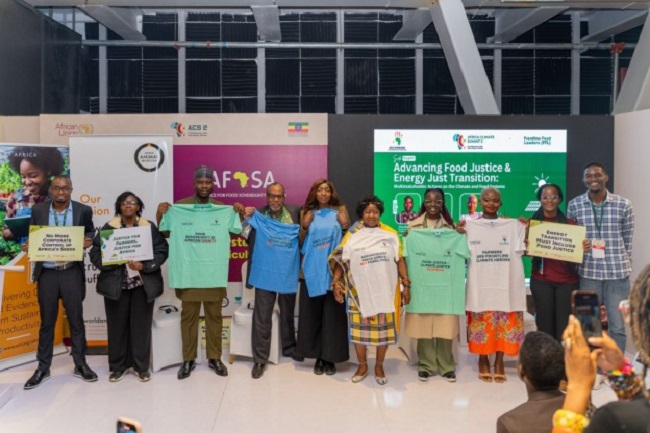
In their evaluation of the programme’s theme, “Advancing Food Justice & Energy Just Transition: Multi-stakeholder Actions on Climate and Food Systems,” the participants argued that agroecology should not be seen as a backup plan because it is actually the continent’s original climate pathway for reclaiming degraded lands, ensuring food sovereignty, and increasing resilience to climate shocks.
As usual, the meeting ended with another historic Addis Ababa Declaration and startling financial commitments, most notably the introduction of the Africa Climate Innovation Compact (ACIC), a $50 billion yearly fund for renewable energy, innovation, and climate adaptation. The other pledges outlined in the new arrangement include the Expanded African Climate Change Fund and the African Just Resilience Framework. All of these initiatives seek to open up funds and direct them towards locally driven solutions that protect disadvantaged groups from climate-related risks.
Dr. Pius Oko, the head of the grassroots organisation, has a different opinion about the summit’s outcome; he believes that it was time to move Africa’s climate and development discourse from words to action.
Climate finance, he insisted, must flow directly to smallholder farmers, women, and young people who are powering grassroots solutions, not stop at governments and institutions.
According to him, this is critical if the continent is serious about delivering energy to the roughly 600 million people who are currently estimated to be living in darkness. It will also help to provide access for another 900 million Africans who presently lack access to clean cooking technologies, as well as the 118 million predicted to migrate by 2030.
“If global finance fails to reach the grassroots, these promises will remain empty headlines,” he asserts.
Dr. Oko appealed to leaders and international development agencies to emphasise grants over loans to alleviate Africa’s debt burden and achieve environmental justice by investing in renewable energy and sustainable agriculture.
The just concluded ACS2, which brought together political leaders, development partners, and grassroots movements, represents a critical shift and turning point in Africa’s climate leadership, as the continent is no longer on the sidelines but rather at the centre of global climate negotiations. With the Addis Ababa Declaration, Africa has spoken with one voice, and the rest of the world must listen and act immediately.
By Etta Michael Bisong, Abuja