

How can Africa elevate climate finance justice by ensuring transparent, equitable and accountable use of both domestic and international resources?
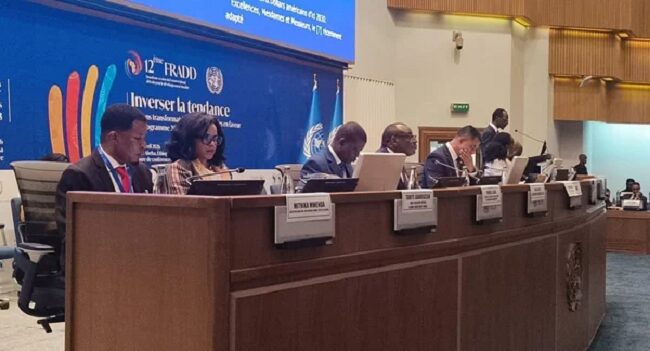
This query was raised by Dr Mithika Mwenda, Executive Director of the Pan African Climate Justice Alliance (PACJA), as he threw a challenge to the global community during the second day of the 12th Africa Regional Forum on Sustainable Development (ARFSD-12) taking place in Addis Ababa, Ethiopia.
Dr Mwenda joined a panel discussion of panellists, including the Executive Secretary of UNECA, the COP32 Presidency, AGN Chair, among other guests, who discussed “Unlocking climate finance for sustainable development in Africa”.
In his intervention, he noted that if the world is truly serious about climate justice, three major problems in the current system must be urgently addressed.
“Looking back at the Climate Finance Responsibility, the UNFCCC and Paris Agreement are dotted with the Common but Differentiated Responsibilities and Respective Capacity (CBDR-RC) principle, which acknowledges that all nations must address climate change, but developed countries bear greater responsibility due to their historical emission and higher capacity. The principle dictates that climate actions should be tailored to national circumstances.”
Pointing to CBDR-RC, Dr Mwenda said that the first challenge is the gradual weakening of the principle of the common but differentiated Responsibilities and respective capacities (CBDR-RC) principle under UNFCCC. He said that African continues to see climate finance delivered mainly as loans instead of grants, commitments that are unpredictable, and growing pressure for African countries to finance their own survival.
He stressed that Africa must demand climate finance that is public, grant-based, sufficient and reliable, especially for adaptation. He emphasised that development and climate justice cannot be separated.
Africa is carrying the crisis it did not create
Africa contributes least to the global emissions, and in the current context, the continent is being asked to decarbonise faster than its stage of development allows. This also forces it to absorb worsening climate shocks and navigate financial systems designed elsewhere. Dr Mwenda described this as the second injustice of transferring the climate burden to Africa.
“The question is not whether Africa should act, because Africa is already acting. The real question is why Africa is being asked to carry a disproportionate share of the cost,” Dr Mwenda said.
He continued calling for more concessional finance, simplified access to funding, and global trade and energy rules that do not disadvantage African economies.
Financing Based on Needs, not Donor Priorities
African Climate activists have been pointing out that African countries know what they need in line with the local context. Hinting at that, Dr Mwenda said that this remains a challenge as the current Climate Finance system prioritises what is profitable, low-risk, or aligned with donor interests rather than what African Communities truly need.
He argued that justice requires a needs-based Approach, one that asks what African countries require to adapt, build resilience, protect livelihoods, and achieve sustainable development.
He urged African countries to push for stronger commitments under the New Collective Quantified Goal (NCQG) on climate finance, ensuring resources align with national priorities and reach local communities directly, especially women and grassroots actors.