

The Global Initiative for Food Security and Ecosystem Preservation (GIFSEP) has called for more practical policies that regard waste as both a societal challenge and an opportunity capable of fostering economic transformation to tackle the inadequate waste management crisis in Nasarawa State.
According to GIFSEP, such policies must prioritise waste reduction, recycling, sustainable financing, and especially bio-waste management, which holds significant potential for value creation.
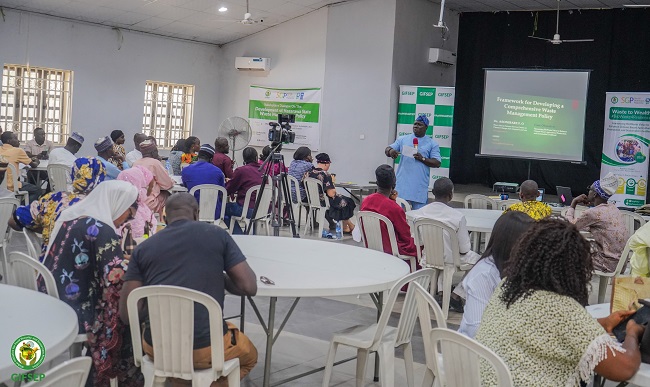
Speaking at a Stakeholders’ Dialogue organised by GIFSEP, with support from the Global Environment Facility – Small Grants Programme, on Tuesday, April 21, 2026, in Nassarawa State, Ms. Dorcas Nicanor, the acting programmes manager, expressed her concerns regarding the persistent challenge of efficient waste management, which she identified as a significant barrier to the state’s development.
Some of the causes she identified as contributing to the problem include rapid population expansion, urbanisation, poverty, and a lack of awareness about proper disposal of waste, particularly bio-waste.
She revealed that findings from a recent baseline survey that GIFSEP conducted showed that about 71 per cent of dumpsites across the state are unmanaged, with most of them small, scattered, and lacking proper oversight.
Ms. Nicanor also disclosed that only 15% of households sort their waste in any way. This is concerning because, although households produce an average of 1.8 kilogrammes of biowaste per day, 97% of them lack the equipment or systems necessary to turn this waste into useful products like compost or biogas.
The fact that over 65% of these dumpsites contain hazardous waste, which poses major threats to the environment and human health, is a concerning issue that she feels the public should be aware of. From a legislative and policy standpoint, the representative of the permanent secretary, Nasarawa State Ministry of Justice, Barr. Ibrahim Sabo, emphasised that waste management is not only an environmental concern but also a legal and regulatory matter.
He referenced the Nasarawa State Waste Management and Sanitation Authority Law of 2021, noting that the law mandates the authority to regulate waste disposal and ensure compliance with established environmental standards.
“However, the success of any policy or legal framework depends largely on inclusive participation, collaboration, and collective ownership,” Barr Sabo said.
He praised the diversity of the stakeholders whose views and contributions he said will help shape a policy that is practical, enforceable, and responsive to the realities on the ground.
Similarly, Mr. Christopher Abari, who spoke on behalf of the director general of the Nasarawa State Waste Management and Sanitation Authority (NASWAMSA), said that his establishment as a body tasked with supervising waste management and sanitation in the state acknowledges the pressing need for a coordinated, inclusive, and modern approach to waste management.
Mr. Abari emphasised that the issues, spanning from increasing waste production to inadequate disposal systems, require collaboration, innovative thinking, and sustained commitment from all stakeholders involved.
He noted that the dialogue presents an opportunity to integrate sustainable solutions such as improved waste segregation, recycling, and biowaste management into our systems.
Barr. Ede, the representative of the permanent secretary, Ministry of Environment and Natural Resources, Nasarawa State, accepted that the Nasarawa State Government, through NASWAMSA, has remained diligent in its efforts to uphold environmental standards and promote proper waste management practices across the state.
He advocated as a matter of urgency that there should be a transition from the traditional “collect and dump” approach to a more modern, efficient, and sustainable waste management system supported by appropriate infrastructure and innovative solutions.
Mr. Envoh Okolo, State Coordinator, Nasarawa State Network on Environment and Climate Justice, agrees with the fact that the development of the waste management policy is timely, noting that in some areas, dumpsites have become reference points for giving directions, highlighting the scale of the problem.
He pointed out that there are existing gaps within the waste management sector, with the gaps ranging from inadequate infrastructure and limited public awareness to inefficiencies in collection and disposal systems that continue to hinder effective waste management across the state.
According to him, to address these challenges would require not only sound policy frameworks but also coordinated action, innovation, and sustained stakeholder collaboration.
Participants at the event included government officials, representatives from civil society organisations, private sector actors, academics, journalists, and community members. They expressed optimism that the current policy development process will result in practical solutions, enhanced institutional coordination, and a cleaner, healthier environment for the residents of Nasarawa State.
By Etta Michael Bisong, Abuja