

Ghana is hosting a pivotal three-day Strategic Meeting of the African Group of Negotiators (AGN), bringing together UNFCCC National Focal Points, African Lead Coordinators, and key partners to consolidate Africa’s common position ahead of the 31st and 32nd sessions of the Conference of the Parties (COP31 in Antalya, Turkey, and COP32 in Addis Ababa, Ethiopia).
The meeting, taking place from March 30 to April 1, 2026, marks the first in-person strategic convening under Ghana’s chairmanship of the AGN. It is expected to deliver a practical roadmap to strengthen Africa’s negotiating platform, sharpen continental priorities, and reinforce coordination within the AGN and the broader African three-tier negotiation structure.
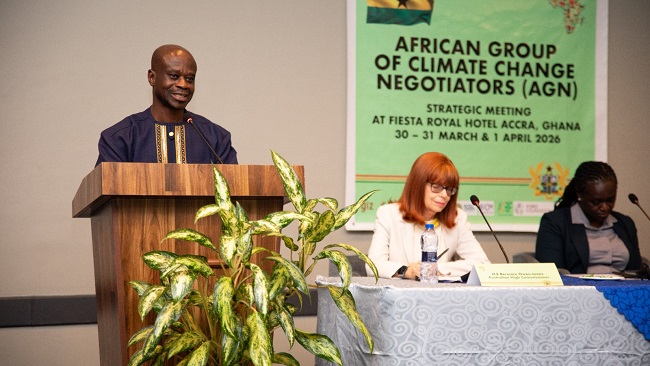
Welcoming participants to Accra, Prof. Nana Ama Browne Klutse, Chief Executive Officer (CEO) of the Environmental Protection Authority (EPA), described the meeting as timely and critical.
“Africa’s strength in global climate negotiations has always been its unity. At this defining moment, we must reinforce that unity and ensure our collective voice continues to shape outcomes that reflect our realities and aspirations,” she stated.
Prof. Klutse underscored that Africa continues to face disproportionate climate impacts despite contributing the least to global emissions, emphasizing that climate action must be anchored in equity, justice, and adequate support.
She highlighted key priorities for Africa, including scaled-up and predictable climate finance, enhanced adaptation efforts, capitalization of major UNFCCC funds, and equitable access to technology and capacity-building support.
The meeting also recognises a historic milestone for Ghana, as Nana Dr. Antwi-Boasiako Amoah assumes leadership of the AGN – the first time the country has chaired the group since signing the United Nations Framework Convention on Climate Change in 1992.
Delivering the keynote address, Baba Issifu Seidu, Minister of State at the Office of the President for Climate Change and Sustainability, stressed that the global climate process has entered a critical phase focused on implementation, accountability, and delivery.
“Africa must position itself not only as a participant, but as a driver of outcomes across all negotiation tracks,” he said.
The Minister outlined priority areas for Africa’s engagement, including:
- Advancing the Global Goal on Adaptation with measurable, flexible, and impact-driven indicators;
- Ensuring clarity, adequacy, and accessibility of climate finance under the New Collective Quantified Goal (NCQG);
- Safeguarding equity within the Mitigation Work Programme, while supporting just transitions, energy access, and economic transformation.
He emphasised that climate finance remains a matter of equity and trust, and that without accessible and adequate funding, adaptation and mitigation efforts will fall short.
The Strategic Meeting features both open and closed sessions. The open session on March 30 focused on partner dialogue and Africa’s engagement in global platforms such as the G20, while subsequent closed sessions will drive thematic alignment, develop negotiation instructions, and establish coordination mechanisms for effective follow-through.
Participants are expected to produce clear decisions, identify outstanding issues, assign responsibilities, and agree on immediate next steps to guide Africa’s climate diplomacy through the 2026-2027 biennium.
As Africa prepares to host COP32 in Addis Ababa, the meeting is seen as a critical opportunity for the continent to consolidate its voice and influence global climate outcomes.
“The future of Africa will not be defined by negotiations alone, but by how effectively we shape them,” Seidu noted. “This is the moment for Africa to act with unity, purpose, and resolve.”
Ghana reaffirmed its commitment to climate resilience and inclusive development through national frameworks, including adaptation planning and nationally determined contributions, while calling for strengthened regional cooperation.
The Government of Ghana and the Environmental Protection Authority expressed confidence that the outcomes of the meeting will position Africa to engage more effectively and strategically in upcoming global climate negotiations.
Rona Ali Ahmed, International Organisation for Migration (IOM) – UN Migration Special
Liaison Office to the AU and United Nations Economic Commission for Africa (UNECA), said: “Sub- Saharan Africa recorded 19.3 million internal displacements in 2024, including 7.8 million caused by disasters, underscoring the scale of climate-induced movement. IOM’s three strategic pillars for addressing climate mobility include; developing solutions for people to move, for people on the move, and for people to stay. Examples include efforts in West Africa to reduce displacement and enable regular migration pathways; support to pastoralist communities in Kenya to safeguard trans-humance routes and diversify livelihoods; and initiatives in Morocco where diaspora engagement promotes agro- ecology, strengthens food security, and creates green jobs in rural areas.”
Kulthoum Omari Motsumi, Technical Advisor, Adaptation Initiative (AAI): “As a creation of African Heads of State and government to support adaptation efforts on the continent, AAI remains committed to this mandate. As we commemorate 10 years of our existence, we remain steadfast in our quest to continue offering technical support to the African Group of Negotiators as mandated by our leaders, with particular emphasis on ensuring that adaptation remains a global priority, particularly given the dwindling financial resources and limited capacity to adapt to what we have not caused.”
Dr. George Wamukoya, African group of Negotiators Experts Support (AGNES) Team Lead: “Agriculture, being critical for Africa’s economy and livelihoods and therefore COP 32 must unlock increased investments into agriculture.”
Walters Tubua, Regional Lead for the UNFCCC Regional Collaboration Centre (RCC) for West and Central Africa: “The UNFCCC and its RCCs are available to support countries in identifying their national priorities and needs, including mobilising support to ensure these are adequately costed and are grounded in the third generation NDCs and NAPs, as well as their implementation plans.”
Augustine Njamshi, Pan African Climate Justice Alliance (PACJA): “Africa cannot afford to treat COP31 and COP32 as routine negotiation cycles. We must see them as strategic turning points. The reality is that we have become very skilled at defending positions. And we now understand, from our many years in these global policy arenas, that positions alone do not alter outcomes. Recent COP decisions highlight the issue. The financial outcome from COP29 fell short of what science, equity and fairness require.”