

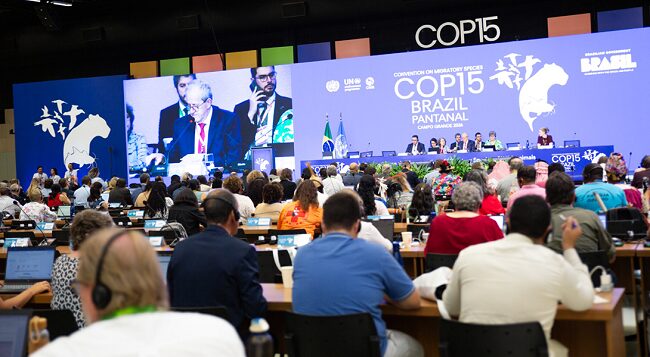
Confronted with stark new evidence that many migratory species are moving closer to extinction, governments at a major UN wildlife conservation meeting on Sunday, March 29, 2026, agreed on expanded conservation efforts, including new or enhanced treaty protections for 40 species and populations of birds, aquatic wildlife, and terrestrial animals.
Meeting in Brazil, Parties to the Convention on the Conservation of Migratory Species of Wild Animals (CMS) adopted several measures to strengthen global or regional conservation efforts of such iconic species as the cheetah, striped hyena, snowy owl, giant otter, great hammerhead shark, and several shorebird species facing steep population declines.
Parties agreed to list the 40 additional species or populations of species on CMS Appendices I (species in danger of extinction) or II (species in need of coordinated international action), which now include over 1,200 unique species under the 47-year-old Convention.
They also approved multi-species conservation plans in key regions such as the Amazon.
The week-long CMS COP15 opened with new findings that key indicators for many treaty-protected species continue to trend downward, reinforcing warnings that habitat loss, overexploitation, and infrastructure barriers are accelerating declines across species that traverse national borders.
The conference also highlighted a growing need to address threats such as deep-sea mining, climate change, plastic pollution, underwater noise, illegal wildlife killing, fisheries bycatch, and marine pollution.
CMS COP15 began with strong political and scientific warnings: migratory species are in accelerating decline and international cooperation is required to effectively respond.
- The State of the World’s Migratory Species: Interim Report (2026) report underlined that key biodiversity indicators are trending negatively, with rising extinction risk and population declines
- Scientific and political leaders, including Presidents Luiz Inácio Lula da Silva of Brazil and Santiago Peña of Paraguay, underlined threats such as habitat fragmentation, bycatch, illegal killing, and infrastructure barriers
- Parties emphasised ecological connectivity, international cooperation, expanded partnerships with CITES, IPBES, and other multilateral agreements
- There was a strong push to integrate Indigenous and local knowledge into scientific considerations, with a parallel debate on how to balance scientific rigor with multiple knowledge systems
Said CMS Executive Secretary, Amy Fraenkel: “We came to Campo Grande knowing that the populations of half the species protected under this treaty are in decline. We leave with stronger protections and more ambitious plans but the species themselves are not waiting for our next meeting. Implementation has to begin tomorrow. Expanded protections for striped hyena, snowy owls, giant otters, great hammerhead sharks, and many more, demonstrate that nations can act when the science is clear. Our duty now is to close the distance between what we’ve agreed and what happens on the ground for these animals.”
Said João Paulo Capobianco, Chair of COP15 and Executive Secretary, Ministry of the Environment and Climate Change, Brazil; “We protect species that may never remain within our borders. We invest in a natural heritage we do not own, but are all responsible for. In doing so, we give concrete meaning to global solidarity, recognizing that migratory species transcend nations, jurisdictions, and generations. From the Pantanal to the Arctic, from the oceans to the savannas, migratory species connect our planet in ways no political map ever could. They remind us that ecological integrity depends on continuity on flows that must remain alive, uninterrupted, and resilient.”
With the conclusion of COP15, the Government of Brazil now holds the mantle of the CMS COP Presidency and will carry the momentum from this meeting into the next three years, not only in South America but also for all regions of the world, for the conservation of migratory species and their habitats.