

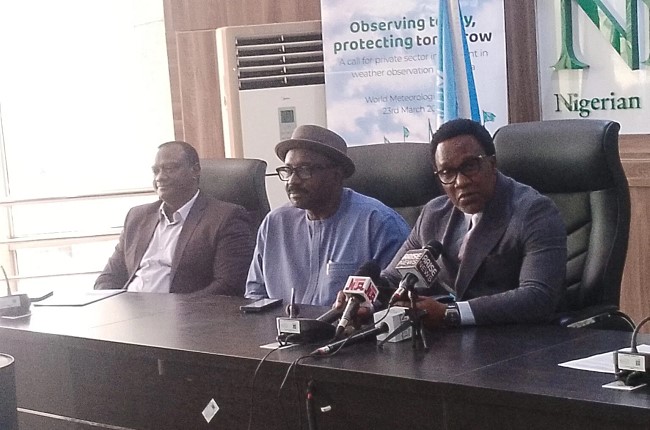
Director-General of the Nigerian Meteorological Agency (NiMet), Prof. Charles Anosike, has urged the private sector to increase investment in advancing weather and climate services across Nigeria and the wider region.
Anosike made the call during his opening remarks on Wednesday, March 25, 2026, in Abuja at the World Meteorological Day celebration themed “Observing Today, Protecting Tomorrow,” highlighting the critical role of timely and accurate weather information.
According to him, the private sector can strengthen meteorological observation systems by investing in weather stations, remote sensing technologies, data analytics platforms, AI weather models, and innovative observation tools complementing national networks globally.
“We recognise that public-private collaboration is essential to achieving a robust and sustainable national observation system.
“Strategic partnerships promote shared investment, improve data exchange, and encourage innovations in meteorological observation technologies.
“’Observing Today, Protecting Tomorrow’ is more than a theme; it is a call to action.
“Investing today in data and systems safeguards our future, ensuring accurate forecasts and stronger climate resilience,” Anosike added.
He said that every weather station installed and every observation collected nowadays enhanced understanding of atmospheric dynamics for decades and strengthened predictability of future weather and climate events.
Anosike emphasised that weather and climate observations form the backbone of meteorology, stating that accurate forecasts, early warnings, and climate outlooks all depended on timely, reliable data from land, water, air, and space.
He said NiMet continued to expand and modernise Nigeria’s meteorological infrastructure, including surface and upper-air observation networks, satellite data reception systems, and automatic weather stations critical for forecasting and climate monitoring.
“These observations support safer aviation operations, improved agricultural planning, better disaster preparedness, maritime safety, and informed decision-making across all sectors of the economy.
“In line with the WMO Voluntary Cooperation Programme, NiMet provides Peer Advisory services to Liberia, Niger, Somalia, and Burkina Faso on the Systematic Observations Financing Facility, producing technical documentation, analysis, and recommendations to strengthen their observational capacity.”
In spite of these strides, Anosike stated that current demands on meteorological services were greater than ever due to climate change, which increased the frequency and intensity of extreme weather events and shortened the lifespan of monitoring equipment.
He explained that governments, communities, and businesses relied on timely weather information to protect lives, safeguard infrastructure, and sustained economic activities, highlighting the urgent need for accurate meteorological data.
Citing the Nigeria Climate 2025 report, he said extreme daytime temperatures (≥40°C) were recorded across 23 cities, with the northwest and northeast experiencing the most intense heat, including 100 days above 40°C in Nguru, Yobe State.
“Flood events are also increasing in frequency and intensity nationwide. Quality observation information is essential for anticipating these events and guiding response efforts,” Anosike said.
He added that technological innovations, growing knowledge, and expanding markets made private sector participation viable, with governments providing policy support, incentives, and tax breaks for investment in climate services.
“I call on industry leaders, technology innovators, research institutions, financial institutions, and development partners to collaborate with NiMet in expanding Nigeria’s meteorological observation capabilities.
“As we celebrate World Meteorological Day, let us reaffirm our commitment to strengthening observations, deepening partnerships, and investing in science that protects our present and preserves our future,” Anosike said.
The World Meteorological Day is commemorated globally every March 23 to celebrate the establishment of the World Meteorological Organisation and highlight achievements in weather and climate science.
The day provides an opportunity to reflect on how meteorological services safeguard lives, support sustainable development, and strengthen economic resilience across nations worldwide.
By Gabriel Agbeja