

China has released its 15th Five-Year Plan (2026–2030) during the country’s annual “Two Sessions” meetings, setting out economic and industrial priorities for the next five years. The plan confirms continued expansion of renewable energy and a carbon-intensity reduction target of 17%, notably lower than the previous carbon intensity target.
It however stops short of outlining the structural changes needed to put China firmly on a path toward declining emissions this decade, referring to peak instead of previous language to phase down coal.
The announcement comes as the Chinese People’s Political Consultative Conference (CPPCC) and the National People’s Congress (NPC) meet in Beijing, gatherings that traditionally set the direction for major policy priorities, including energy and climate strategy. Recent approvals of new coal power capacity, the highest in nearly a decade, highlight the gap between China’s strategic ambition and near-term implementation, a gap the 15th Five-Year Plan does not sufficiently address.
The plan was widely expected to mark a clearer transition from carbon-intensity targets toward absolute emissions reductions, following China’s pledge to peak emissions before 2030. Instead, it leaves significant ambiguity about how China will translate record renewable deployment into sustained emissions cuts, particularly as coal approvals have surged to their highest level in nearly a decade.
With China responsible for roughly one-third of global emissions, it is believed that the direction set in the plan will have major implications for the world’s ability to limit warming.
Andreas Sieber, Associate Director of Policy and Campaigns at 350.org, said: “China has built more renewable energy than the rest of the world combined, but this plan still does not clearly translate that progress into a fast enough structural and deep decline in emissions. This is insufficient progress.
“Expanding wind and solar at record speed is a huge achievement, but it must now be matched with a decisive phase-down of coal and a clear pathway to absolute emissions reductions. People want clean air, stable energy prices and climate security. China’s next development phase must deliver more than clean energy growth; it must end fossil fuel expansion.”
350.org said the scale of China’s renewable rollout demonstrates that the energy transition is technologically and economically achievable but warned that continued coal expansion risks undermining global climate goals.
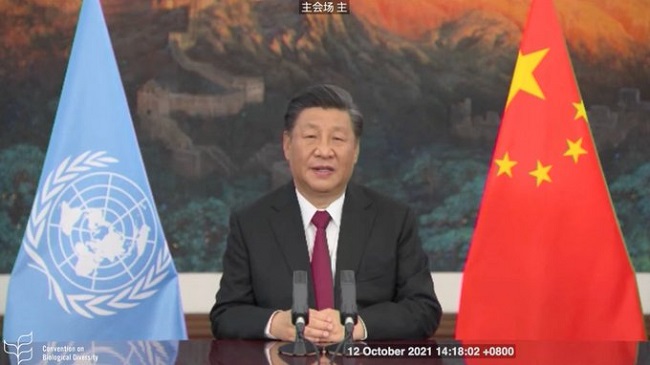
In September 2024, President Xi Jinping announced China’s climate target under the Paris Agreement, its Nationally Determined Contribution with binding economy-wide emission reduction target of 7-10% by 2035 from peak levels, “striving to do better
This target was widely viewed as insufficient. According to UNEP analysis, China could reduce emissions by at least 28-37% by 2035.
Year 2025 has marked a turning point: Chinese emissions have flatlined or fallen since March 2024, nearly two consecutive years, with a likely 0.3% decline in 2025, marking the first sustained stabilisation and slight fall – hence 2025 is likely to serve as the base year for Chinese emission reduction target.
However, China would be on track to glaringly miss its carbon intensity targets if it were not for revising the definition of carbon intensity to include industrial process emissions.
With estimated emissions of 15.8 Gt CO₂e in 2024, China stands as the world’s largest emitter, accounting for roughly 32% of global greenhouse gas emissions.