

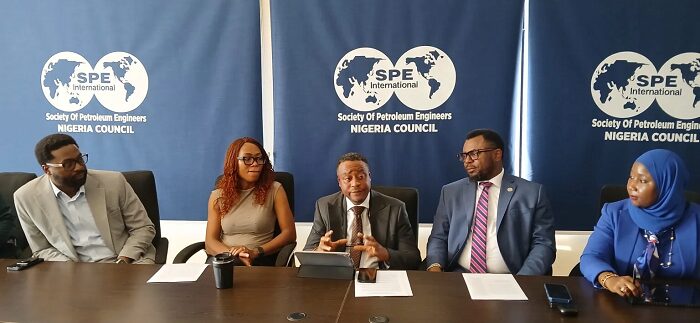
Chairman of the Society of Petroleum Engineers Nigeria Council, Mr. Francis Nwaochei, has called for resilience, strategic coordination and disciplined execution to reposition Nigeria as a dominant force in the global oil market.
Nwaochei made the call ahead of the 2026 Oloibiri Lecture Series and Energy Forum (OLEF), scheduled to hold on April 9 at the Petroleum Technology Development Fund (PTDF) Tower in Abuja.
The 2026 edition has the theme “Beyond the Three Million Barrels Target: Harmonising Digitalisation, Capital and Policy Frameworks for Intelligent Operations and Asset Optimisation”.
It will focus on moving Nigeria’s production drive from aspiration to implementation.
He said geopolitical tensions and supply chain disruptions had exposed vulnerabilities in global energy systems while creating leadership opportunities for resource-rich nations like Nigeria.
“Global instability underscores the importance of disciplined planning in our petroleum industry. But it also presents Nigeria with a unique opportunity to lead,” he said.
According to him, Nigeria’s ambition to exceed three million barrels per day is achievable, but only through innovation, disciplined capital deployment and smarter institutional coordination.
“Easy production is no longer an option. Only intelligent operations will deliver sustainable growth,” he added.
Nwaochei noted that crude oil output directly affects public revenue, foreign exchange stability, infrastructure financing and overall economic confidence, stressing that production levels ultimately influence the cost of living.
He said surpassing the three-million-barrel threshold was fundamental to strengthening fiscal stability, supporting domestic refining, unlocking gas resources for power and industry, and reinforcing Nigeria’s credibility as a dependable global supplier.
However, he cautioned that ambition without structural alignment would falter.
“When approval processes are slow or mandates overlap, investment momentum weakens. Unclear fiscal terms deter capital.
“Real progress depends on aligning digital innovation and funding with efficient and transparent policies,” he said.
Nwaochei explained that OLEF 2026 would centre on three pillars: financing, policy alignment and asset optimisation – with discussions expected to address implementation of Nigeria’s petroleum industry framework, fiscal stability and investor confidence.
He added that the forum would also examine ways to strengthen indigenous operators through improved access to financing and technology partnerships, as well as unlock value from idle wellbores.
The chairman highlighted the transformation underway in the downstream segment, driven by the emergence of the Dangote Refinery and a growing network of modular refineries.
He said expanded domestic refining capacity could reshape fuel supply dynamics, employment levels, pricing structures and foreign exchange management, but stressed that investments in pipelines, storage and gas-to-liquids projects remained critical.
Nwaochei reaffirmed the council’s commitment to facilitating technical dialogue and providing data-driven insights to support informed decision-making.
“Unlike ceremonial conferences, OLEF 2026 is structured as a working forum designed to produce concrete recommendations capable of shaping regulatory reviews, investment strategies and national planning.
“Nigeria’s energy future must be competitive, resilient and sustainable. We must balance innovation with strong regulation, investment with stability, and ambition with disciplined execution,” Nwaochei said.
By Yunus Yusuf