

Representatives from every inhabited continent joined forces on Friday, February 27, 2026, in an unprecedented show of solidarity over the escalating crisis in the Marshall Islands, where decades-old nuclear contamination and rising sea levels are converging to create what advocates call a “double tragedy” with potentially global consequences.
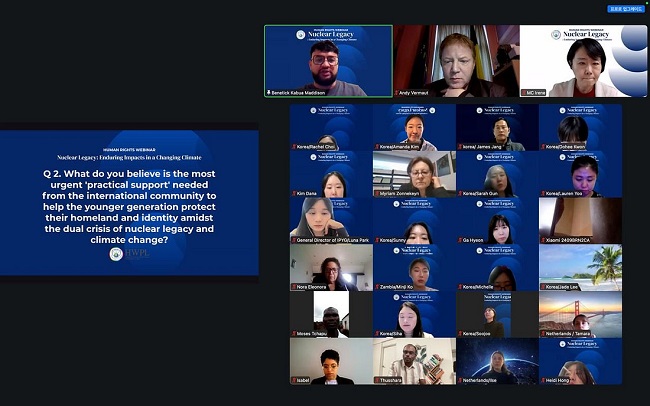
The international webinar, held on the eve of Nuclear Victims and Survivors Remembrance Day, brought together lawmakers, judges, climate ambassadors and civil society leaders to demand coordinated international action before radioactive debris from Cold War-era weapons testing re-enters marine ecosystems – a scenario scientists warn is growing increasingly likely as Pacific waters rise.
March 1 marks the anniversary of the 1954 Castle Bravo hydrogen bomb test, the most powerful nuclear device the United States ever detonated, which showered inhabited atolls with radioactive fallout and left a legacy of illness, displacement and environmental destruction that persists more than seven decades later.
A ticking nuclear clock
Between 1946 and 1958, the United States conducted 67 nuclear tests in the Marshall Islands, vaporising entire islands and contaminating vast stretches of land and ocean across the central Pacific.
Today, the most pressing concern centres on the Runit Dome on Enewetak Atoll – a concrete cap built in the late 1970s to contain radioactive soil and debris from the testing programme.
Rising sea levels now threaten to compromise the aging structure, raising urgent fears that plutonium, cesium and other radioactive materials could leach into the surrounding ocean.
The potential breach would not only devastate local communities already grappling with severe climate vulnerabilities but could also contaminate broader Pacific marine ecosystems, transforming what has long been treated as a localised problem into an international environmental emergency.
‘The world can no longer look away’
Benetick Kabua Maddison, executive director of the Marshallese Educational Initiative, framed the crisis in stark terms.
“The world is witnessing a ‘double tragedy’ in real time,” Maddison said.
“The unresolved nuclear contamination in the Marshall Islands, combined with the climate crisis, constitutes a global security concern. This is about our right to a safe future, and the world can no longer look away.”
Maddison said the intercontinental nature of Friday’s gathering was deliberate, intended to demonstrate that the Marshall Islands’ fight is no longer a bilateral dispute between a small Pacific nation and the United States but a matter demanding global engagement.
Legal accountability endures
Justice Thushara Rajasinghe of the High Court of Fiji delivered a pointed legal assessment, arguing that state responsibility for environmental harm does not diminish with time – a principle with direct implications for the United States’ obligations to the Marshall Islands.
Rajasinghe called for the development and implementation of practical legal frameworks to ensure accountability and preventive protection against climate-induced nuclear risks, suggesting that existing international law provides sufficient basis for action if the political will can be marshaled.
Hiroshi Vitus Yamamura, a Marshallese member of Parliament and former minister of public works, praised the resilience of his people while emphasising the urgent need for global technical and legal cooperation to address the long-term health and environmental consequences of the testing era.
European voices join the chorus
The crisis has drawn increasing attention from European climate advocates. EU Climate Pact Ambassadors, Lalit Bhusal of the Netherlands and Andy Vermaut of Belgium, highlighted the critical role of civil society in elevating the Marshall Islands’ plight within the broader global climate justice agenda.
Their participation underscored a growing recognition that the intersection of nuclear contamination and climate change in the Pacific represents a test case for international accountability – one with implications for contaminated sites and climate-vulnerable communities worldwide.
Beyond rhetoric
The dialogue, convened by Heavenly Culture, World Peace, Restoration of Light – an international peace organization founded in 2013 – concluded with a unified call for the international community to move beyond rhetoric and commit to coordinated technical, legal and financial mechanisms to secure contaminated sites before irreversible environmental consequences unfold.
The demands reflect mounting frustration among Marshallese leaders and their international allies that decades of advocacy have produced insufficient action from the United States, which has maintained that a 1986 compact settlement adequately addressed its obligations – a position the Marshall Islands government and independent assessments have repeatedly contested.
For the approximately 42,000 people who call the Marshall Islands home, the convergence of nuclear legacy and climate crisis presents an existential threat.
Their atolls, most barely two metres above sea level, face inundation within decades.
The question now is whether the international attention generated by gatherings like Friday’s webinar can translate into the concrete action needed before the Pacific swallows both the evidence and the people who have borne its consequences for three generations.
By Winston Mwale, AfricaBrief