

Canon EMEA, in partnership with Coral Spawning International (CSI) and Nature Seychelles (NS), says it has successfully achieved, and experienced its first coral spawning event in the newly established on-land coral breeding lab on Praslin Island in the Seychelles.
The lab was built as a part of Nature Seychelles’ Assisted Recovery of Corals (ARC) facility and is said to represent a significant advancement in restoring and protecting coral reefs against climate change by pioneering controlled sexual reproduction.
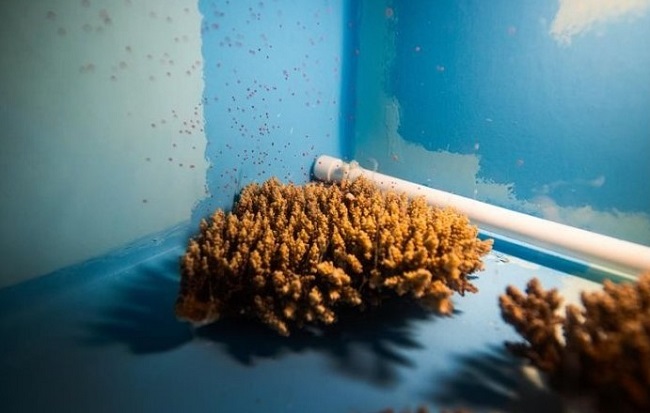
Since its operational launch in November, the lab has successfully produced approximately 800,000 coral embryos from 14 colonies belonging to the species Acropora tenuis cf. macrostoma. Initial evidence is said to be highly encouraging showing the settlement of approximately 65,000 new corals, indicating the potential increase of genetic diversity and thermal resilience of the reef in the Seychelles.
This has been achieved by moving beyond traditional “coral gardening” techniques that normally result in genetically identical corals. Supported by Canon’s investment and advanced imaging equipment, the lab enables unprecedented observation and documentation during these natural spawning events.
These tools are essential for building a diverse genetic bank of resilient coral species and provide researchers with invaluable data on reproductive timing and critical early growth and survival, all of which are crucial for developing reefs capable of withstanding threats like coral bleaching.
“Witnessing our first successful spawning event at the lab has been incredibly rewarding,” says Dr. Nirmal Shah, CEO of Nature Seychelles. “This lab, a key addition to our ARC facility thanks to Canon’s vital support and technology, has changed what is possible for coral restoration in the Seychelles. Since November 2025, we have seen coral offspring not only survive, but settle, grow, and cross the most fragile thresholds of early life, turning a moment of spawning into a pipeline of living, growing reef builders. In the months ahead, our focus is to move from proof of concept to impact at scale: increasing production, sharpening our understanding of priority species, and opening to students and partners so restoration becomes a next-level effort.”
“To see the lab within the ARC facility open and already achieve its first natural spawning event is a testament to the dedication of this partnership and the innovation it represents,” comments Dr. Jamie Craggs, marine scientist and co-founder of Coral Spawning International.
He adds: “Canon imaging technology has been pivotal, allowing us to observe critical reproductive processes with a clarity we could only dream of before.
“We designed the systems to facilitate predictable spawning, enabling rapid learning and providing unprecedented insight into coral reproductive timing in Seychelles through the data and images collected by the team. The initial number of corals produced is hugely encouraging, and this marks just the first of many spawning events over the coming years.”
Peter Bragg, Sustainability and Government Affairs Director at Canon EMEA, says: “This year, our focus will be on reaching key milestones, including beginning to outplant juvenile corals grown in the lab and placed directly in the reef, and tracking the survival of these genetically diverse corals post-out planting, as well as expanding local expertise through advanced technical training.
“The outcomes of this first spawning have been incredibly positive, and we will continue pushing the boundaries of coral reproductive science to new heights while equipping more communities with these vital tools.
“The fully operational lab and its successful coral spawning events are a clear demonstration of how technology can support scientific progress. We are particularly excited by how our imaging equipment is enabling researchers to reveal the intricate, previously unseen processes of coral reproduction, delivering invaluable real-world insights. We look forward to seeing this project evolve and in believe it will continue to foster a sustainable future for these vital marine ecosystems.”