

People want different things out of their cities… The last thing you want are people who are uncaring and disinterested in their cities. That is when you get true neighbourhood decline” (W. Paul Farmer, APA, CEO)
For those who grew up in Lagos between the fifties and the seventies, a vivid recollection of Lagos Island then brings back nostalgic feelings and the pride of a well-governed municipality where basic urban services were held in high esteem and provided regularly.
Urban security, provision of potable water, and zero tolerance for a filthy environment were the hallmarks of the municipal government. Erected water taps, locally called “idi odo”, were common urban features of public water supply for residents whose buildings were not connected to the water mains from the Lagos municipal government of yore, Lagos Town Council.
Environmental pollution was a rarity. Most of the frontage of the residential houses along the popular streets was landscaped with beautiful flowers. Greenery was encouraged and voluntarily imbibed by the city residents. Property owners did routine maintenance on their properties, and door-to-door waste collection was a regular basic service.
The fear of city crime was remote because the city government prioritized security, while neighbours were their brother’s keepers. Generally, city living was peaceful and less stressful.
The current situation reports on a set of popular streets in Lagos
Fast-forward to the current city situation in comparison to the past situation described above, and let us do a comparative analysis of the following popular roads in Lagos, identified for this discussion, namely:
Lewis Street
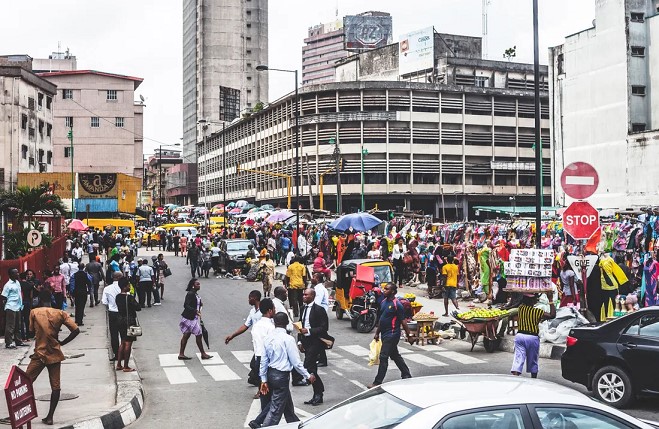
Compared to the 50s, 60s, and 70s, the present Lewis Street has been turned into a linear market where traders display their goods on both sides of the road with impunity. The road width has been drastically reduced, thereby obstructing the smooth flow of traffic. Traders of all hues compete with motorists, while mobile water vendors, wheelbarrows in tow, dangerously meander among teeming pedestrians and motorists at great risk. The street is jocularly referred to as “Sandgrouse Market Phase II,” in reference to the nearby government-approved local market.
At the northern end of the street, close to Obalende, is a rowdy motor park for the ubiquitous Danfo bus operators. They contribute significantly to the ongoing degradation of the public open space that has been improvised as a roadside motor park. The waste generated daily by the Danfo operators poses a challenge for LAWMA to manage.
As constituted, Lewis Street has completely lost its past allure and serenity as a convenient motorway due to official neglect and citizens’ crass indiscipline.
Igbosere Street
This street runs parallel to the famous City Hall, a landmark building on Lagos Island. It is currently being used as an alternative road market. The generous open space along the road, preserved for landscaping, is an eyesore! The ungoverned open space is illegally occupied by keke maruwa mechanics, furniture sellers, livestock sellers, building material vendors, and sundry economic activities near the Lagos State court houses, where noise pollution is strictly prohibited.
Two motor parks are located on this road. One is at the side of the City Hall, and the other is at the junction of Igbosere/Moloney Streets. Both motor parks are spontaneous developments without official authorisation. Both incompatible land uses are unsightly and environmentally disruptive.
Moloney Street and Environs
Moloney Street is a significant feeder road on Lagos Island. The road is linked to other secondary roads, namely: King George V Street, Campbell Street, Igbosere Street, Hawley Street, Beckley Street, and nearby short alleys. It is a popular street leading to many historic government buildings, institutions, social clubs, playgrounds, schools, courts, and museums.
The street is within walking distance of the Tafawa Balewa Square( a national parade ground), the old Parliament building, the 25-storey Independence iconic building, and the former headquarters of the Federal Ministry of Works and Housing, former Nigeria Army Headquarters, Supreme Court, Lagos State Court houses, former Nigeria Police Headquarters, Lagos Island Club, Lagos Lawn Tennis Club, Yoruba Tennis Club, The City Mall, Muson Centre, Kings College, National Museum, the JK Randle Centre and Obalende Transport Hub.
Also on this street is a masterpiece residential house built by the first indigenous Federal Minister of Finance, the late Chief Festus Oko-tie Ebo, who was assassinated during Nigeria’s first military coup on January 15, 1966.
The state of Moloney Street currently is better described as tohu bohu (a state of extreme confusion and disorder-a bedlam). The road is usually inundated by an army of fruit vendors, roadside local eateries popularly known as buka, fresh fish sellers, redneck street urchins, and agberos (motor boys) who constitute a security risk to both pedestrians and motorists who use Moloney Street daily.
The environment around the FMWH within the same area under review cannot be overlooked. The area is disorganized and untidy, as a result of illegal occupants who engage in various trading and rogue activities, deleterious to the environment.
The least expected invasion is the open space directly in front of the Kam Salem Building, the former Nigeria Police Headquarters, where trading activities are active despite the security implications! Two motor parks are located on Moloney Street, with no plausible justification or official approval. They are mainly responsible for the constant public chaos and insecurity on this particular road.
Beckley and King George V Streets
The two streets are “sore thumps” in the vicinity of Moloney Street. Both are congested with itinerant traders who intentionally occupy the street space despite the inconvenience to road users. On Beckley Street are various wooden cubicles attached to the perimeter fence of the Kam Salem police building, mostly used as barbing salons, while small make-shift containers are also used as mobile shops. Itinerant fruit vendors find succor on this street to sell their edible products.
On King George V Street, the scenario is worse. Visible are strings of wooden and mini steel containers attached to the perimeter fence of the YWCA building, where trading goes on unregulated. The open space was deliberately occupied without government approval. A shop owner on that street permanently parked a truck that occupies half of the road without consideration for other road users. Why such inappropriate behavior missed the prying eyes of KAI officials beggars’ belief.
While I was about to conclude this piece, a video clip was sent to me through social media titled “Why Are Africa’s Cities the UGLIEST in the World?” Lagos was featured negatively. The reasons the narrator gave for weak urban management in African cities are tenable, cogent, and instructive. They apply to the Lagos situation. Interested readers can search for the video clip with the same title on YouTube.
A need for action
If Lagos is truly the Centre of Excellence, the State government must walk the talk and be committed to implementing strategies that promote/enhance city aesthetics. But the caveat is: as noted by Larry Bossidy (co-author of Execution: The Discipline of Getting Things Done), strategies are intellectually simple, but the implementation is not. Any good thoughts or ideas without action are meaningless.
Therefore, the Lagos State Government must demonstrate the political will to improve the quality of life in the megacity. The government must have zero tolerance for indiscipline, corruption, lethargy, and venality.
The duo of Engr. Tokunbo Wahab, the incumbent Commissioner for Environment and Water Resources, and Dr. Olayinka Olumide, Commissioner for Physical Planning and Urban Development, have a yeoman’s job to do in restoring sanity to Lagos streets and preventing further flagrant misuse.
The first step is to beam a searchlight on all the Lagos Island streets mentioned in this piece. Ban all motor parks and roadside markets with immediate effect, and restore order to the vicinity. They should facilitate and relentlessly promote friendly streets with clean, walkable, and eco-friendly facilities. LASPARK should plant trees in ungoverned public open spaces to prevent misuse and sudden takeover by itinerant traders.
Motor parks are permitted only in designated areas, not haphazardly on the streets as is currently being done.
KAI must intensify monitoring along the streets and prohibit any obstructive developments against traffic flow. Let KAI be upgraded to KHAI (Kick Harder Against Indiscipline) as a new public enlightenment mantra for citizens’ self-control, environmental cleanliness, and city aesthetics. Enforcement of environmental regulations should not be an option. It should be non-negotiable, as exemplified in Kigali, Rwanda, Africa’s cleanest city, or in Singapore, a biophilic city (a city in the garden).
Finally, on a cautionary note: If a city law is not obeyed, it gives room for anarchy. And a city that will not say “NO” to anything will get the worst of everything.
By Tpl. Yacoob Abiodun, Planning Advocate, Chicago, IL, USA
This is a fantastic piece. It captured the situation and scene very well. I thought I was reading a ‘story’ as we call it in journalism by the Features Editor of one of the national dailies. I equally like the recommendations for actions/improvement. In truth, that part of Lagos Island needs to have total restoration / regeneration. It should be declared as a Heritage Building Zone and be promoted for urban tourism.
– By Dr. Moses Ogunleye
Yet we are supposed to be able hands in the environmental management and physical development of the city called Lagos, the question I asked some of them on my contact when I had that there would be Eyo festival was that how were they going to manage the roving eyes of the camera during the festival to the world? But unfortunately, they seem not to be bothered or can’t see beyond their noses as they not only did the Eyo festival, but they also went further to install new white cap chiefs and pronounced the incumbent commissioner for physical planning and urban development “Chief Atunluto of Lagos”. Meaning they’re aware of the deplorable environment but care less as long as the money roles in.
– By Tpl. A. P. Onaneye
Good write-up, Sir Tito!
It is an eyesore when developing cities undergo population explosion without due control, and especially when municipal officers fraudulently allow their illegality to fester. The street traders and the ubiquitous motor parks will not exist for ten seconds if local city officials are not in connivance with them through collection of “market taxes.”
– By Dele Brown, Lagos Island
I believe truth must be told to people in the corridors of power. Lagos Mega-city is environmentally unfriendly. People don’t care about the city. Ditto those in charge of urban planning and development. Sad.
– By Jimo Oyetolu, Sagamu
Quite an interesting piece as usual, sir.
As highlighted, necessary political will, which is the essential commitment of our leaders to drive policy changes, overcome obstacles, and implement reforms, serving as link between intention and critical action, would be needed to combat the menace of motor parks, and markets on Lagos Island streets.
– By Tpl. Elegbede, Satellite Town, Lagos
This is the creation of the political class meant to harass the voting populace into submission whenever the need arises. The motor park leaders are now members of the political parties. The populace is being fleeced daily with the criminal fares charged for transportation all over the state. The government supports this system because returns are rendered to the state secretariat monthly. The parks are there rough and dirty because the government monitoring authority had long been compromised.
– By Gbolahan Ogunneye, Campos, Lagos