

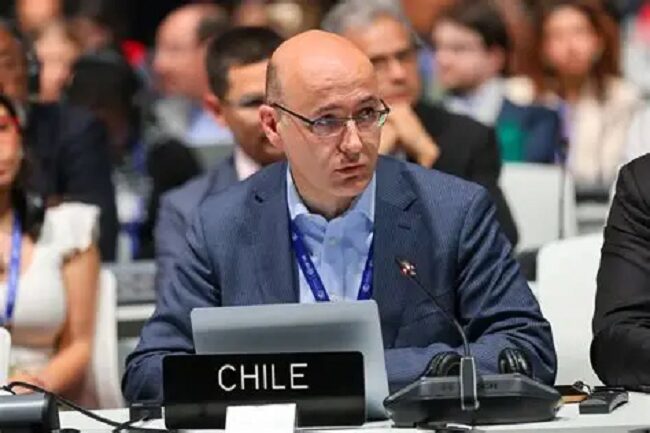
On Saturday, February 7, 2026, UN member states elected Julio Cordano of Chile as the next Intergovernmental Negotiating Committee (INC) on Plastic Pollution chair.
He replaces Luis Vayas Valdivieso (Ecuador) and officially started his role same day. His first order of business will be resuming the plastic treaty negotiations, which came to a halt last year.
The election took place on Saturday during the third installment of the Intergovernmental Negotiating Committee’s (INC) fifth meeting (INC5.3).
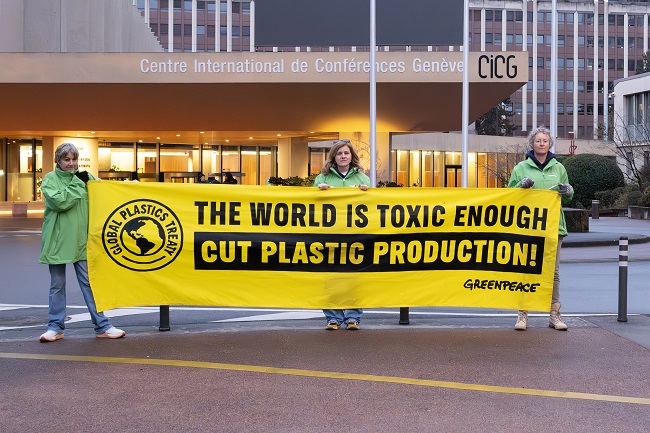
Graham Forbes, Greenpeace Head of Delegation to the Global Plastics Treaty negotiations and Global Plastics Campaign Lead for Greenpeace USA, said: “Ambassador Cordano inherits a treaty negotiation process under strain. We have lost precious time since the negotiations began while the plastics crisis worsens by the day.
“We urge the new chair to rally world leaders to deliver a strong and effective agreement that puts people and the planet first. No more excuses. This is a once-in-a-generation opportunity to protect human health, our climate system and global biodiversity from toxic pollution, and initiate a new era of global innovation.
“Around the world, billionaires and corporate interests are challenging democratic institutions and undermining global cooperation. Effective multilateralism is a necessary condition of human survival. It is time for governments that understand this to step up to the challenge and deliver the Global Plastics Treaty that justice and science demand.”
Similarly, Nicholas Mallos, vice president of Ocean Conservancy’s Ending Ocean Plastics programme, responded: “We are encouraged by the election of the newest UN plastics treaty chair, an essential step toward reviving the stalled international plastic treaty negotiations. Now, we can get back to work on delivering an ambitious agreement that addresses plastic pollution in all its forms–from its fossil fuel origins to marine litter.
“A strong plastics treaty must include meaningful reductions in plastic production, especially of single-use plastics; efforts to address abandoned, lost or otherwise discarded fishing gear – known as ghost gear – that traps and kills wildlife; and a robust funding mechanism to ensure the treaty can be carried out, especially supporting the countries most impacted by plastic pollution.”
Observers believe that Cordano’s election as the new Chair of the committee tasked with negotiating a global plastics treaty marks a significant step in the Global Plastics Treaty talks. His appointment is seen as a crucial opportunity to rebuild trust in the treaty negotiation process, which has faced challenges and delays.
Cordano’s leadership is expected to rally world leaders to deliver a strong and effective agreement that prioritises human health, the climate system, and global biodiversity from toxic pollution.
The new Chair will also face the challenge of navigating difficult divisions and addressing critical issues such as the scope of the treaty, funding, and measures of combat plastic pollution.
Jam Lorenzo, BAN Toxics, Philippines: “The election of the new Chair is an important step towards progress, but a treaty that addresses the full lifecycle of plastics can only be achieved if Member States cease to protect the interests of plastic polluters. The impacts of plastic throughout its lifecycle are undeniable, and Member States need to be united in the central goal of protecting human health and the environment if we want an effective global plastics treaty.”
Shahriar Hossain, ESDO, Bangladesh: “At this stage in the negotiations, ambition, not evidence, is the missing ingredient. The science is settled, impacts are undeniable, and the moment now calls for collective political will. A credible, legally binding treaty must address plastic pollution at its source while safeguarding equity and human health.”
Robert Kitumaini Chikwanine, SOPRODE DRC: “Civil society brings the voices of affected communities, independent expertise, and the vigilance necessary for a credible treaty. The Chair must guarantee our access and ensure a transparent and inclusive process.”
Kwame Ofori, Ako Foundation, Ghana: “To millions of people who experience the impact of plastic pollution on a daily basis, this leadership is what will decide whether science, justice, and livelihoods are secured or delayed.”
Larisa de Orbe, Acción Ecológica México: “The Global South has historically been one of the regions most affected by the plastic life cycle, which is why it has taken the lead in setting the most ambitious targets. The new Presidency must recognise the region’s leadership and ensure that its voice is heard.”
Cecilia Bianco, Taller Ecologista, Argentina: “The Chair must ensure compliance with Resolution 5/14 on the life cycle of plastics, from raw material extraction to final disposal. It is essential that the treaty address the reduction of plastic production with binding global targets.”
Frankie Orona, Society of Native Nations: “Indigenous Peoples and frontline communities are living with the impacts of plastic pollution every day. Indigenous Peoples participation is essential to ensure lived realities, the rights and knowledge of Indigenous Peoples are not sidelined in favor of polluter interests.”
David Azoulay, Environmental Health Programme Director of the Centre for International Environmental Law: “We congratulate Mr. Cordano as the newly elected chair of the INC. His leadership will be essential in guiding Member States through the next phases of negotiations toward a robust and effective global plastics treaty, and in laying the groundwork for renewed, substantive negotiations.
“Since the conclusion of INC-5.2 and the resignation of the previous chair in August 2025, the plastics treaty negotiations have stalled. Although INC-5.3 did not involve substantive discussions, Mr. Cordano’s election sends a critical signal that the process can resume.
“However, while electing a chair keeps the process alive, it won’t fix what’s broken in and of itself. Today’s session was once again dominated by the same delay tactics and obstruction that have bogged down the negotiations from the beginning. The negotiations are in desperate need of a reset.
“For years, a small handful of States have told us that consensus is the only way to make decisions – today proved that when it matters, governments can and will use all the tools of multilateralism available to them, including voting. No more delays and no more excuses – Members of the Committee must show willingness to deliver an ambitious, legally binding treaty that tackles plastic pollution starting at the source.”
Rabeb Aloui, WomenVai, Tunisia: “The election of a Chair must now translate into decisive action. A global plastics treaty is no longer optional it is a moral, environmental, and intergenerational obligation. Every delay deepens the pollution crisis and shifts the burden onto communities who did the least to cause it.”
Laurianne Trimoulla, Gallifrey Foundation, Switzerland: “Now that a Chair has been elected – congratulations to him -, let’s hope for a swift resumption of the negotiations. Let us not forget the ultimate goal: to land an ambitious, legally binding Global Plastics Treaty that includes production reduction, the protection of human and environmental health, safeguarding Human Rights, and Indigenous Knowledge. Most importantly: we have seen that voting is part of the regular UN procedure. Let’s repeat this at INC-5.4, under a strong leadership.”
Jules Vagner, President, Objectif Zéro Plastique, France: “We congratulate the newly elected Chair and recognise the responsibility that comes with guiding this process at a critical moment. The previous months have shown that facilitation alone is not enough and that leadership now requires direction.
“Plastic pollution is a systemic crisis, and systems change only when root causes are addressed. Restoring trust in this process means aligning it with science, human health, and justice, and confronting plastic overproduction head-on. The world is not asking for perfection; it is asking for ambition and action at the source.”
Jyoti Mathur-Filipp, Executive Secretary of the INC Secretariat, said: “I congratulate Ambassador Cordano on his election and look forward to supporting the Committee under his leadership as it carries forward its mandate.”
The INC process was launched in March 2022 at the resumed fifth session of the UN Environment Assembly (UNEA-5.2), where Member States adopted a historic resolution to develop an international legally binding instrument on plastic pollution, including in the marine environment.
This session, held at the Geneva International Convention Centre, follows INC-5.2 in August 2025 that was also held in Geneva, Switzerland.
That meeting was preceded by five INC sessions: INC-1 in Punta del Este, Uruguay, in November 2022; INC-2 in Paris, France, in June 2023; INC-3 in Nairobi, Kenya, in November 2023; INC-4 in Ottawa, Canada, in April 2024; and INC-5.1 in Busan, Republic of Korea, in November–December 2024.