

The Nigerian National Petroleum Company Limited (NNPC Ltd.) says Africa’s energy transition must be equitable and people-centred, noting that more than 600 million Africans still lack access to electricity.
Mr. Bayo Ojulari, the Group Chief Executive Officer of NNPC Ltd., made this known while delivering an address at the Nigeria International Energy Summit (NIES) 2026.
Ojulari said that although Africa was endowed with vast energy resources, the continent continued to grapple with trilemma of accessibility, affordability and sustainability.
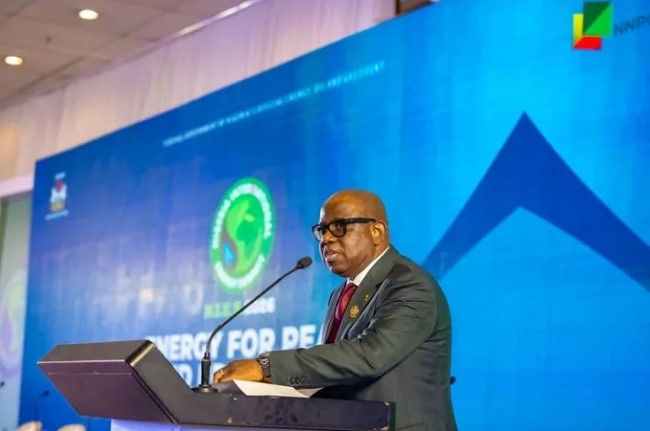
According to him, Africa’s energy pathway should not be a replication of models from developed economies, given its unique developmental realities.
He said Nigeria, with over 37 billion barrels of oil and about 2.9 trillion cubic feet of natural gas, remained Africa’s strategic energy reserve holder and an emerging global energy powerhouse.
Ojulari added that Nigeria was strategically positioned to lead Africa’s energy evolution by leveraging its oil and gas resources to drive industrialisation and economic growth across the continent.
“Energy is no longer just a sector; it is the lifeblood of global peace, security and human development.
“Modern energy systems determine whether nations can thrive, industries can grow and societies can remain stable in a rapidly changing world.
“Nigeria is no longer on the margins of the global energy conversation but at the centre of Africa’s energy transformation,” he said.
Ojulari traced the link between energy and human progress, noting that oil and gas had historically powered industrial growth, created jobs and lifted nations, including Nigeria, out of poverty.
He acknowledged, however, that global energy systems were evolving due to climate concerns, technological innovation and economic pressures.
The NNPC boss highlighted recent milestones achieved by the company, including the unveiling of its Gas Master Plan and progress on key infrastructure projects such as the Obiafu-Obrikom-Oben (OB3) Pipeline, the Ajaokuta–Kaduna–Kano (AKK) Pipeline, expansion of the Escravos–Lagos Pipeline System (ELPS) and the Regional Pipeline Survey Project.
He described the projects as catalysts for economic opportunities rather than mere infrastructure assets.
According to him, NNPC Ltd. is also investing in processing facilities, digital infrastructure and workforce development to build a competitive energy economy driven by innovation, efficiency, safety and environmental responsibility.
Ojulari said the company’s ongoing transformation also involved a cultural shift anchored on accountability, performance, excellence and national service.
He attributed recent progress in the sector to reforms under the leadership of President Bola Tinubu, citing fiscal stability, policy liberalisation and improved security as factors enhancing Nigeria’s attractiveness as an investment destination.
By Emmanuella Anokam