

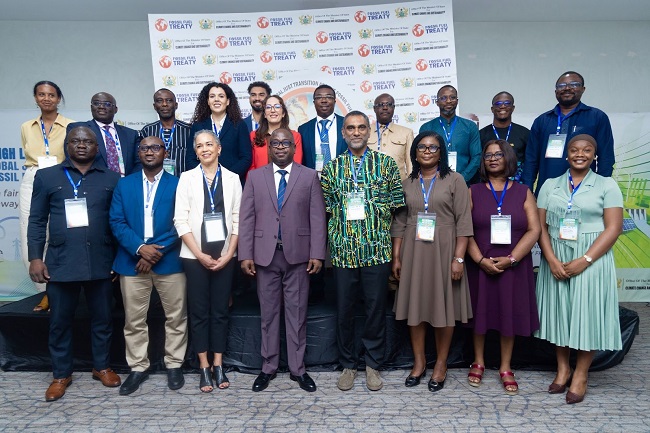
Ghana’s Ministry of Climate Change and Sustainability, led by the Minister Seidu Issifu, on Thursday, January 29, 2026, hosted a High-Level Dialogue in Accra, bringing together government officials, industry leaders and representatives across financial institutions and academia to explore how the country could both shape and benefit from emerging global frameworks for a just transition away from fossil fuels to equitable renewable energy systems, including a Fossil Fuel Treaty.
The convening marked a significant national moment to examine pathways for a fair, fast and financed transition and support the development of a coordinated engagement strategy and consultative process among sectors of Ghana’s society. The dialogue took place as the proposal for a Fossil Fuel Treaty, a mechanism to foster international cooperation for a managed and equitable global transition, continues to gain momentum globally.
In particular, as nations across the globe prepare for the First International Conference on Transitioning Away from Fossil Fuels, hosted by the governments of Colombia and The Netherlands in April 2026.
Ghana’s position at the intersection of deepening climate vulnerability and debt crisis highlights the growing urgency for a Fossil Fuel Treaty that would facilitate finance, technical support, pathways for economic diversification and debt relief for nations that are disproportionately burdened.
While 18 nations from the Pacific, Caribbean, Latin America and South East Asia are currently involved in discussions to advance the proposed Treaty, Ghana’s decision to host this high-level engagement signals its intent to actively contribute to the global conversation and to ensure that African priorities and realities are reflected in just transition frameworks.
Seidu Issifu, Minister of State for Climate Change and Sustainability, Republic of Ghana, said: “Ghana welcomes the idea of a Fossil Fuel Treaty and recognises the efforts of the growing bloc of nations already engaging in discussions across the Pacific, Latin America, the Caribbean, and Southeast Asia. As momentum builds, it is time for more African nations to join this bloc so that the terms of any future agreement prioritise Africa’s development needs, secure transition finance, unlock technology transfer, support debt relief, and ensure that no one is left behind.
“We see the proposed Treaty as a key piece of the puzzle, a framework that can help unlock finance, support debt relief, and create a fair global pathway to transition away from fossil fuels in line with the 1.5-degree goal. The global just transition will not be delivered by slogans. It will be delivered through patient diplomacy, credible finance, institutional reform, and political courage.”
Kumi Naidoo, President, Fossil Fuel Treaty Initiative, said: “This High-Level Dialogue is a vital step in ensuring that African voices and priorities shape both the Fossil Fuel Treaty process and the broader global transition away from fossil fuels. At a moment when the world needs solutions grounded in justice and equity, Ghana’s leadership shows that African nations refuse to be sidelined in defining the future of the transition and are ready to co-create the solutions.
“This engagement is essential to build an understanding that addresses the needs of the people first and foremost and contribute to a global framework that addresses the needs of other climate-vulnerable nations and accelerates meaningful action.”
Hubert Zan, Lead Mitigation Negotiator for Ghana, said: “A Fossil Fuel Treaty is doable. There are a few countries that have supported the proposal for a Treaty thus far, but there is a clear framework in which we can believe, and we hope that we will be able to adapt it. The objectives are ending the expansion of fossil fuels, managing the decline of existing production, and supporting the transition for workers and communities.
“It’s our shared responsibility to promote this proposal, in order to have more nations on board that identify with what we are trying to do. We need to provide a legal framework and finance and ensure that the pathways for the just transition are clear. Our collective actions will make sure that we are able to keep global warming under 1.5 degrees.”
The proposal for a Fossil Fuel Treaty is anchored in three pillars – a global just transition away from fossil fuels, where wealthy nations provide technical support and finance for developing nations to transition and equitably expand renewable energy access, diversify their economies and harness alternative development pathways; an end to the expansion of new fossil fuel projects; and an equitable phase out, which would require wealthy nations to phase out existing fossil fuel extraction first and fastest while providing support to fossil fuel dependent developing nations for the transition.