

Nigeria’s shift toward a pro-health review of the tax payable by manufacturers of non-alcoholic, sweetened, and carbonated drinks, commonly known as Sugar-Sweetened Beverages (SSBs), has reached a critical moment.
Last November, the Senate Joint Committee on Finance, Customs and Excise convened a public hearing in Abuja to consider a bill seeking to amend the existing excise duty framework for SSBs.
The bill before the National Assembly, formally titled “A Bill for an Act to Amend Section 21(3) of the Customs, Excise Tariffs, Etc. (Consolidation) Act to Replace the Fixed Ten Naira (N10) Per Litre Excise Duty on Non-Alcoholic, Carbonated Sugar-Sweetened Beverages with a Percentage Levy Based on Retail Price, and to Provide for the Earmarking of a Portion of the Revenue for Health Promotion and Disease Prevention Programmes”, marks a significant policy turning point.
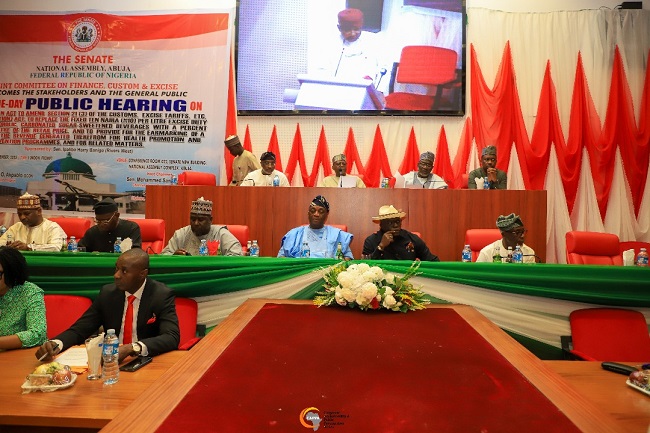
Sponsored by Senator Ipalibo Harry Banigo, the bill is grounded in growing medical and public-health evidence linking SSB consumption – soft drinks, energy drinks, and artificially sweetened juices – to a rising burden of non-communicable diseases (NCDs) across Nigeria.
Opening the hearing, Senate President Godswill Akpabio, represented by Senator Adeniyi Adegbonmire, captured the essence of the proposal.
“This amendment is not merely fiscal in nature; it is a public health investment strategy that aligns taxation policy with our national health priorities. It proposes a restructuring of existing excise duty on sugar-sweetened beverages (SSBs) not to impose more burden on citizens, but to redirect part of the existing revenue to finance health-related programmes and infrastructure that will improve the wellbeing of Nigerians,” he told the committee, quoting Banigo.
This framing deserves serious reflection.
Globally, SSBs are scientifically recognised as major dietary drivers of obesity, type 2 diabetes, cardiovascular diseases, childhood malnutrition, and premature death. In Nigeria, consumption of sugary drinks – particularly among children and young adults – has risen sharply. Non-communicable diseases now account for almost 30 percent of annual deaths, placing enormous strain on families and overwhelming an already fragile health system.
Nigeria has also emerged as one of the world’s fastest-growing markets for sugary drinks. Reports indicate that the average consumer drinks about six bottles weekly, spending roughly N2,500. The consequence is a growing population burdened by debilitating illnesses that were once perceived as “foreign” diseases.
The human and economic toll is staggering. Last month, the Diabetes Association of Nigeria revealed that approximately 30,000 Nigerians die annually from diabetes, while about 11.4 million live with the condition. Managing diabetes now costs between N100,000 and N120,000 monthly, well beyond the reach of most households. Heart disease, another diet-related NCD, presents an even bleaker picture. As of 2021, Nigeria had only 13 centres conducting heart surgery and about 80 heart surgeons for a population exceeding 200 million. With surgery costs rising from roughly N3 million to N5.5 million in recent years, life-saving care has become inaccessible for the majority.
To its credit, the Nigerian government acknowledged this crisis in 2021 by introducing an excise duty on SSBs through the Finance Act. By inserting Section 21(3) into the Customs, Excise Tariffs, etc. (Consolidation) Act, it imposed a N10 per litre levy on non-alcoholic, carbonated, and sweetened beverages, recognising that public-health taxation can be a life-saving tool.
However, the current tax level is far too weak to be effective.
A fixed N10 per litre duty represents a negligible fraction of the retail price of sugary drinks. In 2021, a 33cl bottle of soft drink sold for N100–N150, meaning manufacturers paid less than N3 per bottle in excise duty. Today, that same bottle costs between N350 and N500, yet the tax remains unchanged. The result is a levy that barely affects shelf prices, fails to discourage consumption, does not incentivise reformulation, and is easily absorbed by manufacturers.
This weakness is particularly troubling against the backdrop of Nigeria’s underfunded health sector. The country allocates less than five percent of its national budget to health – far below the 15 percent benchmark set under the 2001 Abuja Declaration. Patients exhaust family savings to manage diet-related illnesses, while health workers continue to emigrate due to poor conditions and inadequate funding. Like Coordinating Minister for Health and Social Welfare Prof Muhammad Ali Pate noted recently, the system is stretched to breaking point.
Even more concerning is that recent tax reforms again sidelined public health. While new development levies earmarked funds for education, technology, defence, and cybersecurity, none were allocated to health – despite declining donor support and growing disease burdens. Without sustainable domestic financing, the deterioration of Nigeria’s health system will only accelerate.
Against this backdrop, the National Assembly’s proposed amendment to the excise duty framework is not only timely but essential. A retail-price-based SSB tax would meaningfully reduce consumption and encourage manufacturers to lower sugar content, thereby reducing health risks.
Predictably, industry opposition has followed. Manufacturers warn of job losses, factory closures, and economic hardship – the same arguments historically deployed against tobacco, alcohol, and other public-health regulations. Yet international evidence consistently shows these claims to be exaggerated. Across the globe, more than 50 countries including South Africa, Mexico, the United Kingdom, Saudi Arabia, and the Philippines have implemented similar taxes with demonstrated success.
These countries have not recorded widespread job losses. Instead, companies adapt – diversifying products, reformulating drinks, and investing in healthier alternatives such as bottled water and low-sugar beverages.
What also makes the economic alarmism particularly hollow is that it is advanced by companies that continue to report strong revenues and sustained profitability in their Nigerian and African operations. Annual financial disclosures routinely show huge turnover, even amid broader economic pressures. The contradiction is as clear as daylight. An industry that remains profitable suddenly discovers economic fragility only when asked to bear modest responsibility for the public-health damage its products help drive.
More importantly, this narrow focus on corporate balance sheets by industry lobbyists obscures the real economic question. The cost of inaction is already being paid by households and the state. NCDs impose enormous losses through healthcare spending, reduced productivity, and premature death. A recent investigation estimate that Nigerians spend about N1.92 trillion annually treating such conditions. Prevention, through an effective SSB tax, is far cheaper and far smarter.
Another misleading claim is that the amendment represents a “sugar tax.” It does not. The proposed levy targets sugar-sweetened beverages, not sugar itself, and does not affect farmers, traditional foods, or local diets.
Ultimately, this debate is about political will. Governments exist to protect public welfare, not corporate profit margins. While businesses play a vital economic role, their interests cannot override Nigerians’ right to healthy lives.
Strengthening Nigeria’s SSB tax would align with global best practice and address the country’s urgent health challenges. Lawmakers now have an opportunity to show that evidence – not intimidation or misinformation – will guide public policy.
Accordingly, Nigeria should:
Adopt a strong retail-price-based excise structure, setting the levy at 50 percent of the retail price, with a minimum floor of 20 percent, in line with WHO guidance and the Bloomberg Task Force on Fiscal Policy for Health.
Earmark SSB tax revenues for public health, particularly for NCD prevention and management, to ensure sustainable health financing.
Establish a national monitoring and evaluation task force to oversee implementation, ensure compliance, and assess health and fiscal outcomes.
Nigeria cannot afford delay. As NCD rates climb and healthcare costs soar, maintaining an ineffective N10 per litre tax amounts to policy complacency. The real question is not whether the SSB tax should be strengthened, but whether public health will finally be placed above private profit.
The answer should be unequivocal.
By Robert Egbe, healthy food advocate at Corporate Accountability and Public Participation Africa (CAPPA)