

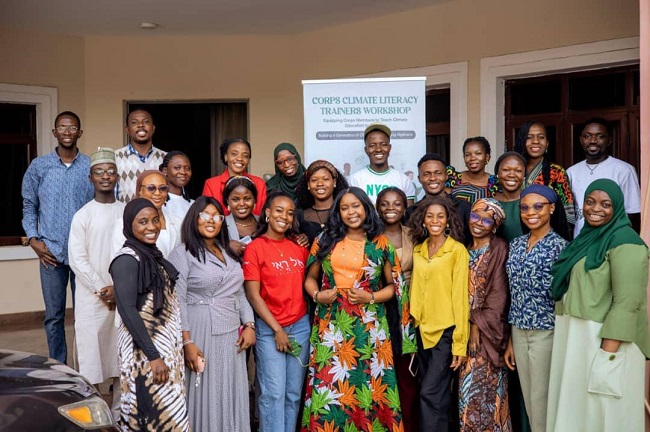
Young climate advocate, Tolulope Gbenro, in partnership with Brain Builders Youth Development Initiative (BBYDI), organised a corp climate literacy train-the-trainers workshop for 14 corp members in Abuja. The initiative is part of the Eco-champions programme supported by SOS Children’s Village Nigeria.
At the event held on Wednesday, December 10, 2025, in Abuja, Ms. Tolulope Gbenro, the founder of the initiative, HONE NYSC, shared insights into the motivation behind the project. According to her, it was inspired by the need to help beneficiaries understand the fundamentals of climate change.
Drawing on her personal experience during her service year in Ilorin, Kwara State’s capital, the environmental rights campaigner used a variety of analogies, including a covered cooking pot, to explain the negative impact of greenhouse gases and how they cause climate change.
Her session on climate change in Nigeria provided information on the nation’s specific impacts, how they alter harmattan patterns and increase flooding. Additionally, it revealed how these greenhouse gases disrupt agricultural production, which eventually leads to the incessant hike in the prices of food and some health challenges that many people experience but are not aware are caused by these effects.
In the end, her experience equipped the participants with elementary climate literacy skills on how to counter misinformation and apathy in the global climate dialogue.
Mr. David Gabriel, the national programme manager of SOS Children’s Village Nigeria, asked the corp members to be environmental custodians by initiating projects that promote the safety and inclusion of all children, particularly the most vulnerable.
“This underscored the humanitarian core of climate literacy,” he stated.
His presentation at the meeting provided a powerful ethical framing that emphasised the link between environmental degradation and child rights issues. It also drew the participants’ attention to how these issues encourage the displacement of people from their ancestral homes, prevent access to education, and create other forms of vulnerability.
In the same vein, Mr. Chima Okoli, one of the facilitators at the event, tasked the attendees to see themselves as “sparks” who would ignite action in their places of primary assignment, using storytelling and local advocacy to turn awareness into tangible projects like community gardens and waste management systems.
Speaking on the theme “Mobilising Grassroots Action,” he stressed that sustainable change begins with local ownership, referring to climate action as a grassroots movement.
Other presentations at the programme focused on strategic engagements, cultural sensitivity, and power mapping within communities to identify key influencers, as well as methods for co-creating solutions rather than imposing them.
Furthermore, the sessions stressed the need for a step-by-step guide on initiating school-based action, such as forming Eco-clubs, setting up a waste sorting station with labelled bins, planning a safe community clean-up with waivers, and launching an “Adopt-a-Tree” programme.
The career-focused session delivered by Chizoba Nzeakor mapped the landscape of climate careers in policy, technology, finance, and communication. It provided strategic advice on skill specialisation and portfolio building through documentation and professional networking to transition passion into a viable profession.
Some of the beneficiaries who spoke at the end of the training described it as extremely empowering.
According to Michael Onoja, the exercise simplified climate science in a form that improves knowledge and fosters real-life actions.
For Kave Blessing, the engagement was superlatively detailed, and she pledged to leverage the opportunity to accelerate climate action and impact her community.
Finally, the workshop concluded with a comprehensive programme implementation segment, reviewing deliverables, reporting templates, presentation of certificates, BBYDI climate champions flashcards and schedules for follow-up virtual sessions.
The next phase of the project promises to concentrate on how to empower over 400 young Nigerians through the step-down training that will be implemented by the fellows.
By Nsikak Ekere, Abuja